Showing posts with label Gen X. Show all posts

Jun 29, 2023

The Serious Takeaways of Play. An Interview with Starcom’s Steve Bonner

The concept of “Play’ in this digitized world can take on many meanings. To Steve Bonner, Starcom’s Executive Vice President and Head of Cultural Intelligence, Play simply refers to activities that bring pleasure. His recently released study Live2Play examines, according to Bonner, “How people choose to spend their time and attention in ways that are fulfilling, enriching, sometimes educational, but often just really for pleasure.”

While video gaming fits into this definition, it is only one component. There are many other ways for people to spend their time at play. Live2Play deconstructs Play -a seemingly simple concept – in a highly nuanced way, leading us to compelling and evocative insights not only of consumer behavior but of society itself.

Bonner’s study used a hybrid methodology with a self-service platform to conduct quantitative surveys and two focus groups – one of families with children and another of Gen X men. For families the goal was to see how their children’s play evolved over time compared to their own play. “We asked what play meant to them. How do you define play for yourself and for your children? Do you think your children play enough or too much compared to when you were a child? How has play changed? What do you think the implications of the way play has changed for your children will be as they get older?” he noted.

The Gen X men group, “uncovered an interesting dynamic in their need for play and the way they play,” Bonner explained. “With men we asked, how do guys think about playing? How do they play in the context of friendships? That was, probably for me, the most interesting thing that we learned in this.”

Overall, what Bonner and his team realized was the essential benefits of play for a happier life. Using an 85 year old longitudinal study about human happiness as a lodestar, Bonner saw that, “one of the strongest, most highly correlated things to happiness is long term, deep friendships. Men tend to have a hard time fostering and maintaining long term, deep friendships with other men.” This is underscored through their play.

Play for men means competition and bragging rights adding an adversarial component to the way they play. “That diminishes the value of play because you're making it a competition as opposed to exploring the world around you,” he stated and added, “Einstein said that play is research. Kids play to learn about the world around them. Men want to have a winner and a loser most of the time when they play with each other and that can fray the friendships between them, perpetuating this problem.”

For men, this dynamic in play and happiness led to an insight explaining the rise in Gen X men's suicide rates and, possibly, lone wolf attacks. “That was a surprise,” Bonner admitted, “But we thought it was interesting because as a media agency, as a marketing company, we help inspire our clients to think about new brand behaviors for themselves. We think there's an enormous hero role for marketers to play in helping men play more helpfully and champion active play and curiosity-driven play.”

Another insight included how the definition of play for adults has changed over time. “We had people saying that as an adult, playing is like watching a show on Netflix or browsing the Internet or scrolling Tiktok. What that does is stretch the definition of play to include passive consumption of content,” Bonner noted. Admittedly, “there are a lot of organizations that are happy about that because they say, yes, play is important. Human beings need to play and if we can say that play equals consuming content passively then we all sleep better at night because we fundamentally sell the passive consumption of content.”

But for Bonner, “Our position was that we want to resist that creeping definition of play because it's becoming something passive. Play has to have an active element of decision making or of exploring different scenarios. If you remove curiosity and self- determination from play, you lose a bit of the benefit of play.”

The study also found that, “People define themselves by how they play. They will say, I'm a gamer or I like to dance or I'm a singer. I like to make music with my friends, collect things, build with Legos,” indicating a changing definition of play as one ages and a different concept of play for their children. “When you talk to people in their late 20s to 40s, they will say when I was a kid, playing was going outside. We'd run around, play with the neighbors and have fun. Now it has become a digital thing which creates dissonance in parents who say that their kids spend most of their play time on screens. It makes life easier for me but I don't know if it's good,” he explained. For brands, “I think brands can take action against this. How do you make screen time feel healthier when parents feel they're outsourcing babysitting to a screen.”

Understanding the role of play in individuals and in society through this type of quantitative ethnography is a much more expansive way to better define the true essence of brands. Bonner’s role in this effort is clear. “I am fundamentally concerned with looking at the world through people's eyes as opposed to looking at the world through a brand. It's very easy in our business to look at things through the lens of a category.  But what we really care about is what people really care about. We are incessantly curious about what it is that drives people and makes them unique and special. That fundamentally takes you to a place of play.”

This approach is also vital for brands seeking cultural relevancy. “You have to understand what people care about outside of your brand. That's at the root of everything we do. Job number one should always be to make the experience something a consumer is going to care about and then figure out how to make sure that it provides the biggest or best return,” he concluded.


This article first appeared in www.MediaVillage.com

Artwork by Charlene Weisler

Oct 4, 2018

Podcasting Delivers a Highly Engaged, Youthful, Diverse Audience

Podcasting is a major force at work in audio; one that shows no signs of slowing down as it gains steam among the masses.  Everyone is talking about it.  With the recent announcement of the expansion of the podcasting portfolio at Vox Media, and all the announcements coming out of the IAB Podcast Upfront 2018, podcasting is on the verge of a breakout.  Audio isn’t just alive and well, it’s thriving and garnering major attention from content creators and advertisers.
What are they finding so attractive about podcasting?  It starts with the audience.  Gen Z, Millennials and Gen X, each desirable consumer targets, are seeing greater podcast use, attention and engagement than ever before.  Westwood One’s recent Audioscape 2018 report, featuring data primarily from Edison Research’s Share of Ear study found generational and behavioral podcast trends that should make advertisers pay particular attention.

According to Edison’s Infinite Dial 2018, podcast listening by all adults is on the rise.  One in four Americans listened to a podcast in the past month, and the growth has been exponential from 9% of the population in 2008 to 26% in 2018.  “Podcasting has been around for over 15 years, but the medium is seeing a surge in interest not just from listeners but from content creators and advertisers,” said Suzanne Grimes, President, Westwood One and Executive Vice President of Marketing, Cumulus Media.  “We need to better understand the podcast listener, and that’s why Westwood One Podcast Network is now focused on developing the kind of actionable insights found in the Audioscape report.”

How this audience of listeners breaks down by demographics, behaviors, purchasing and affinities is especially interesting.  Here are the takeaways:

Great Demographics
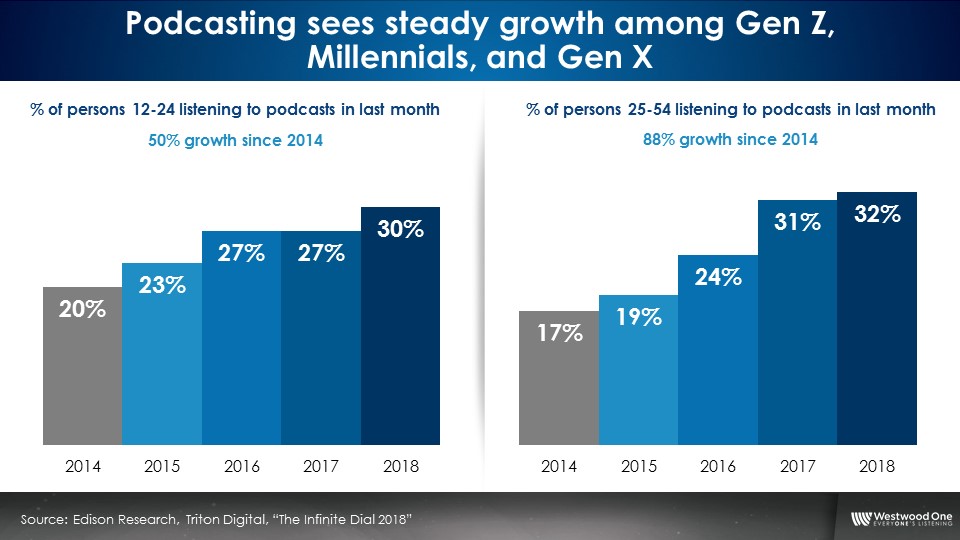
Podcast listening is young.  In the past four years, the percentage of persons 12-24 who listen to podcasts grew +50% while 25- to 54-year-olds grew +88%.  Almost one third of both age groups listen to a podcast in the average month.  This assures future growth for the format with generations that are consistently consuming media wherever and whenever they want.  Notably, the median age of podcast listeners overall is 34 compared to AM/FM radio listeners (46, according to Edison Research) and ABC/NBC/CBS viewers (56, according to GfK, MRI).


Podcasting audiences are also more diverse and female.  Twelve percent of women 18-34 listen to podcasts daily, growing +25% year-to-year, compared to 19% of men 18-34 (+11%).  African American 18-34 listeners (12%) grew +21%.

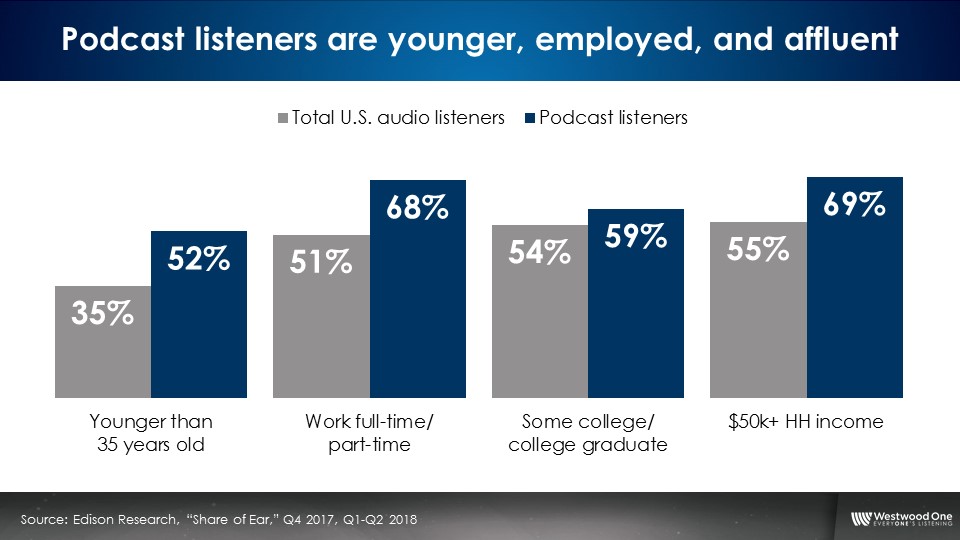
These listeners have more money to spend compared to total U.S. audio listeners as illustrated in high household income $50k+ (69% vs 55%).  They are also better educated (some college or graduated college 59% vs 54%) and are more likely to be employed (work full or part time 68% vs 51%).


Audio Centric Fans with Wide Interests
Digital audio (including podcasts) is attracting an engaged audience because it can travel with the consumer.  According to a recent IAB article, the multiple touchpoints along the consumer journey is one of the perks of digital audio.  “From waking up, going to the gym, commuting; at work, home or in social settings, digital audio is present,” the article explains.

That makes perfect sense when looking at podcast listeners.  They are avid fans of audio, spending 42% more time with audio daily than average listeners.  They spend the most time with podcasts (28%) followed by AM/FM radio (25%) and streaming (14%).

The range of interests among this audience is especially interesting.  Not only are they music fans, they are also heavy consumers of spoken word audio from news to personalities.  In fact, among podcast listeners, the share of time spent listening to talk/personalities has been growing quarter to quarter.

Big Spenders and Higher Engagement
Advertisers of all kinds will find a range of potential customers within the podcast audience.  According to GfK MRI, podcast listeners are more likely to purchase a range of products such as services from cell phones (227 index), camping equipment (162), sports clothing (159) and fine dining (157) to foreign vacations (151), video games (144), baby furniture and equipment (144).  For advertisers, this indicates a vibrant, youthful lifestyle among consumers making podcasting a part of their go-to media choices.

There is also a level of focus among podcast listeners that enables advertisers to make an impact.  IAB research shows 71% of podcast listeners report a high level of concentration; close to checking for news (76%) and weather (74%) and much higher than those watching shows and episodes (62%) or posting on social media (53%).  Notably, reported concentration with podcasts is more than 1.5 times the concentration on social media, which is such a personal interaction.

There is also higher engagement among podcasting (76%), close to news and weather levels (both 79%) and ahead of watching shows and episodes (56%) and posting on social media (50%).  While they seek a variety of experiences in their media choices, podcasting is the only format where learning and entertainment co-exist.

Interest from Advertisers Is Growing
Advertising on podcasts is poised to explode.  Investments in the format among marketers and agencies is now being discussed by 70% of those executives polled (up from 41% two-and-a-half-years ago) and 43% are considering investing within the next six months (up from 18%), according to a Westwood One commissioned study from Advertiser Perceptions.  Activation is growing, too.  Currently 32% of brands and agencies reported that they currently advertise in podcasts (up from 15%) and 36% will definitely advertise in the next six months (up from 10%).

“As important as it is to understand the consumer, for Westwood One it is equally as important to fully grasp advertiser sentiment,” said Grimes.  “The Advertiser Perceptions data included in this report is valuable.  We want to develop content that speaks to the listener, while at the same time piques the interest of media decision makers thinking about investing in podcasts.”

Advertisers need two things to make an impact: an audience comprised of their target demographic and a means of connecting with them on a one-to-one basis.  Westwood One’s Audioscape 2018 report makes it clear that podcasting provides both.  Not only has the medium tapped into a rich vein of young, upscale listeners, it also offers advertisers an opportunity to gain greater impact with their messaging among a group that is highly engaged.  Podcasting is where audio is evolving.  For maximum impact, advertisers and content creators should continue to evolve along with it.

This article first appeared in www.MediaVillage.com