Showing posts with label Simulmedia. Show all posts

May 25, 2019

Simulmedia’s Dave Morgan Seeks Bold Change

Dave Morgan, CEO Simulmedia, made headlines recently when he resigned from the board of the ARF, citing the need for bolder action in fixing ad measurement.  According to Morgan, “We do not have a trusted way to measure the basics of impression reach and frequency across channels, even just the big media channels like linear TV, digital banners, digital video and radio.”
 
He shares his views on the state of the industry, its challenges and opportunities, to help clarify this position:

Charlene Weisler: I know your decision sparked a lot of industry discussion. What is holding us back in measurement?

Dave Morgan: It’s not because we lack the technology to do it. It’s because many lack the will to lead and drive it. The industry has sat back and let the Google and Facebook own the measurement and attribution stage and claim virtually all of the overall ad industry’s growth.

Weisler: How has the media landscape changed since you first launched Simulmedia?

Dave Morgan: A lot has changed, particularly in the world of video. Television didn’t go away – more people watch more live linear TV than in 2009 – but the viewing is much, much more fragmented across many more channels, programs, day-parts and devices. Plus we’ve seen a dramatic increase in streaming video viewing, most of it on connected TV’s, though only a small portion of it with ads. While digital video advertising has been a darling of the buying community for much of the past ten years, many of the advertisers have come to realize that it’s also fraught with problematic measurement, a lot of unsuitable content and way too much outright fraud. This is now driving a lot of large national advertisers to reevaluate TV, particularly now that there are platforms like ours that bring digital, audience approaches to TV ad targeting, activation and optimization.

Weisler: What are the major challenges that you face?

Morgan: Education. Industry trades, press releases and conference stages are loaded with a never-ending swirl of bright, shiny objects and acronyms-of-the-month, creating confusion and sowing too much misinformation.

Weisler: What is the current state of addressable advertising?

Morgan: Addressable advertising on TV is beginning to have its moment. While it will always lack the scale, quick impact and efficiency of data-optimized linear buys, it is becoming a powerful complement to more conventional linear and data-optimized buys and OTT ad buys.

Weisler: What is the current state of attribution?

Morgan: Attribution needs a lot of help. Walled Gardens like Google and Facebook have stolen the march by building strong, though naturally biased solutions of their own and working tirelessly to promote and educate their capabilities. We need more aggressive leadership here, and in advertising measurement generally, by the advertisers themselves. I am hopeful that the recent efforts of the Association of National Advertisers in this area will make a real impact.

Weisler: What do you think the media landscape will look like three years from now?

Morgan: In 2022, we’ll still see 80% of the premium video ad load on linear TV, but most video campaigns will be much better coordinated across linear TV and OTT and we’ll see a real resurgence and growth regional, mid-sized agencies as they begin to leverage software, data and superior client service and strategy to manage national media as well or better than large holding company agencies.

This article first appeared in Cynopsis.

Jun 18, 2018

Optimism in the Face of Dramatic Change. ARF AUDIENCExSCIENCE Conference


For those of us who work in the media measurement space, the annual ARF measurement conference has always been a must-attend.  This year, topics ranged from the standardization of cross platform metrics, ad length, attribution, privacy and the uses of new technology like artificial intelligence to facilitate data insights. 

My impression is that measurement evolution is finally gaining traction with more collaboration between competing companies (Think: OpenAP), more efforts to create new standardized metrics and data labeling (CIMM and the IAB) and the end of business-as-usual constraints (ad lengths that vary from 6 seconds plus).

Three Big Trends
According to Scott McDonald, President and CEO, ARF, there are three major trends advancing in the industry. The first is “making progress with cross-platform audience measurement that is keeping up with technology and consumers—and if not, what the impediments are and how we can up our game.”

The second trend is breaking out of ad length constraints so as to more fully leverage platform and device viewing behaviors. The implementation of short-form ads, some as short as six seconds, is one possible solution. “But there are still questions around their effectiveness, how to best deploy them, and how they may affect the consumer’s frustration with ad clutter,” McDonald averred.

The third trend concerns privacy. “Marketing has been in a headlong race toward ever more precise targeting, fueled by the rise of big data, data analytics, and multi-touch attribution,” he noted. “Now, however, targeting is a risk with signs of consumer mistrust in how data is being used (from the Cambridge Analytica scandal and its follow-on effects), and the continued impact of the rollout of GDPR, an EU law with global implications.” 

However, McDonald cannot predict how the concern over privacy will unfold, how it could impact the media ecosystem, or whether there will be regulatory restrictions on data-driven targeting. “The industry has to evaluate whether it has gone too far in its zeal for targeting – so much so as to diminish advertising ROI and damage relations with consumers,” he concluded.

Changing the Current Metrics to Better Measure Cross Platform
There are those who believe that it is time to find a new standard metric for media that goes beyond age and gender. There is so much useful data out there that can craft a more nuanced and targeted audience measurement that we only need to come together as an industry and craft a more appropriate cross platform metric. But, in reality, it is not that easy. 

For some, Nielsen is and will be the standard. Dave Morgan, CEO Simulmedia, believes that, “Nielsen will be the gold standard of TV measurement well into the future.” But, he expects an evolution with, “core panel ratings enhanced with much more granular measurements that capture much deeper characteristics of audiences reached at the person/impression level and also real attribution to the delivery of desired business outcomes.” He added that we are already seeing some of this enhanced measurement in the marketplace and he expects to see it become a very significant part of the measurement mix by the end of 2020.

For others, the reason why the industry moves slowly is that there are different crediting qualifiers for the same measurements on different platforms. Consensus on which rules should be used for all platforms is an important next step. Josh Chasin, Chief Research Officer, comScore explained that for Live TV/DVR/TV VOD and OOH, credit for the full minute is given based off of who has the plurality of seconds in a given minute. Linear Mobile and Computer has a 30-second qualifier where credit is given only after a full 30 seconds of viewing has occurred. Dynamic Mobile and Computer currently has no qualifier but the MRC standard is 2 seconds with 50% of the ad viewable. How can these be reconciled and equated?

Consumers Continue to Rule
“We’re seeing a huge shift in viewing habits,” said Dan Robbins, Roku’s head of ad research. “Recent research of our cord cutting users shows that 78 percent think cable is too expensive, 57 percent believe there are too many channels, while 80 percent still watch as much TV as they did before they cut the cord. Streaming has become mainstream.”

But Linda Yaccarino, Chairman, Advertising and Client Partnerships, NBCUniversal, believes in the power of television because it offers premium content that is an unbeatable draw for audiences and advertisers. All of this talk about the power of digital is a false narrative, she posited. When advertisers are enticed by cheap CPMs for lower quality content, they fail to understand “the relative value of content they are getting.”

Maybe it’s all semantics. For Megan Clarken, President, Watch, Nielsen, it is all video no matter what device is being used. She explained that “from a measurement perspective, our job is to find comparable measurement across video,” placing TV as “part of the digital industry.”

Conclusion
Despite the continuing upheaval and viewer erosion on certain platforms, “I am extremely optimistic about the future,” Yaccarino stated, and added, “We need to challenge legacy. It is impacting all of our businesses all around. Why are we afraid of change? We have permission to change.” Change is certainly in the air. Now it is time to take a big breath and move decisively forward.

This article first appeared in www.MediaVillage.com

Mar 25, 2018

Simulmedia's Dave Morgan on Predicting the Future of Media

Does the past presage the future?  Generally speaking, one might say yes.  But some media executives see a future with little to no precedent.  Dave Morgan, CEO of Simulmedia, believes that the industry is undergoing such dramatic structural change that it is difficult to parse the future impact based solely on previous disruptions.  I recently talked with him about the complete disappearance of some forms of media, the impact of voice search and the future of TV measurement.

Charlene Weisler:  What is going on now in the media ecosystem?

Dave Morgan:  Most people, when they look at changing trends and forecasts in the media industry, look at what has changed in the most recent past.  They look at the trend lines in the longer-term past to see how fast they impact things and then they project that forward.  What I think is happening now that will make that approach difficult is that we are seeing really big structural changes in how people are consuming media, how advertising is being bought and sold and how marketers are going to deploy the money for the acquisition of customers.  It is going to be very unpredictable for a lot of people.  The truisms we have heard for decades that no subsequent new media destroys the old media will go away.  Yes, we will see less classic radio and more digital audio.  We will see less newspapers and more digital news.  But we will see what we always thought were long-term sustainable advertising channels truly disappear because of their inability to be economically supported.

Weisler:  So in your experience, has there been any other point in time where you have seen such dramatic transformation in the industry?

Morgan:  No.  I think that the big macro issues have been seen for a long time.  Certainly if you go back 30 years, Jack Myers was predicting these things and he was probably one of the only people who was doing so.  The tension between above the line and below the line in spend, what happens when marketers take greater control … the only thing that I think is close is what we saw with search and online classifieds.  I will use Craigslist as an example; what search did to the Yellow Pages and the classified business, that is probably comparable.

Weisler:  The result of that has been a disintermediation of that business.

Morgan:  The newspaper pillars have been taken out.  The Yellow Pages businesses are a fraction of what they used to be -- not even 5% I expect. So the vertical commerce classified businesses that have survived are interesting and pretty powerful but they are not nearly the profit drivers that we used to have in print classifieds.  But the good thing is, without question, the consumer, the user, the potential buyer, the seeker of commercial information has a dramatically more robust experience, simpler and faster than ever before.  So, the people who had to wait for the classified ads to show up, to see what car they could buy, or the person trying to dig through the Yellow Pages to try to find a restaurant to go to from books that were published 18 months before, they won.

Weisler:  Concerning the future of search, I have been hearing a lot about voice search.

Morgan:  I'm a believer in voice search.  I think the user experience of typing text either on a PC or a phone is not nearly as easy and simple and intuitive as talking.  So I do believe that voice search and voice commercial search would be pretty powerful.  This obviously tells you there is a chance to have a significant shift in the search business over time; away from Google, which is so dominant today, to something towards a company like Amazon which is a leading contender at the moment.

Weisler:  Television is still working with proxy measurements when everything is about targetability.  The rate of change appears to be lagging.  Do you see that to be true? 

Morgan:  This is probably the area that will be the most suddenly hit when it hits.  For a number of reasons, TV advertising has been much more resilient than a lot of people expected because it works.  As inefficiently bought, sold and measured as it is today, nothing beats TV in doing what TV does well.  Nothing reaches more people faster.  Nothing delivers more per-person delivery impact.  Nothing is fundamentally cheaper.

National cable CPMs per 30 second spots were $7 to $9 while premium digital, a six second pre-roll CPM is $40 to $50.  This is because most of the buyers in the digital world have come from direct response so they value things as what they are worth to them.  Because the prices are low on TV, there are more buyers than sellers.  So, if you have a line-up of buyers who are willing to purchase your inventory based on what you valuated it on a business model, you don't have to change things a whole lot.

But just like the Hemingway quote from the Sun Also Rises when Mike was asked how he went bankrupt and he replies, "Two ways, gradually then suddenly," I think that is the change coming to the TV industry.  Which is why every TV company is for sale today.

This article first appeared in www.MediaVillage.com

Oct 1, 2017

Ad Week 2017: Communication Is Shifting from Words to Images to Sound


It is hard to wrap your head around the myriad events associated with Advertising Week.  This year the excitement ratcheted up for all things technology, specifically augmented reality, virtual reality, artificial intelligence and especially audio communication.  All these efforts are currently impacting and will continue to impact the media industry, placing strains on traditional business models and enabling new cutting-edge companies.  But a simple overview of all these technological bells and whistles belies some crucial brand and media oriented trends on consumer behavior. Here are some takeaways:

Communication is Changing from Words to Images
Just like the early cave paintings, images today are taking on a major form of communication and storytelling.  We are moving from the word to the image to express ourselves in the forms of photos, videos and emojis.  In fact, according to Lydia Daley, Senior Vice President Social Media and Branded Content Strategy, Viacom, "Visual imaging is currently the major form of Millennial communication."  Millennials value experiences over material things and are seeking authenticity in their interactions with brands.  It is simply not enough to talk the talk.  Brands need to demonstrate that they are good citizens with a compelling story.

Audio Is Not Only Not Dead, It Is Poised to Rule
As technology advances and households continue to adopt voice activated appliances, audio is slated to become even more popular as a way to communicate.  Just as Millennials are gravitating toward images, Gen Z is moving to audio.  Why bother searching the Internet when you can simply request Alexa to find the content for you?  "Podcasts will explode," as part of this audio-ification of communication, said Susan Panico, Senior Vice President, Strategic Solutions, Pandora.  Marketers will have to consider how they can best leverage podcasts and other audio formats to reaffirm their branding and best reach their consumers.

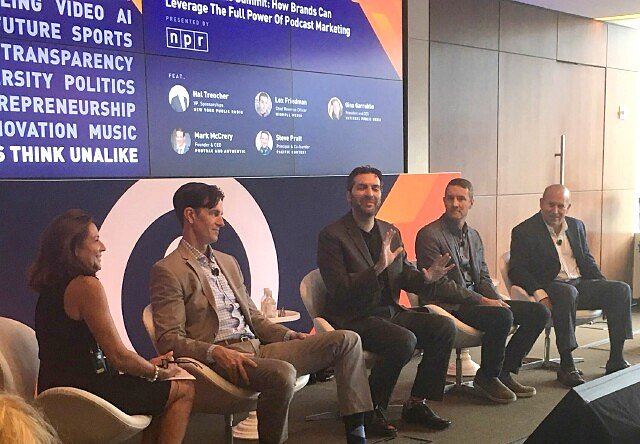
Gina Garrubbo (pictured at top left), President and CEO, National Public Media, emphasized the importance of what she termed “host driven authenticity” as an essential ingredient in both the strong connection that listeners have for audio content and in turn the efficacy of program advertising.

Data Buzz Continues
Data and its related topics of measurement, attribution and blockchain technology were discussed at many panels because, as the old saying goes, if you can't measure it, you can't monetize it.  Simulmedia's CEO and Founder Dave Morgan believes that "the biggest advancements in advertising over the next two years will happen in measurement and attribution."  This is already happening "as advancements in matching media exposures and purchase data at real scale" are leading to "real ROI analysis at a tactical, per campaign level," he said.

But there is still some trepidation concerning data quality.  "Advertisers can buy an incredible array of very precise customer targets now, but no one really knows what they are buying," noted Scott McDonald, President and CEO of the ARF.  "We need much better standards around data quality to provide better guidance to the market.

"An unambiguous rating system that can offer an independent 'grade' on the quality of data sold for ad targeting," might be possible in the next two years, he optimistically added.

Viewing Patterns are Evolving
According to Cindy Davis, Executive Vice President, Consumer Experience, Disney | ABC Television Group, the multi-platform environment is evolving into a new way for families to co-view.  Her department launched a new research study called "Togetherish" that examines the evolving way that households watch, share and engage with content.  "Consumers are changing very rapidly," she noted.  "We must understand what viewers want and what motivates them.  We want to know where viewing is going across devices and platforms."

What the study revealed is that there are eight types of households each with their own viewing dynamic.  "All types watch over 20 hours per week and all types find value in ad-supported content," Davis explained.  While 57% of all of these homes watch TV alone, this is deceiving.  Because of the plethora of devices, no one really watches totally alone anymore.  In fact, of that 57%, 21% are actually communicating with others virtually while viewing, leading to the term convergent viewing.  "Convergent viewing heightens engagement," Davis noted.  "They watch virtually together. They watch more deeply and feel deeply connected to characters on an emotional level.  We also see higher brand metrics across the board with convergent-viewed shows."

This article first appeared in www.MediaVillage.com

Jun 6, 2017

Simulmedia’s Dave Morgan Talks Media


Dave Morgan, CEO and Founder of Simulmedia, is a media legend and a serial entrepreneur, who sees the value of media in prescient ways. 

His company’s latest initiative, to be announced this week, is the roll-out of the licensing of its software product called Vamos that will enable marketers to drive their own campaigns to make their TV ads to be more targeted, similar to the web. Morgan sees great disruption in the media industry over the next few years and has strong opinions about the introduction of blockchain technology to media as well as how to best approach attribution. 

I sat down with him and asked him the following questions:

Charlene Weisler: Where do you see the media challenges in the next couple of years?
Dave Morgan: I think that the challenges we will have over the next couple of years are probably the ones that we have anticipated, maybe over-anticipated, in the last decade or two. We are getting to a moment in time where the advertising and marketing industry is going to confront several really significant realities: 

One: Are marketers prepared to really make their advertising or marketing operations a profit center and not a cost center? I see the entry of really significant and smart private equity firms into the consumer brand space and the retail space. Whether that is 3G and Burger King or whether that is looking at the folks that took over PetSmart and are now buying Chewy. You will have really smart, numbers driven people who are not just about cutting costs – they are actually very smart people – but smart investment people. They are going to start at structurally changing industries, many times through smarter marketing.  And that is going to have an impact on people who just view advertising and marketing as a cost center without connecting the dots to how you actually drive profits and value and create customers. So that is one bucket. 

The other bucket is what we have always talked about and that is that silos will inevitably come apart - The idea that different media or different marketing are valued differently and measured differently. If we become more results focused, cost focused, then it is really easy to figure out what is the common currency. This is something you and I have talked about for many years – how do you build out a multi-channel currency. It is hard to build out a multi-channel currency if you are trying to equate a cost of an audit bureau circulation number for a newspaper with a BPA number for a magazine, with an ad server impression number for a banner with a YouTube number with a Facebook number with a Nielsen Arbitron number for radio and a Nielsen C3 or C7 or C30 for TV and a comScore / Rentrak number for a secondary currency. That is hard to pull them together and equate them at the commodity level, which everybody does. But if you focus only on the output, sales or exactly how many people did I reach (which is also sales), that is really all that matters. We are on the cusp of bringing all research together – experimental design and scientific method – all of that is going to come together and that will probably be the most disruptive thing in our industry.

Weisler: How will blockchain technology impact media?

Morgan: It’s a big question. It’s like saying ‘How will electricity impact media?’ Blockchain is the core building block technology. Most people know it today because it powers bitcoin which creates a lot of preconceptions and maybe controversy. But fundamentally it is a transparent, de-centralized ledger system that lets you take what would have otherwise been a spreadsheet or a ledger and be able to share it with thousands, tens of thousands of different processors to be able to solve some computing tasks. And the ones that tend to work best are very hard to compute. But very easy to verify. In the bitcoin world it verifies what you have in the bank, in your wallet, and in the advertising world it will be one of the ways to verify ad delivery. It is a very interesting way to attack things like viewability and fraud because if you could never afford to look at all of the internet protocol addresses of all impression deliveries at the browser level across every supplier.  It is highly de-centralized, really efficient and verified against every other point.

Weisler: As well as being privacy compliant and secure as in bitcoin.

Morgan: Right, privacy compliant so you can put out the data anonymized. Now, it is transparent as to its result but it can be anonymized as to its consumer source.

Weisler: I consider attribution to be a very big challenge. Where do you see the perfection of attribution?

Morgan: I say that attribution is in the eye of the beholder. It is going to be determined by the marketer, not by the people who are selling the service. Sure, they will apply their own data as they think it will help in attribution but it is going to be determined by those that sell things. It will always be an imperfect science but it is becoming a better and better science. And science doesn’t just mean focus groups. Science really means being able to understand the multivariate impact. Of different commercial communication and determining what actually impacts sales. And it not just about classic last click, last exposure but it is really understanding what are those critical heavy swing purchasers and understanding category buyers and understanding the impact on them. And this will be done in a very proprietary way.

This article was first appeared in www.MediaVillage.com

Apr 24, 2017

Secret Meetings to Advance Advanced TV


Even something like the Secret Society cannot be kept secret for too long. On a very rainy day in New York City, the room was packed with attendees. 

The most recent meeting focused on, as Mitch Oscar, USIM Advanced Television Strategist, noted, “Dialoguing issues on Advanced TV.” Speakers from networks, agencies, data specialists and research companies offered their perspectives on the advantages, challenges and futures of Advanced TV, Addressable TV and Programmatic.

Data has never been more important to ad tech and the systems that are emerging for targeted advertising. In an important next step, some of the walled gardens are coming down as the industry is starting to coalesce around shared interests. Since the Secret Society meeting, Viacom, Fox and Turner announced their joint effort called OpenAP.

The full adoption of Advanced TV still has its strengths and challenges. Obviously, the ability to more finely hone an ad message delivered to the right audience makes Advanced TV a ‘must consider’. Yet, the available inventory is still somewhat restricted and issues like workflow, fragmentation and walled gardens need to be addressed. And we need more overall industry participation to accelerate progress.

Strengths and Challenges
      Ø  Targeting. Finally there is a way to go beyond age and gender in a meaningful way. For those of us who have been in the industry for a while, the opportunity to target is seismic. “In 1975 when I was negotiating for broadcast TV, it was the first year that the guarantees were based on age and gender and not household,” Oscar reminisced, “At that time we said, ‘households don’t buy products, people do.’ Forty plus years later, we are looking at households that have people of different ages and genders that exhibit behavioral characteristics as behavioral targets. We are getting closer to targeting people who might be interested in the product and eventually purchase it.”

      Ø  Inventory. However, there are not enough national opportunities to target. The inventory currently available in Advanced TV is two minutes of local inventory per hour.  

      Ø  Workflow and Fragmentation. “Workflow for audience systems does not exist. We need a universal workflow instead of taking bits and pieces from various media companies,” Oscar noted. But even before the workflow, there is a need to address the myriad of platforms, networks and data sources that silo efforts. “The most important challenge is how many different platforms and data sources there are,” he continued, “Seven addressable TV platforms, 15 programmatic platforms, 6 contextual audience networks that offer 31 flavors of products, and over 68 data sources across these platforms makes it difficult to evaluate and implement.”

      Ø  Participation. Getting more clients on board and involved is paramount according to Dave Morgan, CEO and Founder, Simulmedia. “It is critical that the Advanced TV industry work harder to get clients - the marketers - much more directly involved in development,” he stated, “Customer and purchase data is the key fuel in all Advanced TV applications and it is the client that controls that data.”

      Ø  Marketing Focus. Demonstrate the value of Advanced TV. Morgan believes, “We need to make it more about marketing - driving provable sales, ROI and other desired business outcomes - than advertising - delivering impressions and other media metrics. The future of advertising is about performance. That is where Advanced TV efforts should be focused.”

The Next Step
Arguably the next step in advancing Advanced TV is working together towards shared interests.Enter OpenAP. Audrey Steele, EVP, Sales Research Insights and Strategy, Fox Networks Group, spoke about OpenAP as a way to break down some of the walled gardens, set some level of standardization and accelerate the adoption of Advanced TV advertising. She explained that the three partners, Viacom, Fox and Turner, are “Frenemies,” who are, “similar in intent but the execution of sales inventory is different.” Steele noted that OpenAp:

     Ø  Offers the ability to optimize existing base buys.
     Ø  Is unified in need for standardization.
     Ø  Offers the promise of digital programmatic.
     Ø  Enables the most persuasive message for ad placement.
     Ø  Is an immersive environment with digital precision for your brand message
     Ø  Is fraud free and is transparent.

The Future
Some media executives believe that the future of Advanced TV is now and is quickly enlisting many more players. Morgan stated, “I think that we are going to see a significant acceleration of data-optimized linear TV ads, particularly as we see big enterprise tech companies like Oracle and Adobe getting more involved and as we see the big digital players like Facebook and Google getting more and more involved in TV advertising.”

Others think that despite the recent advancements, progress still seems slow. “In 1996 addressability was thought to happen any day now,” posited Oscar, “So we do have more platforms rolling out. But its deployment slow. Right now with Addressable TV, we have 34 million homes that can get addressable linear TV commercials and 19 million in the ad supported VOD addressable realm. That is 20 years later and we are nearly in half the country of 118 million homes.”

For me, while it has taken decades to reach this point, the technological rollout is accelerating and the industry is embracing all of the elements of a successful Advanced TV marketplace. So I believe that the future is now, as long as we keep the channels of discussion and cooperation flowing.

This article first appeared in www.MediaVillage.com