Showing posts with label Generation Z. Show all posts

Jun 29, 2021

Understanding Gen Z and Millennials with ViacomCBS' Wired for Mobile Study

One of the most fascinating generations is Generation Z, born between 1997 and 2015, the first to be born totally within the digital age. How can programmers and marketers better understand this unique population and how does it compare with Millennials, the generation that preceded it? 

ViacomCBS just completed a seismic study called Wired for Mobile and has a few answers and insights on the subject.

“The study delves into how devices have really changed the ways that Zs and Millennials not only see the world but learn and consume news and information and what role they play in connections with each other with brands and with culture at large,” explained Tristan Marra, VP, Ad Sales Research and Insights, ViacomCBS.

The national study, conducted between June and September 2020 at the center of the pandemic, included a range of methodologies from Desk Research, Digital Quals, Deprivation/Alteration exercises, Expert interviews to, finally, a 3500 respondent quantitative survey. The results underscored the vital importance of mobile. “While there are still a lot that connects Zs and Millennials regarding phones and technology, there are some nuances that we uncovered,” Marra began.  Generation Z are mobile natives and as such, their cellphones are critically important to them. “Their cell phones are inextricably woven into their DNA. There is no separating from them entirely. It’s just so fundamental to who they are,” she revealed. Because of this, they experience the world very differently from generations before them.  

Takeaways

The Complexity of Relationships – The relatively easy access through social media impacts the strength of relationships and creates nuance and complexity in how Gen Z prefers to connect from a text to a DM to a phone call. “The number of platforms we use to connect has been growing rapidly and becoming more nuanced. Because of this, relationships that Zs and Millennials have are also becoming more complex,” she revealed. Levels in relationships – from weak ties like with your local barista or friends of friend to strong ties like with your family - have their own rules and ways of preferred communication. Both are important in boosting happiness, creating a sense of belonging and facilitating discovery.

Unfortunately, “during Covid, we are challenged to having those brief chats, at least in person with our weak ties,” Marra noted. But the pandemic generated other forms of communication that helped facilitate connection. “What we are seeing now are different levels of intimacy. Because of social media, those weak ties that used to exist on the fringes were pulled in a little closer.”

Sharing content is integral to both Zs and Millennials with the top being content that is funny (even more so for Zs), photos or personal stories (for Zs) and inspiring content (for Millennials). Yet, despite the ability to bond via a range of platforms and channels, many Zs expressed a sense of loneliness that might be attributed partly to the virtual-ness of their smartphones or because of the pandemic … or both.

The Age of Mutual Influence – “There used to be a separation between celebrities and authority figures and us,” Marra noted. But that has now broken down as a result of social media which has changed the dynamic. “Now, there is an expected two way relationship between celebrities or brands and followers or fans,” she added. Further, social media enables both the celebrity and fan to interact and respond to each other. “Now that is the expectation. Fans and followers expect that two way relationship between themselves and previously unattainable figures,” she explained, creating a new set of standards for followers.

Take note marketers - These expectations also apply to Z’s and Millennial’s relationship with brands. “One way statements are no longer enough. Youth today expects brands to engage them honestly and personally where both sides are contributing equally like regular human relationships,” she concluded. For both generations, Instagram is proving to be the preferred platform to engage with brands. But brands should be careful not to be creepy by using personal information for targeted ads. This is a turn off for Zs.

Empathetic Facts  - Which is, “how social media  and an earlier, wider world view has made it complicated for youth today to decipher fact from opinion,” Marra explained. This blurring of fact and opinion holds a particular danger for an increasingly divided and complicated world. According to Veronica Fabiani, Director, Ad Sales Research and Insights, ViacomCBS, “Over 70% of young adults hear news on social media first. That means that it is filtered through that personal lens or, at very least, it is very open to opinion and comment. Only 14% of 15 year olds can tell the difference between fact and opinion.”

The challenge today is to help Gen Zs make sense of the facts without going through the filter of social media. It is not easy but the study’s Deprivation exercise may offer a solution. Respondents indicated that when they consciously avoided their smartphone’s social media feed for a certain length of time (as part of their participation in the study), it helped them step back and process how they felt about the news without all of the feedback and reactions that posts collect in real time.

When does too much become too, too much? “It is unique to the individual and dependent upon the day,” Fabiani began, “Social media has given them access to unfiltered news and current events whether they asked for it or not and because Zs are the most diverse generation in history, they already know more people that are different from them. As a result, they are more empathetic.”

Digital Nutrition – Sadly, the stress of the pandemic as well as the potential loneliness cultivated from communicating virtually has created a need for mental health for some Gen Zs. Fabiani noted that, “Six in 10 agree that they sometimes feel like their smartphone has a negative effect on their mental health but not having their smartphone with them, they would miss out on important things.” Digital access offers opportunities for wellness, “seeking that balance of media for both meditation and emotional safeness,” according to Marra.

But it’s not all doom and gloom. “Phones are used as an emotional defense mechanisms by both Millennials and Gen Zs who are looking for content to help them self soothe and protect boundaries and seek out apps to help generate this peace of mind,” stated Fabiani.

“Americans now check their phones 96 times a day,” she added, “And when it comes to social media, 44% of Generation Zs say that they check in at least hourly with 7% checking in more often than every 15 minutes,” creating a digital pacifier when they are lonely or afraid. They seek meditative media to mindlessly consume where they can take a break and have a mental pick me up to feel better. This is particularly true of Gen Zs rather than Millennials. “The content they are choosing is driven by emotion and largely that emotion is happiness more than being inspired,” she noted.

Conclusion

The insights from the study are not only useful for programmers, they can also help guide marketers to effectively connect and resonate with both Zs and Millennials. “This was such a big study. We talked to so many people and we got so many insights. It was hard, in a good way, to prioritize the important insights. We got there in a way that was meaningful,” Marra concluded.


 This article first appeared in www.MediaVillage.com


Sep 30, 2019

Hulu Knows the Secret of Digital Fluency


Image result for julie detragliaIf there is one longstanding bias that permeates the media industry, it is that older adults are techno-phobic. We’ve written long analyses as to why that is not so but the overall prejudice still exists … until now. Hulu has just released the second phase of a study that examines digital fluency by consumer segmentation that transcends age.  

What Hulu has found, according to Julie DeTraglia, Hulu’s Head of Research, is that the actual enjoyment of technology is a better indicator of digital fluency than age. She defines digital fluency as, “comfort with technology and a willingness to interact that way with all types of categories and brands.”

The Journey to Understanding
“We really didn’t set out to do this specific type of study,” she explained. Previously, “we did a generational study where we concentrated on the differences in television behavior between Gen X, Gen Y and Gen Z,” and saw differences in television behavior. The intent was to simply do a follow-up to that study, folding in other types of behaviors across other categories, attitudes towards advertising and brand relationships. But, “as we started brainstorming, we realized that it is not just Gen Z that has changed. Everybody has changed,” and this change has occurred across all generations.

What she found was that people of all ages changed behaviors and attitudes, becoming more digitally fluent as opportunities for convenience became available. Her example was Uber; “We were taught from childhood never to get into a car with a stranger. But now we are doing it all the time,” she noted, because of the convenience of on-demand car service.

The Big Takeaway
“So we tried to understand what that journey is and how people identified themselves and the identity they had around technology,” she stated. That study was released last year at Advertising Week. Hulu studied digital behavior and identity and found that the consumer spectrum was segmented in a way that age was essentially a non-issue. According to DeTraglia, “The one thing that moves people across the spectrum is the enjoyment, happiness and inspiration they get from technology,” and this parses out relatively equally across age ranges.

“The more digitally fluent people use technology often and derive a lot of happiness with their digital connections,” she explained, “People in the middle use technology to make their lives easier but they are not necessarily getting joy from it. Then there are those people who we call minimalists who use technology because it’s the way they can get things done, but they don’t really love it.” But, “one of our biggest insights was that age is not a factor,” she confided. Just as many young people as older described themselves as minimalists on the digital spectrum - 19% of Gen Z compared to 16% of Boomers. But why?

“It could be that Gen Z is interpreting the questions differently than older generations,” she posited. “Or maybe they are just a little more overwhelmed by it,” since they are so immersed, for example, in social media that is ‘on’ all the time.

In the second phase of the study, just released in time for this year’s Advertising Week, segmentations were created around motivations and behaviors and “that is where we saw the segmentations flatten out a bit. Most people define themselves a somewhere in the middle, but when you do a segmentation, there were just about equal percentages of all of the segments,” from low to high. DeTraglia noted that technology prompts behavioral change. Take for example streaming video. One might start in the living room, then move into the bedroom and then onto a computer or tablet. Once content becomes available on smart TV’s Hulu saw that consumers transitioned back to the living room.  That then leads to more comfort with technology and can lead to transactions and shopping.

Conclusions
What DeTraglia saw in this brand study phase, was that advertisers should adjust their creative so there is differentiation between the digital fluency segments. “It is no longer one-size-fits-all,” she explained. “Truly digitally fluent people should get different ads,” according to the viewing environment and platform.

“Hulu has worked hard to come up with ad products that can work in different ways, depending on what your needs are. For those who are more digitally fluent, they want messaging that is more personalized. They want to interact with the creative. They want more personal connection and control and relevance,” whereas other less fluent groups just want to be informed with messaging that remains clear. Advertisers, take note.


Oct 20, 2017

What is the Future of Television?


What is the future of TV? That question was hotly debated at the recent and NYME conference in New York City. Arguably the most impactful change in TV is, as Ned Sherman, Counsel/Director, Manatt Digital and Founder, Digital Media Wire, described is the "major shifts in video consumption." Overall video consumption is rising but how viewers are accessing this content is now impacting the business model.

Cord cutting, once dismissed by industry experts, appears to be accelerating. Emarketer reported that in 2017 they were 22.2 million US adults cutting the cord, "up +33% in this year alone," Sherman reported. On an even more ominous note, the percentage of cord-nevers also rose (+5.8%) to 34.4 million. Will these cord-nevers eventually succumb to the siren call of traditionally accessed TV? It remains to be seen but the trends point to no taking into account behavioral trends on Generation Z and Millennials. In the meantime, the business of TV must respond to the current landscape as it evolves.

Here are some predictions for the future of TV:

Facilitating Content Across Platforms Will Have to Become Pro-Forma
As viewership moves across platforms, the ability to easily offer content cross platform becomes vital to satisfying consumer demands. Tom Shelburne, Director of Operations, Vizrt, stated that, TV is at a crossroads and needs a reboot.” His company enables content to be published anywhere on multiple platforms at the same time.

Generation Z focused companies such as Awesomesness TV have designed their business model on the TV shift, according to Rebecca Glashow, Head of Worldwide Distribution, AwesomenessTV. While legacy networks might be handcuffed by contractual obligations that limit cross platform content rights, her company has established a business model appropriate for their target audience that is multi-platform at its core.

Some traditional companies such as Disney have initiative a direct to consumer initiative. Peter Phillips, Former EVP/GM Interactive & Distribution, Marvel Entertainment, explained, “The challenges are that the MVPD business will change. Cord shavers and cord nevers will greatly impact the business and the options for consumers are confusing. We are a long way from making it easy for consumers.” Making it easy will separate the successful companies from the failures.

Quality and Unique Content is Table Stakes
No matter how easy you make the distribution of content, if that content fails to engage the audience, your efforts will be for naught. Floris Bauer, Co-Founder and President, Gunpowder and Sky, advised, “TV needs to innovate, decline or die.” But there is a certain amount of self-censorship according to Paul Potenzone, SVP/Content Director at Digitas Studios, DigitasLBi. “You need conflict in content to make it interesting,” he posited, “and big companies are too careful with shareholders.” Creating compelling content is not only expensive, often involving trial and error, time consuming -it can take years to develop a winning program - it is also like caching lightning in a bottle - rare and sometimes surprising. But the risk of not focusing on the development of unique content is greater than spending time, money and creative capital on it and risking failure. As Mike Vorhaus President, Magid Advisors, concluded, “Unique content is table stakes.”

Small is Nimble and Yet, Bigger May Be Better
There are three challenges that place stress on smaller networks - increased competition, the cost of doing business and the fight for distribution. While the fight for distribution may be ameliorated with the vastness of the IP that enables nimble smaller networks to expand their distribution, the first two challenges may see the demise of many smaller niche networks, according to some. Glashow noted that “The cable bundle has only ten brands that mean something. The rest was born to fill in” the channel offerings. She sees the death of smaller networks because there is not enough investment in them.

There is no absolute path for television network success in the coming years. But the best advice of the day was from Phillips who concluded, “Experiment and be willing to fail.”


This article first appeared in www.Mediapost.com
 

Oct 1, 2017

Ad Week 2017: Communication Is Shifting from Words to Images to Sound


It is hard to wrap your head around the myriad events associated with Advertising Week.  This year the excitement ratcheted up for all things technology, specifically augmented reality, virtual reality, artificial intelligence and especially audio communication.  All these efforts are currently impacting and will continue to impact the media industry, placing strains on traditional business models and enabling new cutting-edge companies.  But a simple overview of all these technological bells and whistles belies some crucial brand and media oriented trends on consumer behavior. Here are some takeaways:

Communication is Changing from Words to Images
Just like the early cave paintings, images today are taking on a major form of communication and storytelling.  We are moving from the word to the image to express ourselves in the forms of photos, videos and emojis.  In fact, according to Lydia Daley, Senior Vice President Social Media and Branded Content Strategy, Viacom, "Visual imaging is currently the major form of Millennial communication."  Millennials value experiences over material things and are seeking authenticity in their interactions with brands.  It is simply not enough to talk the talk.  Brands need to demonstrate that they are good citizens with a compelling story.

Audio Is Not Only Not Dead, It Is Poised to Rule
As technology advances and households continue to adopt voice activated appliances, audio is slated to become even more popular as a way to communicate.  Just as Millennials are gravitating toward images, Gen Z is moving to audio.  Why bother searching the Internet when you can simply request Alexa to find the content for you?  "Podcasts will explode," as part of this audio-ification of communication, said Susan Panico, Senior Vice President, Strategic Solutions, Pandora.  Marketers will have to consider how they can best leverage podcasts and other audio formats to reaffirm their branding and best reach their consumers.

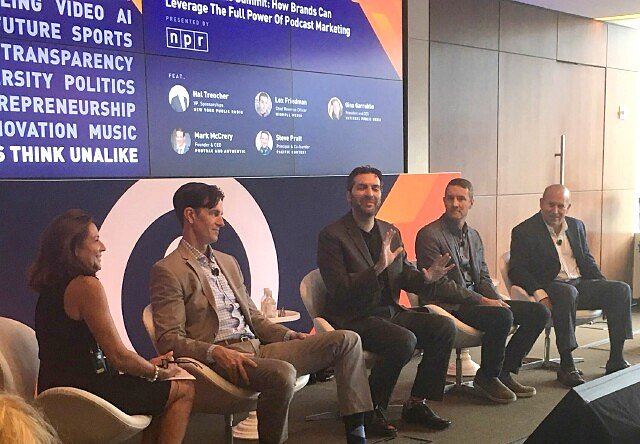
Gina Garrubbo (pictured at top left), President and CEO, National Public Media, emphasized the importance of what she termed “host driven authenticity” as an essential ingredient in both the strong connection that listeners have for audio content and in turn the efficacy of program advertising.

Data Buzz Continues
Data and its related topics of measurement, attribution and blockchain technology were discussed at many panels because, as the old saying goes, if you can't measure it, you can't monetize it.  Simulmedia's CEO and Founder Dave Morgan believes that "the biggest advancements in advertising over the next two years will happen in measurement and attribution."  This is already happening "as advancements in matching media exposures and purchase data at real scale" are leading to "real ROI analysis at a tactical, per campaign level," he said.

But there is still some trepidation concerning data quality.  "Advertisers can buy an incredible array of very precise customer targets now, but no one really knows what they are buying," noted Scott McDonald, President and CEO of the ARF.  "We need much better standards around data quality to provide better guidance to the market.

"An unambiguous rating system that can offer an independent 'grade' on the quality of data sold for ad targeting," might be possible in the next two years, he optimistically added.

Viewing Patterns are Evolving
According to Cindy Davis, Executive Vice President, Consumer Experience, Disney | ABC Television Group, the multi-platform environment is evolving into a new way for families to co-view.  Her department launched a new research study called "Togetherish" that examines the evolving way that households watch, share and engage with content.  "Consumers are changing very rapidly," she noted.  "We must understand what viewers want and what motivates them.  We want to know where viewing is going across devices and platforms."

What the study revealed is that there are eight types of households each with their own viewing dynamic.  "All types watch over 20 hours per week and all types find value in ad-supported content," Davis explained.  While 57% of all of these homes watch TV alone, this is deceiving.  Because of the plethora of devices, no one really watches totally alone anymore.  In fact, of that 57%, 21% are actually communicating with others virtually while viewing, leading to the term convergent viewing.  "Convergent viewing heightens engagement," Davis noted.  "They watch virtually together. They watch more deeply and feel deeply connected to characters on an emotional level.  We also see higher brand metrics across the board with convergent-viewed shows."

This article first appeared in www.MediaVillage.com

Sep 29, 2017

Discovery and Omnicom Study: Reaching Tech Enthusiasts Cross-Generationally


Discovery and Omnicom have partnered in a new research study that discerns the impact of technology on consumers’ lives. Focusing in on “tech enthusiasts,” a psychographic segment identified by tech ownership and attitudes, the study delineated the generational differences between Gen X and Millennials. 

“While technology has created more opportunities to reach consumers through increased touchpoints, a lengthier purchase process and receptivity to advertising, there are dramatic generational differences. We found that technology empowers and inspires Gen X enthusiasts while Millennials find technology more stressful and lethargic,” explained Manu Singh, Group Vice President, Commercial Insights and Digital, Discovery Communications.

I found this insight fascinating and followed up with more questions for Singh:

Charlene Weisler: Why do you think there is such a stark difference between Millennials and Gen X in tech attitudes?

Manu Singh: Both groups feel more productive and empowered by technology and have no desire to step away from their technological lives. Differences stem from how pervasive technology has been in their everyday lives from the start. Millennials are accustomed to technology being woven into all facets of their interactions while Gen Xers have clear memories of a lower tech life.
Millennials are exposed to the pressures of staying on top of technology and being judged by their peers. They are more likely to follow new tech releases and get the latest devices but also report feeling more stressed by technology. While the social benefits of technology are important to both generations, it’s stronger for Millennials. Technology facilitates their main modes of communication, creating an inherent social “burden” to stay relevant. Gen Xers appreciate and respect the benefits of technology but tend to focus more on how it can improve and simplify their daily lives.

Weisler: What should an advertiser do to reach Gen X and Millennial enthusiasts?  Is there different messaging by generation?

Singh: Both say they are consuming more video due to advances in technology so there are more opportunities for advertisers to connect via video. When it comes to viewing, TV remains the go-to device for both generations with a multi-platform strategy.  

When thinking about messaging for Millennial enthusiasts, it’s about having access to the world, freedom of creative expression and career benefits.  For Gen X, messaging should express empowerment and innovation – these are reasons they are driven to use technology and it will feed into existing excitement about capabilities and benefits. Both groups of tech enthusiasts are open to advertising, but place a high value on relevance and personalization.

Weisler: What should programmers and content providers do to reach both groups?

Singh: Technology is integrated into all areas of their day to day. It is a lean-forward mindset.  Networks like Discovery successfully resonate with Tech Enthusiasts because of innovative content that fuels their curiosity.  DCI tech enthusiasts are more likely to notice and be receptive to advertising than non-Discovery enthusiasts. It is also important to make content available where consumers are.  Millennials are more likely to view on mobile devices as well as layer streaming services on their cable/satellite subscriptions.     

Weisler: What is the future peril and opportunity with each group with these attitudes towards tech?

Singh: Recently there has been a movement towards simplicity (Tech Free Tuesdays, adult coloring books, etc.) in response to perceived oversaturation of technology.  While a mass exodus from all technology is unlikely, there should be a focus on the role of technology in enhancing lives more than it detracts.  Focus on smart-tech product creation with the goal of life-improvement (lower utility bills, reliable home security) as opposed to the mere creation of more products. Technology has created new ways to learn about brands, simplified purchasing and expanded product options.  Tech enthusiasts are becoming smarter, more efficient and global shoppers. Their curious nature means they are open to new shopping experiences.

Weisler: What is the future of linear TV with each group?

Singh: TV is not dead! Traditional TV set is still used most often for viewing video content and over half of enthusiasts still have cable or satellite service.  There will continue to be shifts as on-demand culture grows alongside streaming and social platform offerings, but we see linear TV maintaining its base position for content creation and distribution through linear, VOD, DVR and online streaming/app means.   

I just wanted to add that with Apple’s 10th Anniversary iPhone, a new round of consoles hitting the market for the holidays, and a smart speaker spending war brewing between Amazon, Google and Apple, the need to connect with Tech Enthusiasts is stronger than ever. And, since eight out every 10 tech enthusiasts watch Discovery Networks, so I have to say that makes our content a must-buy!

This article first appeared in www.MediaVillage.com