Presentations illustrated platform and device usage trends,
preferences by demographic, ad-supported potential, dynamic ad insertion
and how clients are using Nielsen's data to demonstrate TV's
opportunities for advertisers, as summed up here:
The Trends: More Time Spent with Digital Media
Katsingris
has a team that "tells stories with data," enabling clients to better
understand the impact of how consumers are leaning into content.
"Marketers have to get personal," he noted, and should explore
technological opportunities such as dynamic ad insertion to better reach
consumers who are increasingly spending more time on their personal
devices and various platforms. He reported that, overall, weekly usage
of media continues to grow. In 2018, Nielsen found that viewers spent
79 hours with media per week, compared to 61 hours in 2010 and 51 hours
in 2002. Multi-tasking contributes a lot of this extraordinary amount of
time spent, as smartphones have surpassed radio and time spent with
digital devices in general, reaching parity with time-shifted TV.
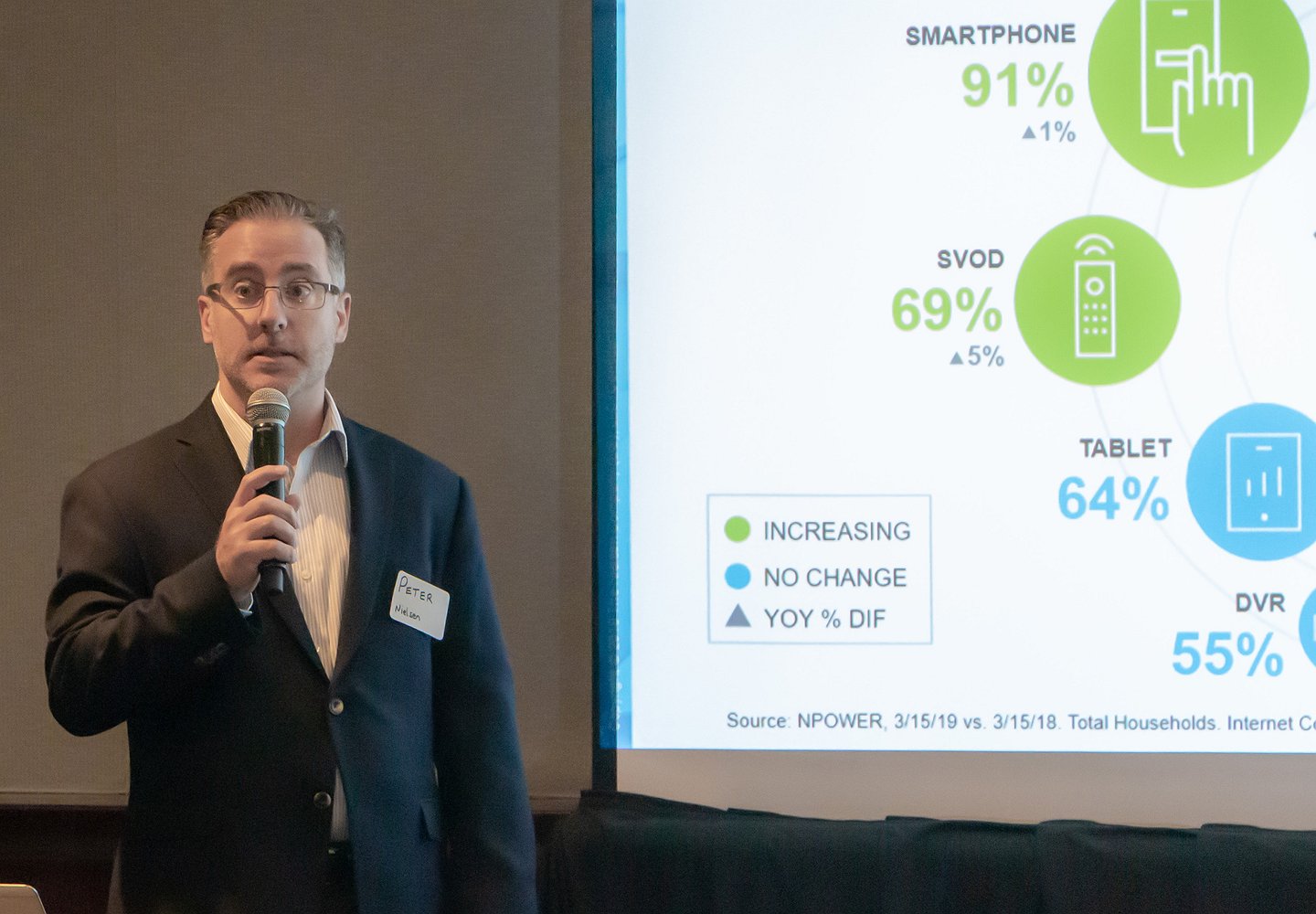
New platforms and devices are being adopted at impressive rates.
According to N-Power, in March 2018 91% of all U.S. households had a
smartphone, 79% a computer, 69% an SVOD service, 64% a tablet, 55% a
DVR, 46% a smart TV, 43% a game console, 40% an internet-connected
device and 4.8% a virtual MVPD. This increase in digital adoption has
resulted in increased usage. Overall, media usage increased +21% from
January 2018 to 2019, especially among African Americans (+26%),
Hispanics (+23%) and Asians (+38%).
The more opportunity to view on various devices and platforms, the
more time is spent on them. The shift in time spent is a cautionary
tale for traditional media. Once adopted, streaming usage grows from
month one (1 hour, 8 minutes) to year one (1 hour, 20 minutes) while
time spent with TV declined in the same timeline (from 7 hours, 19
minutes to 6 hours, 33 minutes).
The expansion of the data pool enables Nielsen to offer new and
interesting ways to analyze usage, including which devices are used in
which room in the house. Enabled smart TVs tend to reside in the living
room (53%) and encourage co-viewing, while internet-connected devices
are in the master bedroom (26%) and (unsurprisingly) enabled video game
consoles are in bedrooms that tend to belong to younger members of the
household (32%).
The Opportunities: Addressable TV Using ACR
"The time for addressable advertising is now," declared
Abcarian.
"TV
has changed and grown. But we need to look at TV differently than in
the past." There is more connected TV ownership (+46% have at least one
smart TV in the home, representing +8% growth from January 2018 to
January 2019) and greater cord-cutting or shaving (25% of all TV
homes). But don't misread the trends, she advised. "TV time is
growing, not shrinking," because viewers are "using other devices to get
to the glass." In fact, the impact of connected devices is influencing
linear viewing, offering a rebirth of TV.
Linear content is experiencing a 5-7x growth with internet-connected
devices, while smart TVs provide a 2x growth to linear content. In this
environment, the ability to apply addressable advertising is a boon to
advertisers. It offers precision advertising that highly targets linear
TV with advanced demographics. It provides value targeting that
enables agencies to reduce waste and, with Nielsen, "best in class
measurement," using "similar audience segments definitions." To that
end, Nielsen is pioneering ACR technology to unlock the full 16 minutes
of ads in programming and transforming C3 measurement, so as to enable
clients to reconcile with addressable and be able to execute ad models
across platforms.
Two main areas of focus in the coming months include audience-based
buying to enable advertisers to use advanced audience segments to plan
and buy linear TV campaigns, and addressable TV, which offers true
one-to-one ad targeting, delivery and measurement across smart TV
platforms. The result will be greater measurement transparency and
standardization across these two areas. One example of industry
collaboration that exists today is between Nielsen and OpenAP. Nielsen's
audience data and Enterprise Audience API are used within OpenAP,
enabling the buy side to create and share 777 segments within the
consortium's platform since it launched in the Fall of 2017.
Part of this is the result of Nielsen's ability to deploy dynamic ad
insertion, which is now in the testing stage. Nielsen uses video ACR
technology that is embedded in the glass screen's firmware or chipset.
"We then take a screenshot every half-second to see what is watched
on-screen every two seconds," Abcarian explained. This is matched back
to the library and a decision is then made whether or not to replace the
original network ad based on pre-arranged rules and audience profiles.
"It is a seamless experience for the viewer and is more engaging
because it is a more relevant ad," she said.
The early learnings from this pilot indicate that broadcasters want
to see improved sell rate percentages and agencies want accurate
forecasts and more standard segments. For all of this to happen,
measurement reconciliation needs to occur, as well as some operational
improvements; there are still too many manual processes at the current
time to deliver addressable campaigns. Some of the challenges are the
result of walled gardens that "tie up addressable at scale," Abcarian
said. "We need more partnerships in the ecosystem." She also noted
that we need more scale in technology while keeping in mind the privacy
that goes with it.
Another challenge is "too many demand pools and measurement sticks,"
she added. "We don't know how to buy at scale with confidence."
Further, there needs to be a reconciliation with C3, bringing the
measurement holistically across platforms. Finally, there needs to be
education. "What do we mean by addressable TV?" she said by way of
example. "And, [we have to] put a value against the impressions."
Ultimately, Abcarianis bullish on Nielsen's ability to deliver an
addressable product that will be embraced by the industry. "It offers
real-time scale that optimizes both the upper and lower funnel," she
noted. Nielsen is focused on creating a standardization framework that
will drive consistency across all platforms.
This article first appeared in www.MediaVillage.com
 New technology and how it is transforming traditional media was the
main focus at the recent Streaming Media East conference. There’s no
doubt AI and machine learning are impacting media, and according to a
panel of experts, it will be a boon to both consumers and the media
business.
New technology and how it is transforming traditional media was the
main focus at the recent Streaming Media East conference. There’s no
doubt AI and machine learning are impacting media, and according to a
panel of experts, it will be a boon to both consumers and the media
business.