Showing posts with label ACR. Show all posts

Nov 2, 2019

Comscore’s Alexander Feldman Reveals How ACR is Key in Cross Platform Measurement

While Comscore has traveled a hard road over the past few years, it appears to be getting back on solid footing. The company’s recent product moves across its business units have been focused in advanced television in order to round out the company’s cross platform offering. As part of that strategic move, Comscore is using automatic content recognition technology (ACR) technology from Inscape to successfully link disparate data points into a viable cross platform measurement capability.
Comscore’s Senior Director of Strategic Partnerships, Alexander Feldman, sat down with TV[R]EV and detailed his company’s efforts in solving one of the media’s most challenging problems: Ensuring that every impression is counted no matter where, when or how it is viewed. 
Charlene Weisler (CW): Why use ACR?
 
Alexander Feldman (AF): There are three interesting things about ACR. First is the Speed with which you can collect data. Historically, data was delivered through more manual means which would take weeks to deliver. With ACR we receive the data within days so we can deliver insights during a campaign and much faster to clients. And when you are able to deliver insights during a campaign, you are able to apply more dynamic creative optimization to discern what is working and what is not. Second is Accuracy. In other forms of data collection there are gaps and missing data, sometimes caused by human error in coding or from tags dropping off in certain environments. The third is Automation. Think of ACR as Shazam. It automatically finds content or advertising that it knows it is looking for because it is in the foundational data set or database.
 
CW: How is Comscore using Inscape’s ACR?
 
AF: The most popular way we are using ACR currently is in measurement such as in attribution. The idea is to prove out campaign efficacy, tune-in or return on investment by essentially closing that loop between whether that person saw a particular piece of content or ad and then finding that same individual within our panel. We have had success with then serving those individuals ads to gauge brand metrics within the purchase funnel. Is that particular piece of creative moving the top of the funnel or lower parts of the funnel?
 
CW: Do you re-sell or re-package the data? Is it integrated into any product offerings?
 
AF: We are not allowed to re-sell the data, but the strength of it as it pertains to Comscore is that when we ingest the ACR data we are able to fuse it with other assets. Comscore has tremendous scale, strong relationships and legacy clients. We are able to leverage ACR data within that framework and integrate that into existing products. Our Brand Survey Lift (BSL) is one product where we are using ACR data. The other kind of obvious use cases are in the planning space where we measure reach and frequency.
 
CW: What types of data and metrics are you using?
 
AF: Not to get too granular but content start time, duration, number of aggregate households reached, IP addresses, titles, are all tied back to individuals in our panel through a third party blind match. But there is a whole slew of granular data that we get from Inscape’s ACR insights.
 
CW: What successes have you realized from the data?
 
AF: I just got back from a conference where we highlighted a piece of new business that we closed with a large CPG brand that measured multiple campaigns using ACR data. We looked at the different types of creative running on many different networks and tied that back to our digital panel. Some of the findings that I thought were really compelling and maybe not-so-obvious to the client were that no single platform was more impactful than a comprehensive cross platform campaign. We saw that when a campaign ran across platforms, it generated lifts of +36% more than any individual platform.
 
The second thing we measured and presented was that 50% of the campaigns had one creative that was six times more impactful than all other creatives, regardless of platform. So that goes back to the power of ACR – we were able to find through our Brand Survey Lift product that there is one creative that typically accounts for a significant amount of the lift that you see in the campaign. Identifying that creative is critical during the campaign while you have the opportunity to prove it or switch it out.
 
Thirdly, we found that TV or TV-like platforms have the strongest synergy with social. The data point that we highlighted in that project was that social / TV delivery was 50% more effective in influencing purchase intent and awareness than other media mixes.
 
CW: How do you measure client success?
 
AF: Client success can be defined by the KPIs they are trying to meet, depending on where they are in the funnel. From my perspective, we are successful when we are providing incremental value to the client and helping them solve business decisions. For example, what does a conversion look like? Is it a visitation to a site, an RFI, or a visit to a location? The power of ACR is when it is combined with Comscore data processes and logic that normalize and standardize consumer viewing data and help us to measure it faster.
 
CW: What marketing initiatives does ACR data support for Comscore?
 
AF: Activation is a natural use case with that data. For example, a CPG client has brands in multiple different markets and while the initial project was U.S. based, we were able to project the potential for international expansion and activation. 
 
CW: What does Inscape ACR data facilitate or improve?
 
AF: They help plug gaps in the connected TV space which is an emerging area and is growing. Consumers are adopting connected TVs quickly. It adds an extra layer of information into our models and logic. So they are improving the overall data sets that we have by providing us with information that we never had. Comscore has historically integrated data from mobile, desktop, set top boxes. This is yet another form of device that is now probably the fastest growing form of TV or TV-like consumption. Inscape helps us increase our strengths beyond premium video and helps us amplify that and complete our offerings. 

This article first appeared in TVREV.

May 10, 2019

How to Get Personal, According to Nielsen

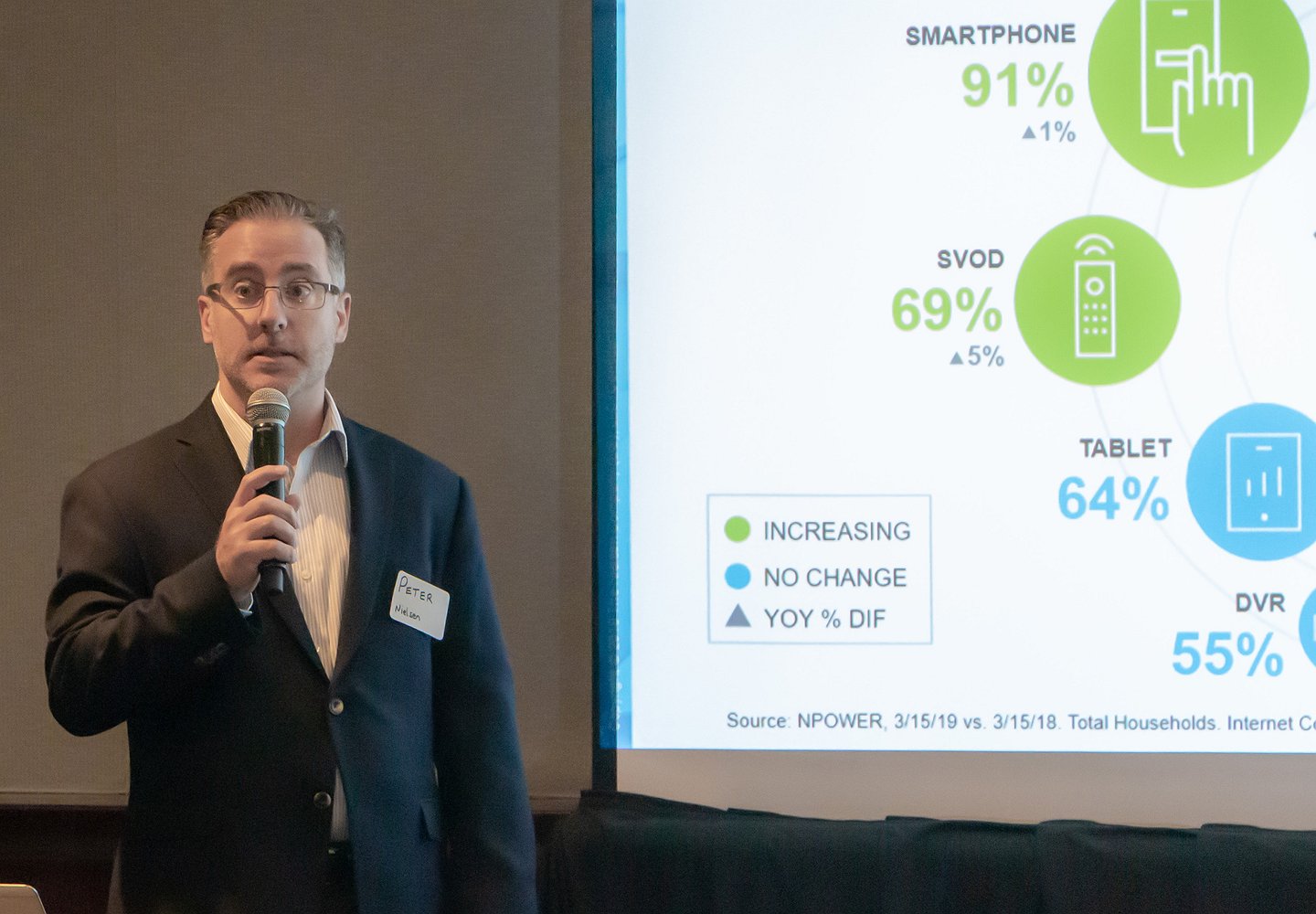
How to Get Personal, According to Nielsen "Marketers have to get personal," and should explore technological opportunities, according to Peter Katsingris, Senior Vice President, Nielsen Audience Insights (pictured at top).  

He kicked off the recent Nielsen press breakfast with additional personal touches added by Kelly Abcarian, Nielsen's Senior Vice President, Watch Product Architecture, and other speakers to highlight how the organization is keeping pace with the evolving media landscape via its own technological advances.
Presentations illustrated platform and device usage trends, preferences by demographic, ad-supported potential, dynamic ad insertion and how clients are using Nielsen's data to demonstrate TV's opportunities for advertisers, as summed up here:

The Trends:  More Time Spent with Digital Media
Katsingris has a team that "tells stories with data," enabling clients to better understand the impact of how consumers are leaning into content. "Marketers have to get personal," he noted, and should explore technological opportunities such as dynamic ad insertion to better reach consumers who are increasingly spending more time on their personal devices and various platforms.  He reported that, overall, weekly usage of media continues to grow.  In 2018, Nielsen found that viewers spent 79 hours with media per week, compared to 61 hours in 2010 and 51 hours in 2002. Multi-tasking contributes a lot of this extraordinary amount of time spent, as smartphones have surpassed radio and time spent with digital devices in general, reaching parity with time-shifted TV.

New platforms and devices are being adopted at impressive rates.  According to N-Power, in March 2018 91% of all U.S. households had a smartphone, 79% a computer, 69% an SVOD service, 64% a tablet, 55% a DVR, 46% a smart TV, 43% a game console, 40% an internet-connected device and 4.8% a virtual MVPD.  This increase in digital adoption has resulted in increased usage.  Overall, media usage increased +21% from January 2018 to 2019, especially among African Americans (+26%), Hispanics (+23%) and Asians (+38%).

The more opportunity to view on various devices and platforms, the more time is spent on them.  The shift in time spent is a cautionary tale for traditional media.  Once adopted, streaming usage grows from month one (1 hour, 8 minutes) to year one (1 hour, 20 minutes) while time spent with TV declined in the same timeline (from 7 hours, 19 minutes to 6 hours, 33 minutes).

The expansion of the data pool enables Nielsen to offer new and interesting ways to analyze usage, including which devices are used in which room in the house.  Enabled smart TVs tend to reside in the living room (53%) and encourage co-viewing, while internet-connected devices are in the master bedroom (26%) and (unsurprisingly) enabled video game consoles are in bedrooms that tend to belong to younger members of the household (32%).

The Opportunities:  Addressable TV Using ACR
"The time for addressable advertising is now," declared Abcarian.  "TV has changed and grown.  But we need to look at TV differently than in the past."  There is more connected TV ownership (+46% have at least one smart TV in the home, representing +8% growth from January 2018 to January 2019) and greater cord-cutting or shaving (25% of all TV homes).  But don't misread the trends, she advised.  "TV time is growing, not shrinking," because viewers are "using other devices to get to the glass."  In fact, the impact of connected devices is influencing linear viewing, offering a rebirth of TV.

Linear content is experiencing a 5-7x growth with internet-connected devices, while smart TVs provide a 2x growth to linear content.  In this environment, the ability to apply addressable advertising is a boon to advertisers.  It offers precision advertising that highly targets linear TV with advanced demographics.  It provides value targeting that enables agencies to reduce waste and, with Nielsen, "best in class measurement," using "similar audience segments definitions."  To that end, Nielsen is pioneering ACR technology to unlock the full 16 minutes of ads in programming and transforming C3 measurement, so as to enable clients to reconcile with addressable and be able to execute ad models across platforms.

Two main areas of focus in the coming months include audience-based buying to enable advertisers to use advanced audience segments to plan and buy linear TV campaigns, and addressable TV, which offers true one-to-one ad targeting, delivery and measurement across smart TV platforms. The result will be greater measurement transparency and standardization across these two areas. One example of industry collaboration that exists today is between Nielsen and OpenAP. Nielsen's audience data and Enterprise Audience API are used within OpenAP, enabling the buy side to create and share 777 segments within the consortium's platform since it launched in the Fall of 2017.

Part of this is the result of Nielsen's ability to deploy dynamic ad insertion, which is now in the testing stage.  Nielsen uses video ACR technology that is embedded in the glass screen's firmware or chipset.  "We then take a screenshot every half-second to see what is watched on-screen every two seconds," Abcarian explained.  This is matched back to the library and a decision is then made whether or not to replace the original network ad based on pre-arranged rules and audience profiles.  "It is a seamless experience for the viewer and is more engaging because it is a more relevant ad," she said.

The early learnings from this pilot indicate that broadcasters want to see improved sell rate percentages and agencies want accurate forecasts and more standard segments.  For all of this to happen, measurement reconciliation needs to occur, as well as some operational improvements; there are still too many manual processes at the current time to deliver addressable campaigns.  Some of the challenges are the result of walled gardens that "tie up addressable at scale," Abcarian said.  "We need more partnerships in the ecosystem."  She also noted that we need more scale in technology while keeping in mind the privacy that goes with it.

Another challenge is "too many demand pools and measurement sticks," she added.  "We don't know how to buy at scale with confidence."  Further, there needs to be a reconciliation with C3, bringing the measurement holistically across platforms.  Finally, there needs to be education.  "What do we mean by addressable TV?" she said by way of example.  "And, [we have to] put a value against the impressions."

Ultimately, Abcarianis bullish on Nielsen's ability to deliver an addressable product that will be embraced by the industry.  "It offers real-time scale that optimizes both the upper and lower funnel," she noted.  Nielsen is focused on creating a standardization framework that will drive consistency across all platforms.

This article first appeared in www.MediaVillage.com

May 16, 2018

Less Secret Every Day: ACR and Logistics at the Secret Society Meeting

The Secret Society, established in 2015 by Mitch Oscar, an advanced television strategist with USIM, was created to inform industry leaders about the advanced TV landscape, addressability, and data-driven advertising. 

Each annual meeting is designed to bring forward pertinent issues within the industry, such as attribution, targeting with data, and other trends and initiatives. Here we dive into two focal trends: automatic content recognition (ACR) and logistics.

What Is Automatic Content Recognition?
ACR is a content labeling protocol that enables the tracking of a piece of content across all platforms. Alan Wolk, co-founder, editor, and lead analyst at TV[R]EV, stated that while automatic content recognition “functions off smart TVs,” it’s also present in smartphones and other mobile devices.
There are two types of automatic content recognition: video and audio. Video captures pixels from a screen and then matches those pixels to others off-screen or on other content platforms. Audio runs off apps, listening to what’s on the TV and then performing the same comparison across other platforms.

Read the full article on the Videa blog.

May 18, 2017

Using ACR to Demonstrate TV’s Power. An Interview with Ashish Chordia, Alphonso


Ashish Chordia, Founder and CEO, Alphonso, is a serial entrepreneur who also is a great supporter of start-ups and mentorship. His current company was launched four years ago by eight founders from Bell Labs and VideoSurf (recently acquired by Microsoft) who have deep backgrounds in the automatic content recognition (ACR) space.  

Using ACR technology will help facilitate seamless cross platform measurement and further demonstrate the value of TV content across platforms and devices by verifying audience delivery. Focusing on TV, Alphonso, according to Chordia, “collects real-time TV viewership data on a second by second basis for TV ads and shows being watched for live TV, DVR and OTT content.” 

Charlene Weisler: Tell me more about Alphonso.

Ashish Chordia: Alphonso is the market leader in providing verified TV audiences. We deliver one-on-one TV audiences on mobile and web, at scale and across premium apps and sites. Through our partnerships with Smart TVs, living room devices and mobile apps we understand what people are watching on TV and in real-time deliver this audience on mobile apps and websites. Currently, our technology is being used by a majority of Fortune 100 brands to run TV targeted digital campaigns and get granular closed loop attribution on TV spend. 

Charlene Weisler: So are you competing with Nielsen on some level?

Ashish Chordia: Alphonso does not directly compete with Nielsen as we do not have a ratings product. Nielsen has had a panel based measurement approach for decades and they provide currency in the form of ratings. Without ratings networks, agencies and advertisers won't have a common basis to transact on. Nielsen is an enabler that way. We are not focused on creating a currency or rating system. Instead, we focus on delivering digital quality insights on TV campaigns. We enable granular and sophisticated measurement for closed loop attribution for TV spend by mapping real-time TV viewership to off-line data sets. 

For example, for a large retailer, we can tell what is the impact of TV spend to drive people to retail or to drive purchase of certain items in store. We enable this measurement across many verticals such as auto, retail, telco, insurance, financial services, QSRs etc. 

Charlene Weisler: How are you connecting the data from all of the different platforms?

Ashish Chordia: The key data set that we collect is anonymous digital IDs, such as IDFAs/AdId, that enable us to map real-time TV viewership from various devices to other data sets both third party and the brand’s own CRM data sets.  

Charlene Weisler: What metrics do you use to measure cross platform?

Ashish Chordia: Alphonso measures impact of TV and TV + Digital by evaluating three main metrics a) engagement across platforms both TV and Digital b) lift in brand metric measured independently with one of the large research companies across both TV and Digital and c) measure of impact of TV and TV + Digital both with off-line data sets such as location data, credit card purchase, policy bind, car sales etc. 

This article first appeared in www.Mediapost.com

May 2, 2013

Cross Platform Measurement with Help From CIMM


One of the most frenetic areas of measurement development today is in cross platform. Creative and scalable solutions are being crafted that enable programmers and advertisers to gain a more complete picture of how the usage of various media platforms compare to and blend within each other.  There is no standard yet, but there are a myriad of possible semi-solutions that can link some, but not yet all, platforms under one metric. Progress is being made and it is only a matter of time (and data) before we get to a complete and scale-able measurement.

CIMM’s annual Summit this past week focused on cross platform measurement. True to its name and mission, the Coalition for Innovative Media Measurement seeks to transform the way audiences are measured. Managing Director Jane Clarke has a clear vision of CIMM’s mission in cross platform and has been a great advocate of advancements in measurement. She said, “This year’s Summit showcased that exciting new methodologies to better understand the complexities of cross-platform media measurement are being formed, and the industry as a whole is taking notice.”

The half day meeting included an update on CIMM’s TAXI (Trackable Asset Cross Platform Identifier) Initiative which CIMM launched two years ago and which CIMM continues to support in the form of project investment and analyses. TAXI’s importance is being recognized. Jane explained that “the widespread industry adoption of Ad-ID and EIDR coding for all advertising and video content assets, the goal of our TAXI initiative, received resounding support from Summit attendees.”

TAXI, with its advocacy of a UPC type standard for content (both programming and advertising) across all platforms, is one very important area of need in developing cogent measurement. And the need goes beyond measurement. Citing the four “R’s of asset identification, Research, Royalties, Rights and Residuals, it is clear that the importance of verifying asset exposure across platforms serves many purposes. While TAXI's first recommendation is to register assets using Ad-ID and EIDR, there is also an initiative to develop an open standard for binding the metadata to the asset, so it won't be lost through transcoding and compression. This may be with a watermark or fingerprint technology (ACR) or by using the closed captioning space in TV broadcasting. 

In a panel on the Roadmap for Cross-Platform “Exposure” Measurement, the value of asset identification was estimated to be $2.5 billion in recurring economic benefit to the industry. So this issue is no small stakes and the challenges to overcome are not difficult, costly or insurmountable. Janice Finkel-Greene of MAGNA Global gave one example. “Without a standard, it is hard to get show titles to match”. Titles are input by humans and even a simple miss-spelling can cause hours of extra clean-up work. Once a standard code is appended to all content, the match will be based on the code itself and not the capricious spelling of the content title. As Harold Geller of Ad-ID explained, “If you can’t identify it, you can’t operationalize it. If you can’t operationalize it you can’t measure it. And if you can’t measure it you can’t monetize it.” That in itself should be a compelling argument for the adoption of a standard coding system.

ESPN has embarked on an ambitious hybrid solution for cross platform measurement with Project Blueprint combining TV, Radio, PC and Mobile data via Arbitron and comScore. As ESPN’s Artie Bulgrin explains, “The knowledge gaps about how people consume media across multiple platforms are growing and so are the business implications. Our goal is not to create new currencies, but to provide an essential layer of research that begins to mitigate those gaps with a scalable, on-going measurement solution. What makes Project Blueprint so unique is that it combines the breadth of reporting from ‘big data’ measures (census analytics) with the depth of persons-level data from single-source panels.” 
 
All in all, the CIMM Summit proved to be an industry changing event, moving asset identification and cross platform measurement forward. “Our event was a success,” Jane Clarke said, “and CIMM will continue sparking discussions to help marketers make smarter ad buy decisions and receive better return on their ad dollar investments.” 

A solution to cross platform measurement appears closer than ever.

Feb 21, 2013

Q&A Interview with Mike Saxon - SymphonyAM


Mike Saxon, SVP Advanced Media at Symphony Advanced Media (SymphonyAM), is an advertising effectiveness maven. His background includes stints at Nielsen//NetRatings, AIG and Harris Interactive. Now at SymphonyAM he is active in re-designing cross media measurement through the use of passive data gathering. In this fascinating interview, Mike talks about digital internet measurement, the importance of ACR (automatic content recognition), the challenge of out-of-home measurement, SymphonyAM initiatives in cross platform measurement and offers some predictions of the media landscape over the next few years.

Launched in late 2010, SymphonyAM is a media research and data technology firm that measures integrated cross-media consumption and resulting behaviors, enabling advertisers, agencies and publishers to optimize media strategies and maximize advertising performance. SymphonyAM has built a single-source panel of Android and iOS smartphone users; panelists download a mobile app that allows for passive tracking of TV, online, mobile and social. Interested in developments in passive media measurement, The Coalition for Innovation in Media Measurement (CIMM) is currently working with SymphonyAM to test the effectiveness of cross-media campaigns for three national advertisers.


The six videos of the interview are as follows:

Subject                                                Length (in minutes) 
Background and Next Generation         (5:33)
SymphonyAM                                      (7:10)
ACR                                                        (6:37)
Privacy, Target Demo                          (5:38)
Panel, OOH Challenge                        (9:09)
Predictions                                           (2:41)


Charlene Weisler interviews SymphonyAM's Mike Saxon who talks about his background and the next generation of researchers in this 5:33 minute video:


CW: Mobile measurement is still evolving. What is SymphonyAM doing in this area?

MS: SymphonyAM is focused on mobile insights in three areas: 1. Media Measurement: We are tracking smartphone and tablet usage of free, paid, and earned media. This includes mobile apps, mobile web, and social media. 2. Advertising Measurement: We are capturing both search and display ad exposure, as well as keyword usage on search apps and search web pages and 3. Mobile’s role in the purchase funnel: we are linking our mobile search and display data with purchase data, to help understand how and where mobile facilitates consumer purchases.


Charlene Weisler interviews Mike Saxon who talks about SymphonyAM and its unique method for cross platform measurement in this 7:10 minute video:


Mike Saxon of SymphonyAM talks to Charlene Weisler about ACR in this 6:37 minute video:


CW: What are the issues you face with cross platform measurement and what is your solution?

MS: As we’ve built out our cross-media advertising effectiveness business, it’s become clear to us that methodologies that rely on natural exposure to digital media have limitations. Part of the issue is sample. Getting enough people in the target demo to fill control and exposed groups for a single media is already difficult. Once you add on a second or third media, natural exposure becomes nearly impossible. Another part of the issue, which has existed for a long time, is that behavioral targeting negates the assumption that the control group and the exposed group will respond similarly to advertising. By design, the exposed and control groups are different. The conventional solution, holdout samples are costly to implement across multiple media of a campaign. Our solution is Media Plan Simulation. We have the ability to serve mobile ads in-line with a panelist’s normal mobile usage. We can replace the ad that would have run on a particular app, or mobile website, with a test ad of our choice. We can also suppress ads, and serve a control ad to a panelist who might have naturally received an ad from a running campaign. This technology also works on PCs, and we will be rolling that out later in the year.

 
CW: How will it be implemented?

MS: Using this technology, we can create test and control groups across multiple media based on whatever rules are appropriate for the campaign. Exposure could be based on demos, on apps used, on websites visited, or survey responses. This allows us to use a much smaller panel, since we can force exposure rather than wait for natural exposure. Cross Media Plan Simulation brings Cross Media Ad Effectiveness out of the land of the exotic, and into the world of the practical.


Charlene Weisler talks to SymphonyAM's Mike Saxon about the privacy issue in Big Data measurement and target demographics in this 5:38 minute video:


Charlene Weisler interviews SymphonyAM's Mike Saxon who talks about panel based measurement and the challenges of out of home measurement in this 9:09 minute video:


In this concluding video, SymphonyAM's Mike Saxon offers some predictions of how the media landscape will evolve over the next few years. This video is 2:41 minutes:


Jul 31, 2012

Automatic Content Recognition - Needed Now

Automatic Content Recognition (ACR) is an idea whose time has come in a multi-platform media environment. Here is how it works - Imagine that a TV viewer is watching a network while using their iPad and a commercial airs. ACR recognizes that the ad is on and it can then display complimentary programming or advertising on the iPad automatically. ACR will also enable programmers to know that their content was consumed on both devices simultaneously, thus potentially facilitating measurement as well as minimizing any audience fragmentation impact.

According to the CIMM Lexicon, ACR is the name for a family of technologies that enable a content user to synchronize content retrieval across several platforms and interact with TV programming from their mobile or tablet computers.  ACR can involve a watermark, signature or fingerprint that is embedded across all video content across all possible platforms. In this way it is possible to trace the traffic route of a specific piece of content no matter where it is viewed. In fact, ACR that is embedded at the program source could prime the media landscape to track content across any type of platform even future, yet-to-be invented platforms. 

Jane Clarke Managing Director of CIMM and Dave Morgan, CEO of Simulmedia talk about ACR, its definition, roll-out and metrics in the following videos ---


“CIMM is very interested in the potential use of ACR technology for passive audience measurement.  We recently engaged Symphony Advanced Media to pilot test new approaches to cross-platform advertising effectiveness using ACR to directly link passive measurement of actual advertising exposure to consumer response data," said Clarke. "This linked data will become the proverbial holy grail as advertisers and brands search for new ways to measure multi-platform ad effectiveness.”


How does ACR impact privacy? In this 1:03 minute video, Dave Morgan and Jane Clarke talk specifics:


Currently it is a bit of the Wild West out there for ACR with companies developing their own proprietary forms of content coding. For example, Nielsen has its own coding system while Shazaam, Yahoo and Google, for example, have developed their own coding protocols. According to Pat DIneen of Nielsen, his company is “developing ACR enabled mobile apps which will one day soon be a part of (Nielsen’s) persons measurement in local measurement.”

Will ACR change the media landscape? Dave Morgan thinks so. “Automatic content recognition software will enable consumer electronics manufacturers - TV, Blue-Ray, gaming - to get into the set-top box viewing data game. It will dramatically reshape and improve the quantity and quality of viewing data which will be in the market to improve the targeting and measurement of ads and recommendation services for video content discovery. Ultimately, it will improve the experience of all over-the-top viewing.”


And yet with all this need, why hasn't an industry standard ACR been created yet? “Standards are not set, they are achieved, and typically achieved by market leaders or market winners” says Morgan. “The industry is too early to even call it nascent. We didn't have online ad impressions standards until online ads had been sold for ten years. Standards-driven data is yesterday's way of thinking, when everyone's data analytic tools depended on ingesting only structured data sets. Today ‘open data' analytics platforms consume unstructured data and spit it out however it is needed at that time by that user. Standards won't be necessary in this market, and trying to create them or waiting for them will only slow it down.”
Will new measurement metrics originate from ACR? Dave Morgan believes that “We will see much more granular measurements relative to TV viewing, particularly in areas like hyper contextualization, not unlike what we've seen online. This will enable AdSense-like businesses on TV.”