Showing posts with label Dynamic ad insertion. Show all posts

May 10, 2019

How to Get Personal, According to Nielsen

How to Get Personal, According to Nielsen "Marketers have to get personal," and should explore technological opportunities, according to Peter Katsingris, Senior Vice President, Nielsen Audience Insights (pictured at top).  

He kicked off the recent Nielsen press breakfast with additional personal touches added by Kelly Abcarian, Nielsen's Senior Vice President, Watch Product Architecture, and other speakers to highlight how the organization is keeping pace with the evolving media landscape via its own technological advances.
Presentations illustrated platform and device usage trends, preferences by demographic, ad-supported potential, dynamic ad insertion and how clients are using Nielsen's data to demonstrate TV's opportunities for advertisers, as summed up here:

The Trends:  More Time Spent with Digital Media
Katsingris has a team that "tells stories with data," enabling clients to better understand the impact of how consumers are leaning into content. "Marketers have to get personal," he noted, and should explore technological opportunities such as dynamic ad insertion to better reach consumers who are increasingly spending more time on their personal devices and various platforms.  He reported that, overall, weekly usage of media continues to grow.  In 2018, Nielsen found that viewers spent 79 hours with media per week, compared to 61 hours in 2010 and 51 hours in 2002. Multi-tasking contributes a lot of this extraordinary amount of time spent, as smartphones have surpassed radio and time spent with digital devices in general, reaching parity with time-shifted TV.

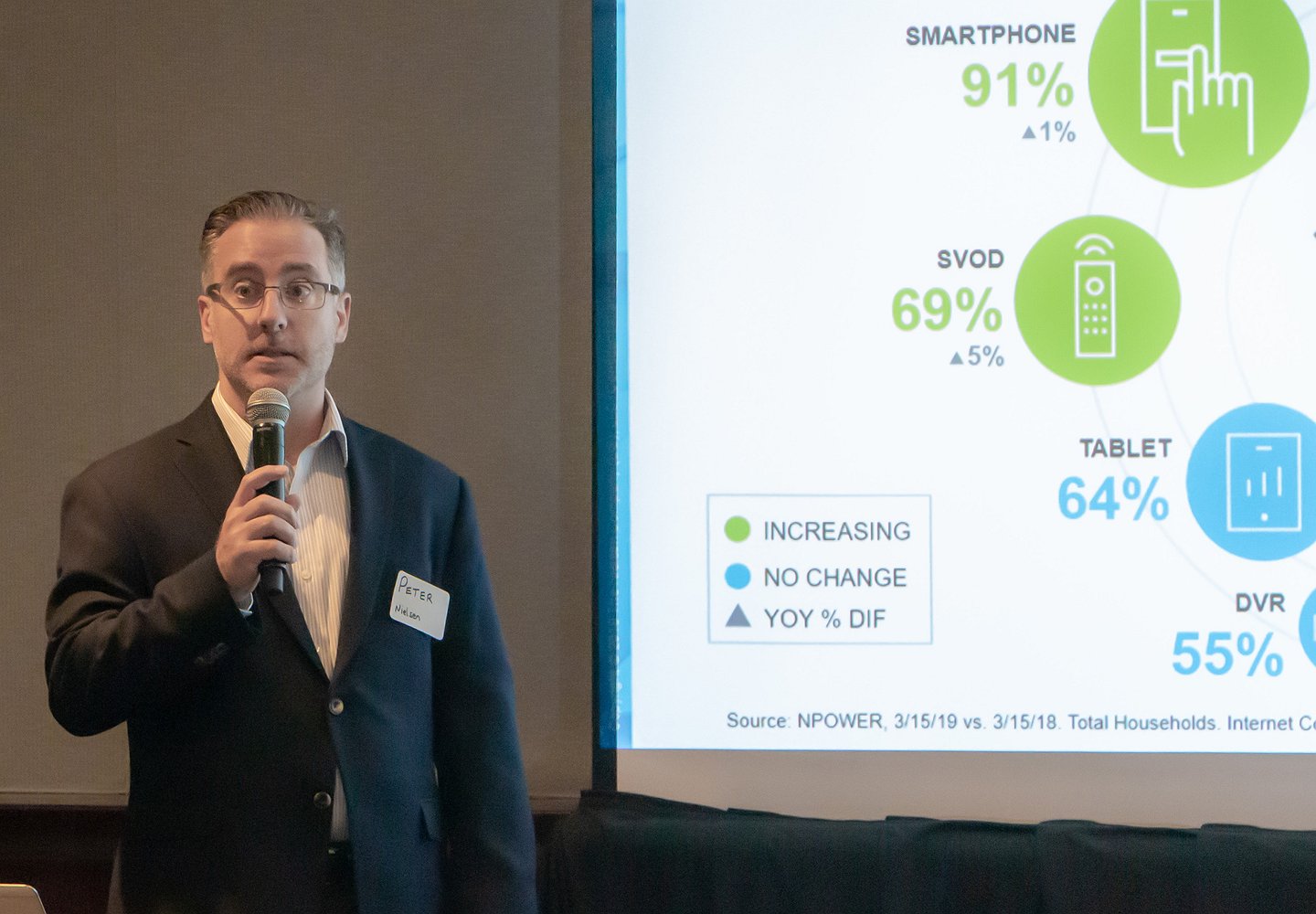
New platforms and devices are being adopted at impressive rates.  According to N-Power, in March 2018 91% of all U.S. households had a smartphone, 79% a computer, 69% an SVOD service, 64% a tablet, 55% a DVR, 46% a smart TV, 43% a game console, 40% an internet-connected device and 4.8% a virtual MVPD.  This increase in digital adoption has resulted in increased usage.  Overall, media usage increased +21% from January 2018 to 2019, especially among African Americans (+26%), Hispanics (+23%) and Asians (+38%).

The more opportunity to view on various devices and platforms, the more time is spent on them.  The shift in time spent is a cautionary tale for traditional media.  Once adopted, streaming usage grows from month one (1 hour, 8 minutes) to year one (1 hour, 20 minutes) while time spent with TV declined in the same timeline (from 7 hours, 19 minutes to 6 hours, 33 minutes).

The expansion of the data pool enables Nielsen to offer new and interesting ways to analyze usage, including which devices are used in which room in the house.  Enabled smart TVs tend to reside in the living room (53%) and encourage co-viewing, while internet-connected devices are in the master bedroom (26%) and (unsurprisingly) enabled video game consoles are in bedrooms that tend to belong to younger members of the household (32%).

The Opportunities:  Addressable TV Using ACR
"The time for addressable advertising is now," declared Abcarian.  "TV has changed and grown.  But we need to look at TV differently than in the past."  There is more connected TV ownership (+46% have at least one smart TV in the home, representing +8% growth from January 2018 to January 2019) and greater cord-cutting or shaving (25% of all TV homes).  But don't misread the trends, she advised.  "TV time is growing, not shrinking," because viewers are "using other devices to get to the glass."  In fact, the impact of connected devices is influencing linear viewing, offering a rebirth of TV.

Linear content is experiencing a 5-7x growth with internet-connected devices, while smart TVs provide a 2x growth to linear content.  In this environment, the ability to apply addressable advertising is a boon to advertisers.  It offers precision advertising that highly targets linear TV with advanced demographics.  It provides value targeting that enables agencies to reduce waste and, with Nielsen, "best in class measurement," using "similar audience segments definitions."  To that end, Nielsen is pioneering ACR technology to unlock the full 16 minutes of ads in programming and transforming C3 measurement, so as to enable clients to reconcile with addressable and be able to execute ad models across platforms.

Two main areas of focus in the coming months include audience-based buying to enable advertisers to use advanced audience segments to plan and buy linear TV campaigns, and addressable TV, which offers true one-to-one ad targeting, delivery and measurement across smart TV platforms. The result will be greater measurement transparency and standardization across these two areas. One example of industry collaboration that exists today is between Nielsen and OpenAP. Nielsen's audience data and Enterprise Audience API are used within OpenAP, enabling the buy side to create and share 777 segments within the consortium's platform since it launched in the Fall of 2017.

Part of this is the result of Nielsen's ability to deploy dynamic ad insertion, which is now in the testing stage.  Nielsen uses video ACR technology that is embedded in the glass screen's firmware or chipset.  "We then take a screenshot every half-second to see what is watched on-screen every two seconds," Abcarian explained.  This is matched back to the library and a decision is then made whether or not to replace the original network ad based on pre-arranged rules and audience profiles.  "It is a seamless experience for the viewer and is more engaging because it is a more relevant ad," she said.

The early learnings from this pilot indicate that broadcasters want to see improved sell rate percentages and agencies want accurate forecasts and more standard segments.  For all of this to happen, measurement reconciliation needs to occur, as well as some operational improvements; there are still too many manual processes at the current time to deliver addressable campaigns.  Some of the challenges are the result of walled gardens that "tie up addressable at scale," Abcarian said.  "We need more partnerships in the ecosystem."  She also noted that we need more scale in technology while keeping in mind the privacy that goes with it.

Another challenge is "too many demand pools and measurement sticks," she added.  "We don't know how to buy at scale with confidence."  Further, there needs to be a reconciliation with C3, bringing the measurement holistically across platforms.  Finally, there needs to be education.  "What do we mean by addressable TV?" she said by way of example.  "And, [we have to] put a value against the impressions."

Ultimately, Abcarianis bullish on Nielsen's ability to deliver an addressable product that will be embraced by the industry.  "It offers real-time scale that optimizes both the upper and lower funnel," she noted.  Nielsen is focused on creating a standardization framework that will drive consistency across all platforms.

This article first appeared in www.MediaVillage.com

Dec 14, 2018

Using A.I. to Insert Ads into Programs. Interview with Mark Popkiewicz, CEO, Mirriad


Mark Popkiewicz, CEO of Mirriad, explains his background as, “the convergence of media, advertising, and technology,” working over the years in telecom, mobile entertainment and broadcasting. His company, Mirriad, embeds brands in programs using advanced technology. 

He views his work as a way to enable brands to break through the clutter and a way for media companies to de-clutter their air. “As networks begin to cut ad loads and experiment with shorter ad formats, there is less opportunity for quality advertiser exposure,” he asserted, “So we’ve developed technology that uses AI and image recognition to embed brand messaging directly into video content.”

Charlene Weisler: How do you track the ads?

Mark Popkiewicz: Advertisers can buy ad units and track delivery while being assured of quality of exposure, ensuring meaningful and contextually relevant ad insertion presented to the relevant audience every single time.

Charlene Weissler: How do you measure the ads?

Mark Popkiewicz: We have developed a set of metrics based on industry best practices from companies such as comScore and Nielsen together with our own research including eye-tracking, guaranteeing viewability and exposure for brands. These metrics, known in aggregate as the Visual Impact Score (VIS) have been verified to adhere to industry norms as practiced by leading ad effectiveness measurement businesses such as comScore. VIS allows us to manage which ad units are be billable. Algorithms using Computer Vision and Machine Learning generate a score between 0 and 2, and any segment scoring above a 1 is deemed ‘billable’ and those scoring below a 1 are discarded.

Charlene Weisler: How is this different from other in-program ad insertion companies?

Mark Popkiewicz: There are currently some companies offering high-end digital video solutions, but none have yet developed the comprehensive methodologies and measurement capabilities we provide. In-video advertising gives brands verifiable exposure and an ad format that’s plannable, reconcilable, and measured and sold on an audience basis, even though it’s integral to the content experience itself.

Charlene Weisler: Is it possible for the actors to interact with the advertising?

Mark Popkiewicz: We utilize a technique called ‘implied usage’ where a product is inserted into a scene suggesting it is actually in use, although it was never there.  For example an ad unit containing a bottle of wine would manifest with the wine being open and maybe half consumed placed next to a wine glass also containing the wine, all contextually relevant to the action.

Charlene Weisler: What do you see as the future of TV advertising in general?

Mark Popkiewicz: The economics of delivering content has vastly changed over the past several years. TV networks are cutting ads en-masse and a number of networks including NBC and Fox have vowed to cut ad breaks by as much as 20% over the next couple years. As the cord cutting trend continues, the video entertainment industry will need to find new ways to monetize content and remain profitable. Media ententes will need to get creative in relaying their messaging to potential consumers and with that will come new forms of advertising, which will be much more contextually relevant to the viewer based on what they watch.

Charlene Weisler: What do you see as the future of in-program advertising specifically?

Mark Popkiewicz: In order for in-program advertising to be successful, it will have to cater equally to brands, networks, and viewers and be engaging.  We have tested several methodologies to engage audiences and drive e-commerce transactions without damaging the audience experience. The results are staggeringly positive.  It’s clear that a blend of content marketing and engagement is part of the future of advertising - but at all times protecting the audience experience and adding value.

Charlene Weisler: Can this be bought programmatically?

Mark Popkiewicz: At the heart of In-Video is data.  Content is analyzed for brand fit and when combined with audience information we have the essential ingredients for programmatic.  The magic is about transforming content into data, the rest is straightforward.

Charlene Weisler: Can this be inserted on other platforms aside from TV?

Mark Popkiewicz: Our primary focus is on premium entertainment content wherever its consumed but our strategy is all about SVOD, and other OTT platforms wherever there are large audiences and a great deal of content in aggregate.

Mar 7, 2016

Preparing for Cross Platform Measurement. Q&A with Harold Geller


Harold Geller, Chief Growth Officer, Ad-ID LLC actually studied to be a journalist. But he soon ventured into television production because of his affinity for backend operations. Little did he know at the time that this interest and aptitude would lead him into media buying and eventually into inventory management and ad identification. “I have always thought that we could do things better and more efficiently,” he explained.

Geller has been working closely with Jane Clarke, CEO and Managing Director of the Coalition for Innovative Media Measurement (CIMM), to ingrain Ad-ID in the measurement ecosystem. Ad-ID has its roots in the ISCI code and may be the solution to today’s complex world of ad identification across platforms. I sat down with Geller who shared his views on the origins of Ad-ID, current ad identification, television today and the future growth of the ad identification ecosystem.  

Charlene Weisler: You started your career in production. Tell me about your move into the agency world.

Harold Geller: I went into advertising as a media buyer. Our agency (Foster Advertising in Toronto) had a big government contract where the client complained about the time it took to post. My idea in 1984 was to provide desk-based personal computers equipped with Lotus 1-2-3, and we were able to turn around the post buys much faster. At the time, that was pushing the edge of technology. Then I worked at O&M in Canada as the Director of Media Technology before moving to the U.S. in the same role at O&M in New York. I worked with Irwin Gottlieb when MindShare started up in a role we called “strategic technology” developing client extranets, document sharing portals and media planning tools.

Charlene Weisler: What is Ad-ID?

Harold Geller: In 1969 the ISCI code was conceived by a group of ad execs, including David Dole, then an account executive at Leo Burnett in Chicago, because of the need for unique IDs for ads. We had word processors and binders for the eight character ISCI code which made identification easy since most advertisers had only one agency of record in those days, but these codes were only supposed to last 10 to 15 years. Fast forward into the 2000s. There was a need to replace ISCI codes with a more scalable method. The Association of National Advertisers (ANA) and American Association of Advertising Agencies (4As) agreed to jointly fund the development of the Ad-ID system, to replace ISCI. 

Ad-ID is the advertising registration authority for measurement, for interoperability and to exchange information on ads. It is a centralized metadata repository for ads. In 2007 we had 300 advertisers registered. Today we have almost 3,000 and are poised to grow even more in the next 18-24 months. As Chief Growth officer of Ad-ID, I connect the dots where people didn’t know dots existed – bringing together the engineering, measurement and advertising communities, all of whom have a stake in the efficiency of advertising workflow.

Charlene Weisler: What is CEA – Complete External Access?

Harold Geller: CEA is the capability through which media outlets, online publishers and approved measurement companies can access Ad-ID codes and related metadata stored in the Ad-ID system. Historically ad metadata has needed to be re-keyed between 20 and 30 times in an ad’s journey through the supply chain. Mistakes in entering data can be made along the way, which makes the ads harder to track and measure. 

In addition, many competitive reporting programs from companies like Nielsen and Kantar ascribe ad information by having people view the ad and then assigning it to a manufacturer and product. All of that is guessing. For example, viewership of a Tide commercial could be for Extra Strength Tide, but that fact may not be noted by the person recording it. Now, with CEA, the metadata is exchanged accurately and efficiently so none of the ad’s identifying information slips through the cracks.

Charlene Weisler: So Ad-ID is a way to prepare to measure ads across platforms?

Harold Geller: Yes. We now have thousands of channels across multiple platforms. Advertisers want to be able to reach consumers wherever they are. If you have a unique code for the ad and the metadata for that ad, you can serve it into media that matches the ad’s content via its metadata. Ad-ID makes ad placement more efficient and automated. We are in a world of one-to-one communication with dynamic ad insertion and are moving toward less manual commercial placement decisions. Metadata enables us to make better and more advanced decisions. 

This process is seamless if all metadata is in the same place. The registration of ads through Ad-ID as the central authority establishes a source for standardized metadata and is the foundation of process improvement. This takes away the need for the ad’s identification information to be rekeyed as it travels through the advertising ecosystem because all of that information is in the metadata. This leads to measurement that is more granular and timelier, and enables measurement across multiple platforms– even if that platform is a screen on a refrigerator door.

Charlene Weisler: What is your definition of TV?

Harold Geller: The definition of TV is evolving as we speak. Content is consumed across many platforms not just via a television set. Each platform may present the same content, however there is nuance in the way each device is used to consume content. Video as a medium is what matters.

This article first appeared in www.Mediapost.com

Dec 28, 2012

Q&A Interview with Mark Altschuler - Comcast Spotlight


It all comes down to sales and Mark Altschuler knows sales. Mark is Vice President, National Advertising Sales at Comcast Spotlight in New York. He started at the national sales organization in 2002 as Director of National Sales for the Eastern and NorthCentral Divisions and was promoted in 2007. Prior to joining Comcast Spotlight Mark held management and sales positions with software technology startup ClickRadio (1999-2002); The Myers Group (1997-1999); New World Sales & Marketing (1994-1997); Group W Sports Marketing (1989-1994) and WGN TV (1986-1989).  He began his sales career in 1980 with Telerep. 

His work at Comcast Spotlight is at a time when digitization, cross platform and the impact of new technology is disrupting “business as usual”. Mark talks about cross platform impact on his business, addressable advertising, dynamic ad insertion, use of segmentation, relationships with agencies and how his job is evolving. He also offers some insights on the sales road ahead.

The five videos of the complete interview are as follows:

Subject                                    Length (in minutes)
Background                              (4:58)
Xfinity, Video, STB data             (4:52)
Comcast Spotlight                    (7:11)
Addressable and DAI                (9:14)   
Predictions & Agencies             (7:58)


Charlene Weisler interviews Mark Altschuler who talks about his background in this 4:58 minute video:


Mark Altschuler talks to Charlene Weisler about Comcast's Xfinity service and the Video media environment in this 4:52 minute video:


Mark Altschuler talks to Charlene Weisler about Comcast Spotlight in this 7:11 minute video:


Charlene Weisler interviews Mark Altschuler who discusses the addressable advertising marketplace and the structure of dynamic add insertion in this 9:14 minute video:


In this concluding 7:58 minute video Mark Altschuler talks to Charlene Weisler about the agency environment and looks forward intot he media landscape over the next five years: