Showing posts with label mobile. Show all posts

Jun 29, 2021

Understanding Gen Z and Millennials with ViacomCBS' Wired for Mobile Study

One of the most fascinating generations is Generation Z, born between 1997 and 2015, the first to be born totally within the digital age. How can programmers and marketers better understand this unique population and how does it compare with Millennials, the generation that preceded it? 

ViacomCBS just completed a seismic study called Wired for Mobile and has a few answers and insights on the subject.

“The study delves into how devices have really changed the ways that Zs and Millennials not only see the world but learn and consume news and information and what role they play in connections with each other with brands and with culture at large,” explained Tristan Marra, VP, Ad Sales Research and Insights, ViacomCBS.

The national study, conducted between June and September 2020 at the center of the pandemic, included a range of methodologies from Desk Research, Digital Quals, Deprivation/Alteration exercises, Expert interviews to, finally, a 3500 respondent quantitative survey. The results underscored the vital importance of mobile. “While there are still a lot that connects Zs and Millennials regarding phones and technology, there are some nuances that we uncovered,” Marra began.  Generation Z are mobile natives and as such, their cellphones are critically important to them. “Their cell phones are inextricably woven into their DNA. There is no separating from them entirely. It’s just so fundamental to who they are,” she revealed. Because of this, they experience the world very differently from generations before them.  

Takeaways

The Complexity of Relationships – The relatively easy access through social media impacts the strength of relationships and creates nuance and complexity in how Gen Z prefers to connect from a text to a DM to a phone call. “The number of platforms we use to connect has been growing rapidly and becoming more nuanced. Because of this, relationships that Zs and Millennials have are also becoming more complex,” she revealed. Levels in relationships – from weak ties like with your local barista or friends of friend to strong ties like with your family - have their own rules and ways of preferred communication. Both are important in boosting happiness, creating a sense of belonging and facilitating discovery.

Unfortunately, “during Covid, we are challenged to having those brief chats, at least in person with our weak ties,” Marra noted. But the pandemic generated other forms of communication that helped facilitate connection. “What we are seeing now are different levels of intimacy. Because of social media, those weak ties that used to exist on the fringes were pulled in a little closer.”

Sharing content is integral to both Zs and Millennials with the top being content that is funny (even more so for Zs), photos or personal stories (for Zs) and inspiring content (for Millennials). Yet, despite the ability to bond via a range of platforms and channels, many Zs expressed a sense of loneliness that might be attributed partly to the virtual-ness of their smartphones or because of the pandemic … or both.

The Age of Mutual Influence – “There used to be a separation between celebrities and authority figures and us,” Marra noted. But that has now broken down as a result of social media which has changed the dynamic. “Now, there is an expected two way relationship between celebrities or brands and followers or fans,” she added. Further, social media enables both the celebrity and fan to interact and respond to each other. “Now that is the expectation. Fans and followers expect that two way relationship between themselves and previously unattainable figures,” she explained, creating a new set of standards for followers.

Take note marketers - These expectations also apply to Z’s and Millennial’s relationship with brands. “One way statements are no longer enough. Youth today expects brands to engage them honestly and personally where both sides are contributing equally like regular human relationships,” she concluded. For both generations, Instagram is proving to be the preferred platform to engage with brands. But brands should be careful not to be creepy by using personal information for targeted ads. This is a turn off for Zs.

Empathetic Facts  - Which is, “how social media  and an earlier, wider world view has made it complicated for youth today to decipher fact from opinion,” Marra explained. This blurring of fact and opinion holds a particular danger for an increasingly divided and complicated world. According to Veronica Fabiani, Director, Ad Sales Research and Insights, ViacomCBS, “Over 70% of young adults hear news on social media first. That means that it is filtered through that personal lens or, at very least, it is very open to opinion and comment. Only 14% of 15 year olds can tell the difference between fact and opinion.”

The challenge today is to help Gen Zs make sense of the facts without going through the filter of social media. It is not easy but the study’s Deprivation exercise may offer a solution. Respondents indicated that when they consciously avoided their smartphone’s social media feed for a certain length of time (as part of their participation in the study), it helped them step back and process how they felt about the news without all of the feedback and reactions that posts collect in real time.

When does too much become too, too much? “It is unique to the individual and dependent upon the day,” Fabiani began, “Social media has given them access to unfiltered news and current events whether they asked for it or not and because Zs are the most diverse generation in history, they already know more people that are different from them. As a result, they are more empathetic.”

Digital Nutrition – Sadly, the stress of the pandemic as well as the potential loneliness cultivated from communicating virtually has created a need for mental health for some Gen Zs. Fabiani noted that, “Six in 10 agree that they sometimes feel like their smartphone has a negative effect on their mental health but not having their smartphone with them, they would miss out on important things.” Digital access offers opportunities for wellness, “seeking that balance of media for both meditation and emotional safeness,” according to Marra.

But it’s not all doom and gloom. “Phones are used as an emotional defense mechanisms by both Millennials and Gen Zs who are looking for content to help them self soothe and protect boundaries and seek out apps to help generate this peace of mind,” stated Fabiani.

“Americans now check their phones 96 times a day,” she added, “And when it comes to social media, 44% of Generation Zs say that they check in at least hourly with 7% checking in more often than every 15 minutes,” creating a digital pacifier when they are lonely or afraid. They seek meditative media to mindlessly consume where they can take a break and have a mental pick me up to feel better. This is particularly true of Gen Zs rather than Millennials. “The content they are choosing is driven by emotion and largely that emotion is happiness more than being inspired,” she noted.

Conclusion

The insights from the study are not only useful for programmers, they can also help guide marketers to effectively connect and resonate with both Zs and Millennials. “This was such a big study. We talked to so many people and we got so many insights. It was hard, in a good way, to prioritize the important insights. We got there in a way that was meaningful,” Marra concluded.


 This article first appeared in www.MediaVillage.com


Mar 17, 2019

The Future Belongs to Mobile, But Ad Spend Growth is Slow

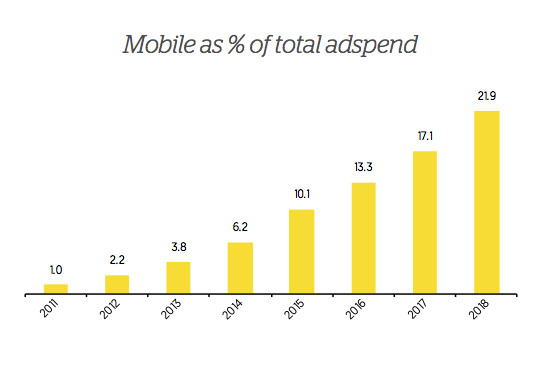
Now, with more and more data coming from digital sources, mobile is emerging as a must have for marketers. Not only is it capturing individual behaviors, it also helps marketers map the consumer journey through location data, app usage and purchasing behavior. One would think that ad spend would follow but while there has been progress, the growth has been steady but slow, according to Joel Rubinson, President and Founder, Rubinson Partners, Inc. speaking at the recent MMA (Mobile Marketing Association) Impact conference.

Currently, ad spend on mobile is 40% of budgets, up from 34% in 2014 or $31.4 billion in total U.S. ad spend, representing 34% of total U.S. ad spend.  “Data is the new oil,” noted Rubenstein, “But there is an oil embargo.”

This embargo is caused by a variety of challenges: Walled gardens of data are causing data gaps. Data is available on some platforms but not on others. User ID sharing has gotten tighter in a GDPR environment. MTA (Multi-touch Attribution) providers vary in their permission to access certain data. All of these missing variables require the need to ascribe and in doing so, “we may not get the comparisons right,” stated Rubenstein, “and the whole predictive value of the model breaks down.”
To avoid the problems in attribution of marketing effects caused by publishers not offering data access, Rubinson suggests considering four possible workarounds:
  • Go all in with a publisher
  • Switch ad servers that don’t restrict IPs
  • Use an MTA provider with approved tagging systems
  • Create an uber-model combining characteristics of Mixed Marketing Models and MTA (with possible A/B testing)
It will take a while for the ad spend to truly represent the full promise and value of mobile but, through the work of such organizations as the Mobile Marketing Association (MMA) and their Marketing Attribution Think Tank (MATT), the world of marketing measurement and attribution  will gain better measurements, tools and predictive connections to the consumer journey.

This article first appeared in Cynopsis

Oct 17, 2017

Zenith Predicts Smartphone Penetration Will Reach 66% Worldwide

Forget your old flip phone.  The world is going totally smartphone, according to Zenith's Mobile Advertising Forecasts 2017, which was released today.  This impressive growth in smartphone adoption will pose both opportunities and challenges to advertisers and brands.

Among the findings in the forecast:  Western Europe and Asia Pacific continue to lead the world in smartphone ownership.  In 2018 66% of individuals in 52 key countries will own a smartphone, up from 63% in 2017 and 58% in 2016.  Those countries projected to have 90%+ penetration in 2018 include the Netherlands (94%), Taiwan (93%), Hong Kong (92%), Norway and Ireland (each at 91%).  Further, eleven markets will have penetration levels between 80% and 90%, all of them in Western Europe and Asia Pacific with the exception of Israel, where penetration will be 86%.  In terms of total number of users, China leads all other nations with 1.3 billion users, followed by India with 530 million users and then the U.S. with 229 million users.

While overall penetration of smartphones is reaching ubiquity to as much as 80% to 90% of populations in the world's most advanced markets, the actual rate of smartphone growth is projected to be only 7% year-on-year in 2018 compared to 10% growth in 2017, 14% in 2016 and 21% in 2015.

What does this bode for advertisers and brands?  "Brands need to design all their online communications for mobile viewing," says Jonathan Barnard, Zenith Head of Forecasting and Director of Global Intelligence.  "These communications need to look good on the small screen, grab the viewer's attention immediately and convey their messages quickly while their attention remains focused."

In addition to smartphone device growth, the importance of mobile will increase and will impact ad spend buying decisions.  The report notes that 53% of all Internet ad spend will go to ads viewed on mobile devices in 2017 and is forecasted to account for 59% in 2018 and 62% by 2019.  The amount of ad spend on mobile has surpassed that of desktop ads for the first time ever this year.  In addition, mobile devices are the primary means of accessing the Internet right now.  Users spend 70% of their Internet time on mobile in 2017 and this will grow to 73% in 2018 and 76% by 2019. "For most consumers and advertisers, the mobile Internet is now the normal Internet," posits Barnard.

Tablets, on the other hand, are losing appeal and projected to stabilize at 20% worldwide penetration.  China is distinctly unimpressed with tablets where their penetration is just 4.8% this year, compared to 85.4% for smartphones.  Tablet penetration is even declining in Thailand.  According to the report, tablets are usually household-owned as opposed to smartphones, which are individually owned, and the ability to attain a smartphone with a larger screen negates the need for a tablet.

The conclusion?  Mass uptake of smartphones and other mobile devices means increased contact between brands and consumers -- whether paid advertising in third party content, branded content exposure or stepped-up social media engagement.  It also facilitates new opportunities for consumers to connect to media content whenever and wherever they are and thus to broader brand experiences.

This article first appeared in www.MediaVillage.com

Mar 13, 2017

Know Your Ad Server. Interview with Brian DeFrancesco


Brian DeFrancesco, co-founder of LKQD has deep experience in ad-tech space building and deploying large-scale ad servers. His latest venture, LKQD, is a self-service video ad-serving platform that works across programmatic, direct, and non-direct demand mediation and optimization.    

“Ad servers have evolved from being closed stack systems that provide basic operational support to open platforms that enable companies to work with vendors of their choice for ad targeting, verification, and programmatic initiatives,” DeFrancesco explained, “The role of an ad server is becoming increasingly important as it defines a company's capabilities to secure and execute ad buys in today’s complex ad tech ecosystem.”

Charlene Weisler: There are several ad-serving companies in the media ecosystem. What distinguishes LKQD?

Brian DeFrancesco: First, there were many legacy ad servers built and architected to run on Flash.  Back in 2014, we knew the future for video advertising would be mobile and HTML5, and no one was taking the mobile video advertising space seriously.  Second, we wanted to release a VPAID (Video Player Ad Serving Interface Definition) compatible solution for mobile.  We had watched the industry transition from VAST to VPAID in desktop due to the advantages of measurement and security offered by VPAID.  We build a VPAID solution from day one for mobile and have offered a VPAID compatible ad player with built in viewability detection since 2014.  We are seeing the early moving agencies adapt mobile and HTML5 VPAID at scale.  We think this will continue to be a large growth area during Q4 2016 and looking forward into 2017.

Charlene Weisler:  What is seamless video advertising?

Brian DeFrancesco: Seamless video advertising is about offering the customer everything they need to run their full business on our platform.  We offer a single self-service platform for mobile apps, connected TV, desktop and mobile web.  We have a customizable ad player, pre-built ad formats, a best-in-class mediation layer that uses a technology to automatically optimize itself based on up to the minute reporting data, paired with creative hosting, 3rd party integrations with Moat, WhiteOps, Krux, and Oracle.  Seamless video advertising is about building technology solutions to address the problems that publishers and advertisers face in the market so that they can stop worrying about technology challenges and focus on their business. We’ve recently taken this one step further with the introduction of LKQD Fusion.
Charlene Weisler:  What is LKQD Fusion?

Brian DeFrancesco: LKQD FUSION provides real-time communication and functionality 'bridges' between Flash and HTML5 video ads. This enables desktop Publishers to support video ads from all Advertisers regardless if they have transitioned to HTML5 or still utilize Flash.  LKQD FUSION partners can maximize their revenue by delivering both Flash and HTML5 video ads on all inventory while also becoming fully prepared for the inevitable end of Flash being pushed by every major browser on the market.  The technology is not focused on content recognition per se, but rather on providing publishers with a simple single solution so they do not need to worry about the codebase of the content, and can focus on running their business.  We rolled out the product publicly in July and have seen incredible traction in desktop since public launch.  LKQD FUSION publishers now have a future-proof solution for desktop to complement LKQD's already best in class solutions for mobile video, making us a platform of choice for over 200 publishers globally.

Charlene Weisler: What types of data do you collect and what metrics do you use?

Brian DeFrancesco: We use both in-house and third party metrics for measuring video ad performance, ROI, and brand safety.  These include: completion rate, click thru rate, viewability, audibility, true domain or app where ad display, human vs. non-human traffic, and many others.

Charlene Weisler: Where do you see the ad serving space five years from now?

Brian DeFrancesco: I believe open platforms will play a vital role in the future of ad tech, especially for Publishers.  Ad servers will provide the core ad delivery infrastructure (uptime, scale, real-time reporting, data management, third party integrations) that will enable companies to build their own business models on top of.  Ultimately, it’s about providing the tools for success and letting Publishers build their own strategy unique to their properties and their audience.

May 6, 2016

Finding Elusive App Data. Q&A Interview with Karl Stillner


Karl Stillner, Co-Founder and CEO of PushSpring, has been focused on the app economy for a few years. “I spent time working with apps like MSNBC and FlightTrack, allowing me to experience first-hand the biggest issue facing the app economy: the lack of data.”  It is hard to imagine any part of the media ecosystem that is challenged by a lack of data so I sat down with Karl and asked him the following questions:

Charlene Weisler: Karl, give me a short description of PushSpring and what it does.

Karl Stillner: PushSpring is a mobile app-oriented Audience Management Platform (AMP). We provide large-scale mobile audience data to marketers, agencies and publishers. App publishers have next to no audience data on who is using their application and other related applications. Applications are browser-less; no cookies exist in the ecosystem. So, collecting anonymized audience data and aggregating it into a format that speaks to behaviors, intents, demographics, etc. is very difficult.  

We’ve created a technology to aggregate data at scale. On the demand side, we allow brands and agencies the ability to use high quality data to target ads in mobile applications and to use this high quality data to reach people on other screens as well. Additionally, app publishers use our data to inform their understanding of their customers, and beyond understanding, to reach these customers with relevant messages.

Charlene: What exactly is app advertising?

Karl Stillner: There is a common misconception that in-app advertising is used only for driving installs for other apps.  While this is an extremely popular and effective method for new user acquisition, in-app advertising is also quickly becoming a preferred channel for brand and performance advertisers spanning a broader range of products and services.  Higher engagement rates and stickier user experiences in apps help drive consumer attention to advertising that, when targeted with definitive, app-based data, drives strong ROI and branding objectives for marketers.

Charlene: What data do you currently collect, use and find most important?

Karl: We aggregate anonymized device-level data from smartphones and tablets. This data is incredibly informative and valuable because it originates from the most personal devices a consumer owns. The mobile device is better at reflecting the user’s preferences than any other device, including desktop or point-solution devices like fitness trackers. The data we find most exciting relates to the apps on the device. The signal-strength associated with owning an app is high. For instance, the fact that I have a running app on my phone indicates I am fitness and running enthusiast. If you combine that signal with 15 other disparate apps, you can imagine the possibilities.

Charlene: Who is your competitive set?

Karl: It’s a very good question that doesn’t have an easy answer. Our demand-side customers buy data and media from closed-loop ecosystems, like Facebook, that have very high quality data and excellent media. We provide the same buyers with access to high quality data as well which they can run across whatever media they wish: RTB, mobile video, Facebook, Twitter, etc. Our customers also buy from the providers of mobile location data. For example, Placecast provides excellent carrier-based location data that can be used to target across the ecosystem as well. However, we view that kind of data as a natural complement to our data, and not so much a competitor.

Charlene: Can your data be used to measure TV via TV Everywhere or via a network app? If so how and if not, why not?

Karl: Our data can be used to understand the types of users that are using TV Everywhere services. We can also provide interesting insights into the people using specific mobile applications that stream video.

Charlene: Looking ahead the next 3-5 years, give me some predictions about how the media landscape will look.

Karl: One of the most obvious analogs to what is occurring in the media space occurred 10-15 years ago with financial markets. Open-outcry trading (traditional hand signals used on the stock exchange trading floor) relied on a variety of unique traits that aren’t necessarily valued to the same degree now. For example, athletes were often used on the floors because they were easy to spot and could command good positioning, social connections and trading history were highly valued. In the world of electronic trading much of this has been devalued in exchange for analytical ability and fluency in the technologies that underlie how trades are executed.  Programmatic is the electronic trading of the media space. The media space will be driven less by long-standing relationships and ‘access’ and more by speed and efficacy.

Buyers will be more analytical and agency buying arms will start to reflect hedge funds. Attribution will become much more sophisticated and much of the 50% of waste that John Wannamaker famously indicated will be not only known but trimmed. Ecosystems will continue to meld into one. People won’t target someone on mobile. They will simply target them whether phone, TV, car, fitness device, etc. Hopefully, the ecosystem won’t only be controlled by 2-3 closed tech stacks.

This article first appeared in www.Mediapost.com
 

Mar 22, 2016

Michelle Klein of Facebook on Video, Mobile and “Thumb-Stopping” Content


Michelle Klein has had an interesting career path starting as a writer for The Sydney Morning Herald in Australia. She traveled the world, settling in the U.K. and working for the Sea Containers Group, including Orient Express Hotels. It was there that she gained experience in new media as part of an internal digital agency which led to a stint at Agency.com, followed by Diageo and ultimately Facebook where she is currently the Director of Business Marketing for North America .  

Klein is an emerging leader in the media and advertising community.

I asked her the following questions:

Charlene Weisler:  Tell me about your current job at Facebook.

Michelle Klein: My job is to bring the Facebook story to life in the market, for large advertisers to small businesses and agencies alike.. We are partners to sales and product working behind the scenes to create meaningful storytelling. 

Charlene Weisler: How has Facebook changed since you first started there?

Michelle Klein: One of Facebook’s five core values is to move fast – which has made the last year incredibly exciting. On the platform, one of the biggest shifts we’ve seen is in how people consume video. There are now 100 millions hours of video watched daily on Facebook, a significant portion of which happens on mobile. Similarly, we’ve watched video become an important and powerful medium for businesses of all sizes.

Charlene Weisler: Where do you think video viewing on mobile is headed? 

Michelle Klein: The shift has already happened – on Facebook, 75% of video views are on mobile. Our research shows that the brain actually engages differently when viewing content on mobile – people are more attentive and tend to feel more positively toward information presented on the mobile screen New video products, like 360 video and Facebook Live will only continue to evolve the way we consume content on our devices.

Charlene Weisler: Is advertising on mobile different than on other platforms?

Michelle Klein: Advertising on mobile requires a fresh approach to creative. You have to capture attention through thumb stopping content, usually with the sound off. So the first 3 seconds are important in the story telling. There are some really great examples out there of brands creating compelling content with the sound off and through strong, emotive visuals.
 
Charlene Weisler: Has consumer behavior changed in a year since you started at Facebook?

Michelle Klein: The consumer shift to mobile is arguably the most important thing that has happened to the media and advertising world since the advent of TV, and we continued to see its impact over the last year. As part of this shift, we’ve seen the rise of messaging apps around the world that are set to usher in the next great evolution in communication. Six of the ten most downloaded apps are messaging apps. At Facebook, we have 800 million active people on Messenger and a billion on WhatsApp. 


Michelle Klein: I am so happy that you asked that question. One thing I love about working at Facebook is how serious our leaders are about everyone leading meaningful lives, both personally and professionally. When you have that balance, integration, whatever you want to call it, you do better work, and you can make a larger impact in everything you do. It’s all about understanding what’s important in our lives, and working around those things. So for example, if you need to drop off your child at school twice a week, you book the time to do it. If going to the gym regularly is important to you, you take time out of your day to do it. I like to work out in the mornings so I can arrive at work at 9:30 and I can leave by 5:45p to be with my children. Everyone is respectful of that and it has had profound impact on morale.


Charlene Weisler: What advice would you give a current college graduate seeking a career in media?

Michelle Klein: Take every opportunity that comes your way. There is no direct career path anymore and by taking on a variety of roles you can learn and grow into new opportunities. Sheryl Sandberg called this a “career jungle gym” and that has been true of my experiences leading up to and at Facebook. Many Millennials have this ethos already, gone are the days of having one type of career in one type of industry. 

This article first appeared in www.MediaBizBloggers.com