Showing posts with label Kate Manatt. Show all posts

Sep 23, 2023

A New MAGNA Study Proves that Repetition Breeds More Than Annoyance

Brands beware. Some amount of ad frequency can be helpful in getting your message out. However, a recent study by MAGNA Media Trials with video advertising platform, Nexxen, revealed that ad repetition, especially within a short viewing window, is not only a bad experience for the viewer, it is also detrimental to the brand.

This study is the first of its kind and offers a warning to both brands and platforms to consider frequency windowing and a mix of creative throughout the campaign. “We know how important the ad experience is. We often focus on the right message, right person and right time and those things are important. But the ad experience can really make or break an impression,” noted Kara Manatt, Executive Vice President Intelligence Solutions at MAGNA.

She explained that the viewer experience of overly repeated ads, especially within connected TV, is familiar. “We were really interested in what the impact was for our brands, the user experience and the platform. Number one for us is how effective our ads are and we knew that ad frequency played a role,” she added. Karim Rayes, chief product officer at Nexxen, noted that, “We knew this would have an effect, but quantifying it was important. This is for us the first time we're able to do that.”

The research was conducted in-house using experimental design with about 1250 online respondents. They were asked to view in their own homes and choose any content, thus replicating as typical a viewing experience as possible with MAGNA ads inserted and a questionnaire to follow. The results are sobering.

Manatt shared that, “87% said that they usually experience this so it's happening all over and people remember it.” Also, many believe that this high degree of ad frequency is intentional. “Even though we know in the industry that it is occurring, brands aren't intending to deliver the same ad over and over in the same TV show. But 68% think that brands specifically intend to do it.” Notably this level of dissatisfaction was consistent across demographic groups and ages.

Another warning to advertisers and platforms is the impact of ad frequency on branding metrics. “Our clients and our agency are working to achieve greater impact on branding metrics like purchase intent, connection to and excitement about our brands. To see that we are actually creating declines and having the opposite of the intended effect is pretty startling. We see a decline in purchasing intent of 14%,” she explained.

Rayes noted that, “Customer experience is critical for the platform as well. There is negative impact when the repeating ads were shown against the same content. Viewers want controls to properly manage that and often seek their content on another platform. CTV offers a lot more options than there used to be a few years ago. It's critical for platforms to take this seriously as well.”

Perhaps not surprisingly, linear TV advertising is not as repetitive as other platforms. Rayes explained that, “Linear TV booking is done in advance and is very static. So you're carefully managing the amount of repetition you have against each show. When it comes to CTV and digital, you have a global budget, daily caps, etc. but overall, the distribution is not as polished. So you can add on unless there are the right controls. You can end up in a situation where you're going to repeat the same advertisement multiple times.”

When you add in user targeting and other factors on digital and start filtering down the number of available campaigns to a specific consumer, “you tend to narrow it down to the extent that you repeat the ads on the same consumer multiple times,” he added. For Rayes, digital has its advantages but ad frequency is one of the major disadvantages that need to be addressed.

For Manatt, “The research findings validate the importance of going the extra mile to ensure that ad over-frequency doesn't happen. We're already working with publishers, one on one, and with a short list of trusted partners like Nexxen who have the technology to manage frequency. So we are already taking action. But these are important findings for us to share more broadly to make sure every team is taking advantage of that because it's counter to what our ads are intending.”

She stressed that it is vital that the industry to work together on this issue. “We don't want people changing their media behaviors and moving to something else because we're not doing a good job of delivering our ads. It's not just an individual brand problem. It's an industry wide problem and we all have a stake in it. Consumers can change the channel and switch platforms and spend their media time other places. So we all need to work together on the right technology to make sure it doesn't happen.”

Looking ahead, there are some interesting and viable solutions. One, according to Manatt is, “Storytelling and using it to be more thoughtful. If we're going to deliver multiple ads, hopefully not six in a TV show, we can use technology to tell a story from touch point to touch point.”

“It’s beyond the technology. It's also working to establish industry standards. The ad serving platform hosting the creative might have the same creative but two different creative ids for platform A to platform B. The broadcasters and platforms don't know it's the same ad. So even if you have the tools to say, ‘Okay, don't show that id more than three times’ consumers may still see the same ad multiple times if there's 2 ids with the same ad. It's important that we have a universal language. There are lots of standards in our space but there is still a lack of standards when it comes to creative management. It's a work in progress,” Rayes concluded.

This article first appeared in www.MediaVillage.com

Artwork by Charlene Weisler

Feb 13, 2018

Deepening the Connection To Hispanic Consumers

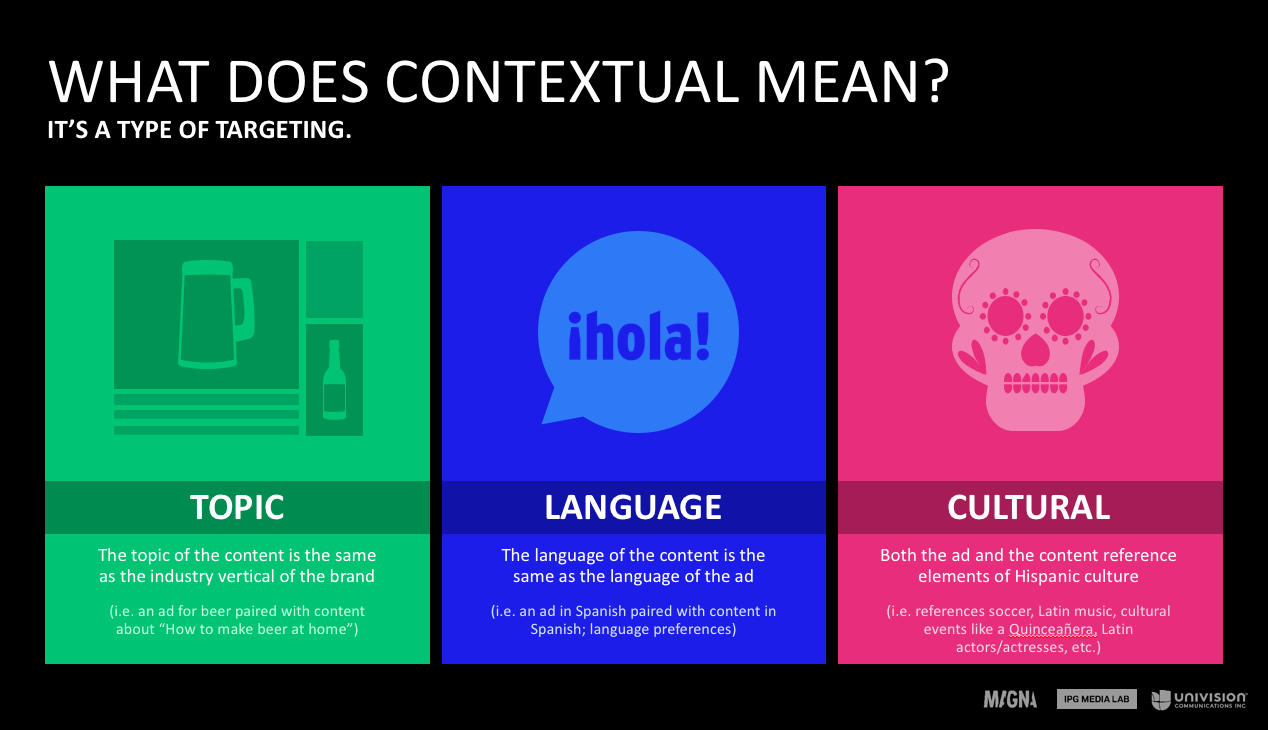
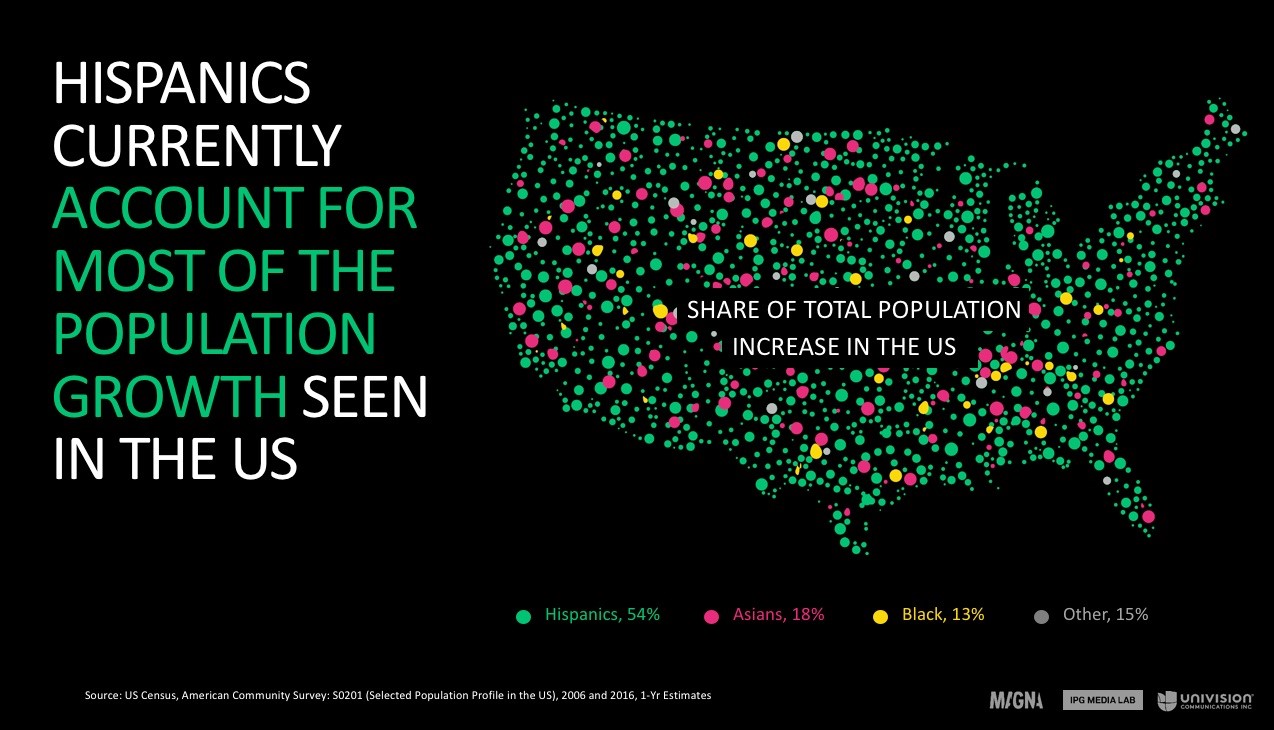
Hispanic spending is projected to grow 85% over the next 10 years and reach $1.7 trillion by 2020, which makes this market segment one of the most important consumer targets for advertisers.  But how can marketers meaningfully connect with Hispanic consumers?  MAGNA and Univision have just released the results of a seminal research study titled "Marketing to the Hispanic Mindset" that measures the impact of contextual targeting (topic, language and culture) in digital video ad experiences.

Among other key insights, the study revealed that language and culture targeting in digital video ads can double the purchase intent of Hispanic consumers and increase their emotional connection with brands.

Surveying 6,000 Hispanic consumers, the study is the first of its kind to include mobile face-tracking in Hispanic research.  "We wanted to understand the role of language and context in digital advertising, including mobile and emotional facial coding to gain deep insights," said Roberto Ruiz, Executive Vice President, Insights and Analytics at Univision.


I sat down with Ruiz and Kara Manatt, Senior Vice President, Intelligence Solutions Strategy at MAGNA to delve more deeply into how the right targeting can connect brands with the Hispanic consumer.

Charlene Weisler:  Tell me how targeting can impact ad receptivity among Hispanics.

Kara Manatt:  We tested three types of targeting.  The first, Topic targeting -- when the topic of the ad is related to the topic of the content it appears in front of -- replicated what we tested among a general audience.  An example would be content on the health benefits of owning a cat that has a pre-roll ad for a cat food brand.  Obviously, there is a strong connection between the product being advertised and the editorial context in which it appears.

The second type that we explored in the study was Language targeting, which is when the language of the ad is matched to the language of the content.  For example, Spanish-language pre-roll ads that run into Spanish-language video content.


Cultural targeting was the third area; that is when an ad speaks to Hispanics through culture.  This can be a bit trickier to nail down since there are a lot of different ways to do that, such as through music, food and specific Latino events.  In Cultural targeting you align an ad that connects on a cultural level with content that does the same thing.

Weisler:  What were the major takeaways from the study?

Manatt:  The key findings for us were the big differences in persuasion metrics, particularly the really important and hard-to-move metrics like brand favorability and purchase intent.  Using language and cultural targeting to double purchase intent was the No. 1 key takeaway; we saw double the impact from merely changing the environment and not the ad.  The other takeaway was that it helps build a relationship between the brand and the consumer.  Hispanics are particularly sensitive to cultural messaging from an advertiser.  They are receptive to the brand going the extra mile by speaking to them in their own language and making that cultural connection.  This is not lost on the consumer.  Again, notably you are not changing the ad.  You are only changing the environment.


Roberto Ruiz:  We also gathered a lot of data on mobile targeting.  When we used the emotion tracking part of the study and we looked at the percentage lift in emotion due to cultural targeting versus no targeting, we saw that with cultural targeting there was more emotion expressed by the people watching the ad.  So, the fact that cultural targeting had a huge impact in emotion on ads received via computers and mobile -- in mobile we saw 60% more emotion being expressed by the Spanish dominant and bi-lingual Hispanics -- told us that cultural targeting is creating a visceral connection and driving emotion.  We know that in branding, emotional connection is really what drives equity.

Weisler:  Were there any surprises in the results?

Manatt:  It's not often we find that what is good for the brand is something that is also good for the consumer.  It is good for brand metrics, but it also leads to a better overall media experience for the consumer.

Ruiz:  It surprised me that Language targeting and Topic targeting performed the best on smartphones.  There is so little data on how to create effective mobile ads that I thought this finding was very interesting.

Weisler:  What are your recommendations to advertisers?

Ruiz:  We say that these are building blocks -- each step leads to a deeper and more profound relationship to the consumer.  Don't limit yourself to Topic targeting and Language targeting.  Take it all the way to Topic, In-Language and Culture to have very powerful digital ads.  You will see the brand KPIs go up.  This research surveyed 6,000 consumers -- a large study with a representative sample that includes non-self-reported data (data that was collected by an app) and that builds on these three targeting steps.  You can see the lift from each one.  But if brands want to do cultural targeting they have to do their homework.  They have to understand the consumer insights that connect the brand to the category, to the consumer and create a solid, culturally targeted creative ad.

This article first appeared in www.MediaVillage.com