Showing posts with label Univision. Show all posts

Apr 11, 2019

Advancing into Linear Television Optimization. An Interview with Stacy Daft of Amobee

Image result for stacey daft amobee
Linear television is currently grappling with how to optimize its offerings in a media world that is increasingly leveraging granular data for targeting purposes. 
The recent announcement of Univision and its selection of ad platform, Amobee, will, according to the press release, enable advertisers to plan and transact against their custom strategic target audiences or proprietary first party data creating a foundation across linear, digital and social channels.
“Univision is the largest broadcaster serving Hispanic America, and has been the number one Spanish-language network in primetime for 27 consecutive years,” explained Stacy Daft, GM  Commercial Business Development, Amobee. “They command a 60 percent share of the Spanish-language primetime 18-49 audience, reaching an estimated 106MM unduplicated consumers a month, with 90 percent of their audience watching in real-time,” she added.
Daft offered the following insights on the partnership and the platform’s attributes:
Charlene Weisler: What do you mean a by linear television optimization platform?
Stacy Daft: The Univision / Amobee partnership advances data and insights across linear TV, bringing the better understanding of audiences, targeting, data and insights we’ve come to expect in digital. Univision can now provide a data-optimized linear television offering to advertisers by applying the same principles of granular audience targeting and campaign measurement as digital, allowing advertisers to better understand audience reach across multiple networks and plan and transact against their custom strategic target audiences or proprietary first-party data.
Weisler: What metrics are used to measure linear planning?
Daft: The primary metrics for advanced linear planning are strategic target index, reach, frequency, impressions and CPM.
Weisler: Is it programmatic?
Daft: It’s not programmatic; Amobee is not operating as a DSP connecting to Univision’s demand. Amobee is acting as Univision’s sell side enterprise platform, optimizing for their direct sales business. With Amobee’s technology and software, Univision will create data-driven plans to help advertisers reach strategic targets across their portfolio of networks.

Weisler: How is it innovative?
Daft: Univision is an extremely innovative broadcaster and this work to make linear television more data-enabled is the type of partnership that helps move the entire television industry forward. Bringing data to the top of the marketing funnel provides better targeting and addressability to television investments, with overall television advertising spending slated to surpass $200 billion by 2020.

Advanced linear television optimization brings more precision to the buying process, allowing targeting beyond age and gender and allowing greater automation in the buying and selling workflow. By layering first-party and third-party data over television viewing data, media buyers and sellers can understand more about reaching their best consumers, most efficiently across Univision’s linear properties.

The relationship with Amobee enhances Univision’s ability to create end-to-end solutions for clients who are seeking advanced data solutions and precision targeting against the valuable Hispanic-American consumer segment. This partnership signals our commitment to collaborating with major broadcasters to deliver best-in-class digital and linear TV capabilities that help bridge the gap between digital and TV and are specifically designed to enhance the TV advertising proposition for advertisers and agencies.

This article first appeared in www.Mediapost.com
 

Aug 18, 2018

Working Together to Improve Measurement. Insights from the Cynopsis Data and Measurement Conference


For anyone working in the research, data and analytics space, there is no better event than the annual Cynopsis Measurement and Data conference. It is an opportunity to dissect what is going on in the Wild West World of media data that maps the intersection of two main issues; the ever increasing availability of new datasets that expand our knowledge of consumer behavior and the legacy measurement that continues to monetize and fuel the business. At some point these two forces must merge. But how?

What is Constant and What is Evolving
There are some aspects of the media business that remain constant such as the need to agree on KPIs for a campaign, the need to form partnerships that have open communication and the need to agree on how success will be measured. But more and more, we are seeing elements of the business that are perpetually in flux such as the range of data availability, metrics and measurement analytics and  consumer behavior with device usage. For George Ivie, CEO and Executive Director, Media Ratings Council, getting a handle on measurement all boils down to data usage. The two major industry changes according to Ivie, are, “How the industry views using research data and how consumers view data usage.”

Defining outcomes are pivotal to managing change. From a technological standpoint we need to understand “how consumers are using technology. They are moving off linear and the MRC is tracking that behavior. Everything is mobile which is harder to measure and nail down,” he noted. “Consumer choice is causing tension in our business. We need to design server side ad insertion and find ways to avoid ad blocking,” he concluded.

Improve the User Experience
Solving for content navigation in a world of increasing choice would seem to be a no-brainer for the industry. Carol Hanley, Chief Revenue Officer, TV Time offers a solution. “We are a consumer facing app,” she explained, “With 13 million global users who interact around TV content. There is a need in the TV business to understand how to get content and we are like a TV Guide on steroids,” she explained. This app also captures user data such as sentiment information, social dialogue and moment by moment interactions.

Scott Levine, Senior Vice President, Product and Technology Distribution, Univision, looks at content to drive viewer satisfaction and delight. This is an ongoing process. “Our whole history as media company is about evolution and creating a closer and more direct relationship to our audience. What makes people happy,” he explained.

Improve the Advertiser Experience
Attention appears to be the most valuable commodity for advertisers, once the ad itself is viewable and unblocked. But how does one define attention? Dan Schiffman, CRO and Co-Founder, TVision, believes that, “Attention can be defined by the outcomes that occur after a person sees an ad.” But how much time does it take for a brand attention to occur? How many seconds? Schiffman says three seconds is that threshold for recall and awareness of that ad. But Julie Detraglia, Vice President and Head of Research, Hulu, disagrees. “It’s hard to believe that three seconds are enough for an individual. We have more work to do to understand what the threshold is.” She noted that Hulu only charges when ad completed 100% and the viewer can't skip ads.

Donna Speciale, President Ad Sales, Turner, has made it her mission to reimagine TV and advertising. “Our collective goal is to make advertising better for our fans and clients,” she explained, “We develop smart marketing initiatives across all platforms empowered with ideas and solutions to drive consumer outcomes.” She advocates a new direction for measurement. “We need to transact on those formulas that show how people are actually consuming our content.” 

Next Steps
Maybe the era of competitive cooperation is here and will lead to much needed new industry measurements and standards. Apropos of OpenAP, the Advanced Audience Platform created by Turner, Fox and Viacom that has now added NBCU to the mix, Speciale noted that, “We have a lot more work to do. No one company can change the industry. We need to hold each other accountable so we all win.”

This article first appeared in www.Mediapost.com

Jul 17, 2018

Hispanic Consumers’ High Engagement and Purchasing Power. Interview with Univision’s Steve Mandala

When it comes to understanding the Hispanic consumer, Steve Mandala, is an expert. His work at both the local level as general sales manager at Telemundo’s KVEA-52 affiliate in Los Angeles to his current position at Univision as President of Advertising Sales and Marketing, Univision Communications, gives him a great perspective on how this coveted group reacts to media messaging. 

Recently, Univision completed a new engagement study using both Nielsen and comScore data that demonstrated how Univision connects with its viewers with both greater engagement and longer length of tune. To find out more, I asked him the following questions:

Charlene Weisler: What do you think is the reason for UCI’s longer length of tune vs. competitors?

Steve Mandala: There are two key factors:  Our content and our distribution platforms. The breadth of our portfolio in reaching Hispanics across TV, radio and digital – something that no media company has—is what sets us apart from our Spanish-language competitors. Additionally, Univision has more hours of regularly scheduled LIVE programming than any of the English-language networks, setting us apart from our English-language competitors.

Charlene Weisler: Is any specific program or programming genre driving this?  

Steve Mandala: We see extremely high tune-in and engagement for women in Daytime, even higher than in Prime. Sports is a key driver in delivering male viewers and we have more soccer than any other media company in the U.S.

Overall, our audiences are seeking big, live, events and entertainment content that culturally resonates.  Univision has a special connection and unparalleled trust with the Hispanic community. Our programming decisions are fueled not only by this connection, but also because that is what our audience expects from us. With all of our shows or events we foster pride in our culture, support of viewers’ daily lives and offer optimism towards the future that sets us apart from everyone else.

Charlene Weisler: How was data used to get your data results?  

Steve Mandala: We used Nielsen data for both television and radio and comScore for digital metrics. We looked at average month Total Day with average number of minutes consumed among Hispanics for all measured networks, radio stations, and digital properties within each media company’s portfolio.

Charlene Weisler: How does it break out by age and gender?

Steve Mandala: The same compelling story is evident for Adults 18-34, 18-49 and 18+. This indicates that our audiences’ loyalty transcends all age segments.

Charlene Weisler: What do you think is the reason for the high level of ad effectiveness for UCI?

Steve Mandala: We justify our ad effectiveness success in two dimensions; Viewing Behavior and Consumer Behavior.

With Viewing Behavior, the vast majority of our TV viewers consume our content live, which leads to top levels of ad engagement. Our viewers continue watching their programs even during commercials, with a commercial retention of over 90 percent.  Also, we know Hispanics are receptive to advertising than non-Hispanics– Hispanics are 19% more likely to agree that “Advertising helps me to keep up-to-date about products and services that I need or would like to have.” (MRI)
With Consumer Behavior, ads that run on Spanish-language consistently outperform English-language ads on recall and likeability among Hispanics.  In 2017 alone, we saw that Spanish-language ads significantly outperformed English-language ads on all metrics. Spanish-language ads likeability indexed 240 vs English-language ads. We believe the key to Spanish-language ads’ over performance is language.  Even with global campaigns (ads that are exactly the same in Spanish-language vs English-language and the only difference is language) we see Spanish-language ads consistently performing better on all metrics vs English-language ads. Additionally, recent studies show that audiences exposed to contextually targeted ads have a higher tendency to respond favorably, especially within the concepts of language and culture targeting.

Charlene Weisler: How does ad effectiveness impact the consumer journey and purchasing?
Steve Mandala: Creative continues to be the largest differentiator for campaign performance and positive ROIs. A good creative helps cut through the clutter, drives clarity, delivers a message to consumers and leads to higher purchase intent and incremental sales. A good Spanish-language creative speaks to the consumer in culture and in-language, establishes a dialogue, develops narrative storylines, leverages culturally-relevant humor and uses relatable characters in a familiar setting. Our source for this information comes from Nielsen’s “The Secrets to Spanish Language TV ROI” study.

Charlene Weisler: How does the Hispanic audience compare to Total U.S. audiences in terms of loyalty and purchasing?

Steve Mandala: From a study conducted in partnership Acosta, we discovered that Hispanic shoppers continue to make more store trips than the Total U.S. shoppers. We also saw that Hispanic shoppers and Total U.S. shoppers on average are spending basically the same, however, the Hispanic shopper with kids is out pacing both groups in monthly spend. This increased trip frequency and spend provide retailers and brand marketers with more opportunities to engage with Hispanic shoppers.

In terms of loyalty, when asking Hispanic buyers what factors were most important in deciding which brand to buy, usually brand was the most important reason for brand selection, indicating that many are brand loyal buyers across a diverse range of categories.

This article first appeared in www.MediaVillage.com

Feb 13, 2018

Deepening the Connection To Hispanic Consumers

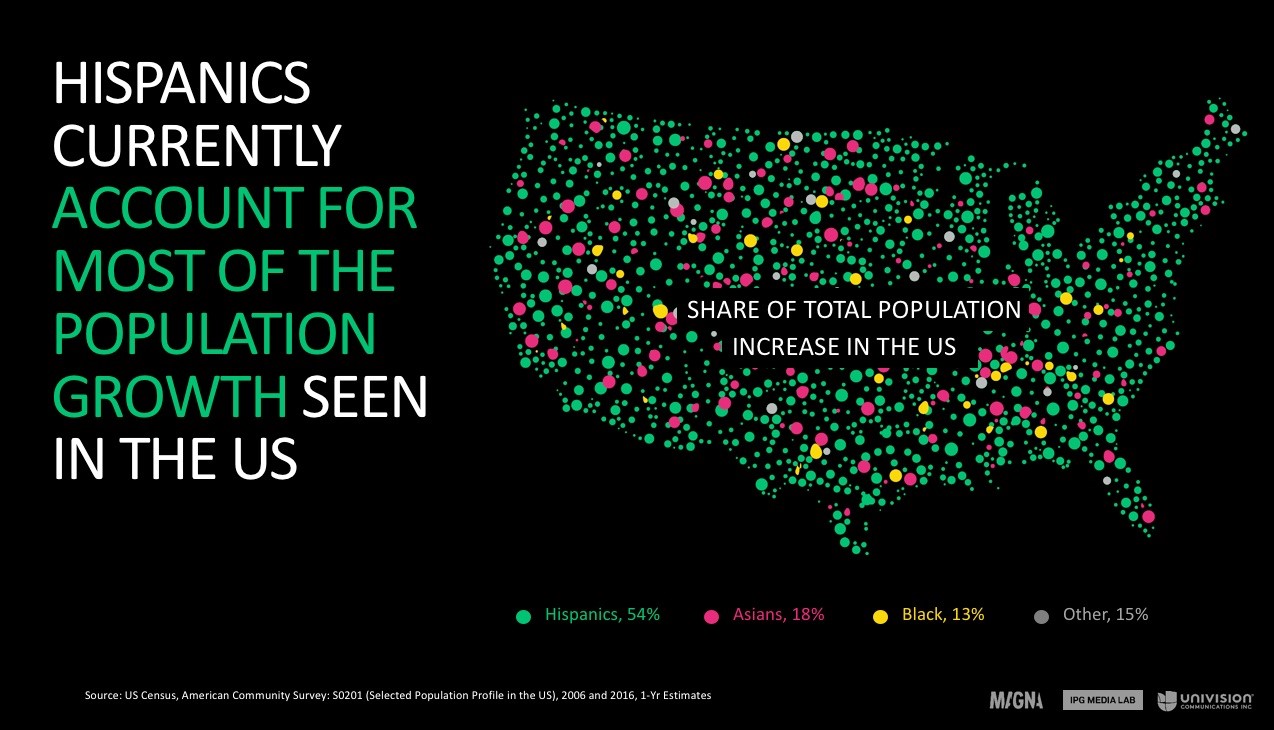
Hispanic spending is projected to grow 85% over the next 10 years and reach $1.7 trillion by 2020, which makes this market segment one of the most important consumer targets for advertisers.  But how can marketers meaningfully connect with Hispanic consumers?  MAGNA and Univision have just released the results of a seminal research study titled "Marketing to the Hispanic Mindset" that measures the impact of contextual targeting (topic, language and culture) in digital video ad experiences.

Among other key insights, the study revealed that language and culture targeting in digital video ads can double the purchase intent of Hispanic consumers and increase their emotional connection with brands.

Surveying 6,000 Hispanic consumers, the study is the first of its kind to include mobile face-tracking in Hispanic research.  "We wanted to understand the role of language and context in digital advertising, including mobile and emotional facial coding to gain deep insights," said Roberto Ruiz, Executive Vice President, Insights and Analytics at Univision.


I sat down with Ruiz and Kara Manatt, Senior Vice President, Intelligence Solutions Strategy at MAGNA to delve more deeply into how the right targeting can connect brands with the Hispanic consumer.

Charlene Weisler:  Tell me how targeting can impact ad receptivity among Hispanics.

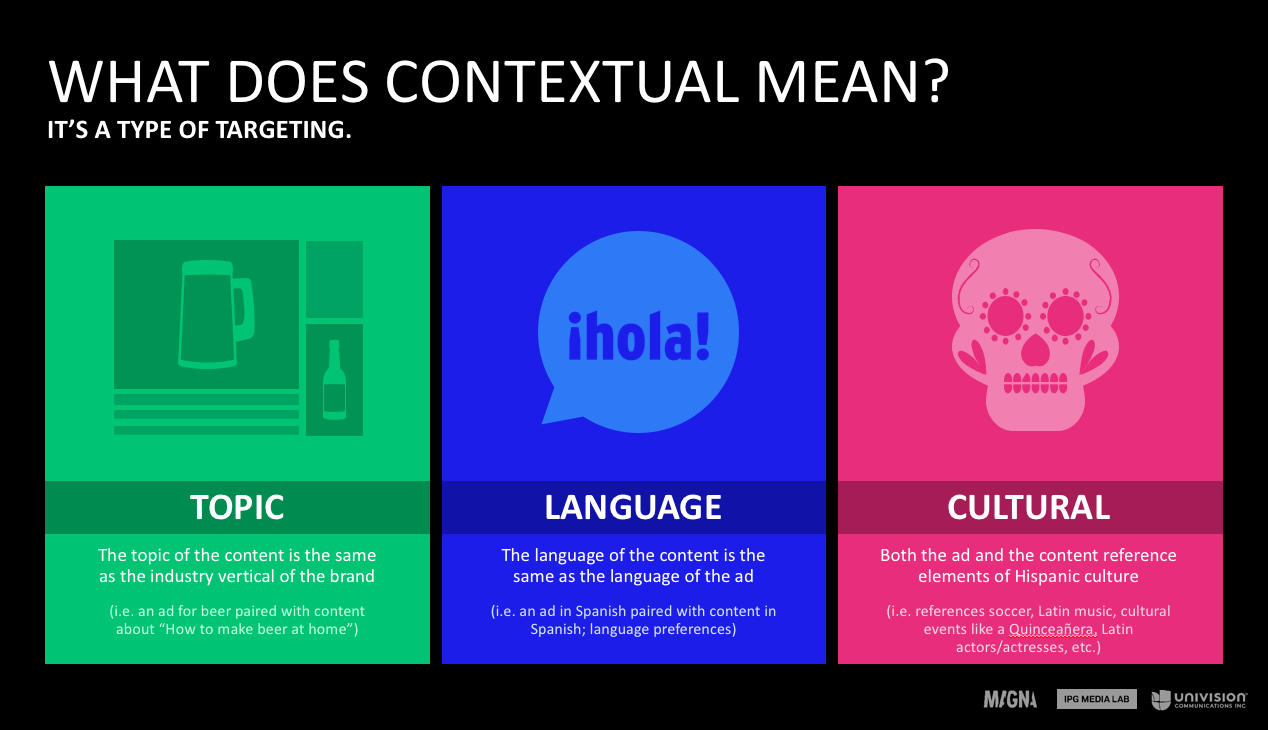
Kara Manatt:  We tested three types of targeting.  The first, Topic targeting -- when the topic of the ad is related to the topic of the content it appears in front of -- replicated what we tested among a general audience.  An example would be content on the health benefits of owning a cat that has a pre-roll ad for a cat food brand.  Obviously, there is a strong connection between the product being advertised and the editorial context in which it appears.

The second type that we explored in the study was Language targeting, which is when the language of the ad is matched to the language of the content.  For example, Spanish-language pre-roll ads that run into Spanish-language video content.


Cultural targeting was the third area; that is when an ad speaks to Hispanics through culture.  This can be a bit trickier to nail down since there are a lot of different ways to do that, such as through music, food and specific Latino events.  In Cultural targeting you align an ad that connects on a cultural level with content that does the same thing.

Weisler:  What were the major takeaways from the study?

Manatt:  The key findings for us were the big differences in persuasion metrics, particularly the really important and hard-to-move metrics like brand favorability and purchase intent.  Using language and cultural targeting to double purchase intent was the No. 1 key takeaway; we saw double the impact from merely changing the environment and not the ad.  The other takeaway was that it helps build a relationship between the brand and the consumer.  Hispanics are particularly sensitive to cultural messaging from an advertiser.  They are receptive to the brand going the extra mile by speaking to them in their own language and making that cultural connection.  This is not lost on the consumer.  Again, notably you are not changing the ad.  You are only changing the environment.


Roberto Ruiz:  We also gathered a lot of data on mobile targeting.  When we used the emotion tracking part of the study and we looked at the percentage lift in emotion due to cultural targeting versus no targeting, we saw that with cultural targeting there was more emotion expressed by the people watching the ad.  So, the fact that cultural targeting had a huge impact in emotion on ads received via computers and mobile -- in mobile we saw 60% more emotion being expressed by the Spanish dominant and bi-lingual Hispanics -- told us that cultural targeting is creating a visceral connection and driving emotion.  We know that in branding, emotional connection is really what drives equity.

Weisler:  Were there any surprises in the results?

Manatt:  It's not often we find that what is good for the brand is something that is also good for the consumer.  It is good for brand metrics, but it also leads to a better overall media experience for the consumer.

Ruiz:  It surprised me that Language targeting and Topic targeting performed the best on smartphones.  There is so little data on how to create effective mobile ads that I thought this finding was very interesting.

Weisler:  What are your recommendations to advertisers?

Ruiz:  We say that these are building blocks -- each step leads to a deeper and more profound relationship to the consumer.  Don't limit yourself to Topic targeting and Language targeting.  Take it all the way to Topic, In-Language and Culture to have very powerful digital ads.  You will see the brand KPIs go up.  This research surveyed 6,000 consumers -- a large study with a representative sample that includes non-self-reported data (data that was collected by an app) and that builds on these three targeting steps.  You can see the lift from each one.  But if brands want to do cultural targeting they have to do their homework.  They have to understand the consumer insights that connect the brand to the category, to the consumer and create a solid, culturally targeted creative ad.

This article first appeared in www.MediaVillage.com

Mar 31, 2017

Media Frenemies Gather to Share Concerns About Data


This past week I attended an off-the-record client meeting of executives from media companies AMC, A&E, NBCU, Google, Scripps, Univision, WWE and Viacom and measurement companies Nielsen, comScore and TiVo. It was convened by Gary Zander, President of Project One, to have a frank discussion about media analytics – current challenges and possible solutions – among, as Zander pointed out, “frenemies in an environment of coopertition.”

Zander’s company focuses on digital tech consulting and staffing for the Media Industry.. “This is an opportunity to discuss topics of importance. In this case it is media and TV/video analytics. No one will be quoted in the press so we can have an open dialogue,” he noted. In writing this article, I agreed to not name names and only report non-attributed opinions. I could, however, report on the opening presentation titled, Measurement in a Multiplatform World, by Lisa Ciancarelli, President of Quark Insights Consulting.

Measurement in a Multiplatform World
Ciancarelli launched into an overview of what companies need to do to formulate a comprehensive data measurement strategy. “We need to be more hands on when it comes to all of the distribution paths that our content takes,” she stated, and offered the following steps:

      1.       Define key stakeholders. Get the right people involved. Create a task force with representatives from all areas.
      2.       Focus on what drives your business. Prioritize the scope and cost. “You may not need to measure everything,” she counseled, “There are costs associated with measurement such as data transports, API, transcoding and for the services that scale by the amount of content.”
      3.       Define your business rules around the data and document them.
      4.       Set up measurement requirements and communicate across the company from ad sales and marketing to operations, engineers and content creators. If it doesn't need measurement, take it off the table.
      5.       Managing measurement by managing expectations. The only constant in digital measurement is change.

Off-The-Record Q&A
After the formal presentation, the meeting was open to a full discussion of data driven media. Here were the top points:

·       Walled Gardens are confounding data aggregation across platforms. “Every new platform comes up with its own metric,” was one complaint. “How do you know if the data is worth integrating?” and “There is no consistency across data sources,” were others.

·         Taxonomy across platforms is lacking. There is no standard content identification protocol. “A unique indicator doesn't exist’” said one executive. “We had to hire a third party aggregator so every product has its own unifier id and it does the mapping,” offered another.

·         How can the data be normalized? “We look at the data by minutes and then we have to model. It is incredibly complicated,” shared an executive. “What is a video impression on OTT for example?” questioned another. 

·         Measuring beyond minutes and views. “When does quality (like attention) get measured?” someone asked. “There is a universal truth,” another countered, “and that is that more attention is paid the closer the screen is to your face.” And yet, “Digital is very solitary,” someone stated, “I would rather see people co-viewing. We are losing that aspect if we just count views.” Another noted, “We look at retention rates. Do they come back? Is there viewing through commercial? We are looking at the user experience more holistically and using various points of engagement for attention.”

·         Tagging – from loading time to the time it takes to add tags. “One of the biggest problems we have is with tags,” one participant noted, “especially piggybacking and container tags.” Another stated, “If we want to place extra tags on a clients’ website, it takes two years.” 

·         Reconciliation of metrics across platforms. “We are living in a world of exactitude and we need to reconcile engagement on digital with Nielsen measurements,” someone noted. “What do you mean by engagement? Is engagement equal across platforms?” said another.

·         Fraud. “Forty percent of activity can be non-human traffic which is a huge deal,” someone offered and added, “It is not getting worse but it is not getting any better.” Another said, “It is a wack-a-mole game. You are getting cheated. TV is totally controlled but on the internet it is easy to set up a farm and have crazy stuff going on.”

·         Prioritization. The amalgam of data has become a focus unto itself. “We are spending too much time counting and not enough time strategizing,” one complained.

The solutions to the above are still be explored. Some conceded that “walled gardens and syndicated measurement will both be here for the foreseeable future,” while others are taking unusual and creative steps to bring data analysis into the 21st century with “the gamification of data charts,” because “traditional PowerPoint doesn't really work when there are so many dimensions to analyze.” Whatever evolves from these conversations will benefit more than just those in the meeting. The first step is always opening up dialogue.

This article first appeared in www.MediaVillage.com