 Hulu
continues to keep up with the times. When it first launched 11 years ago it was
100% desktop delivered. Now, according to Peter Naylor, Hulu’s
Senior Vice President of Ad Sales, the company is 6% desktop, 80% living room
and 100% subscriber driven.
Hulu
continues to keep up with the times. When it first launched 11 years ago it was
100% desktop delivered. Now, according to Peter Naylor, Hulu’s
Senior Vice President of Ad Sales, the company is 6% desktop, 80% living room
and 100% subscriber driven.
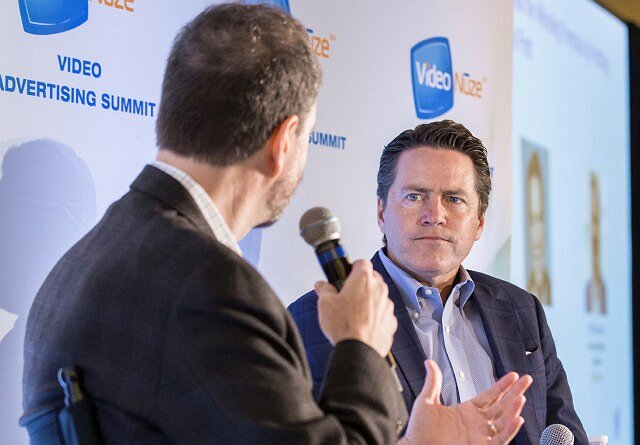
“It’s all about choice and control,” he explained
at the recent VideoNuze conference, with three different types of subscription
services depending if you want ad free or not and multi-member access. Naylor
calculated that 82 million people watch Hulu per month with 70% opting for the
ad supported version of the service.
Hulu’s
mission is relevancy and being respectful of the viewer experience. “Our
subscribers come to us for content,” he explained, and they have ample choice with
an inventory of 85,000 TV episodes. Disney recently announced that they are
planning to completely acquire Hulu. For Naylor this offers great opportunity
for the streaming service. “Control by one owner enables us to move faster and
invest more in content,” he stated, “Our international expansion will accelerate.
So we will keep doing what we are doing. We have the wind in our sales.”
Ad Pod Length Consistency
Part of
Hulu’s success has to be its commitment to consistency and standardization in a
world of multiple choices for both the viewer and the business. In striving for
consistent experiences for viewers, Naylor has had to address the inconsistencies
in ad pod lengths. “There was a time when different shows had different ad pod
lengths,” he explained, “but now all pods are capped at 90 seconds or less with
a countdown clock. And we don’t put ads where you don’t expect them to be. We
try to be thoughtful and also add as much value as possible.”
Further,
“100% of our advertising is addressable and we only charge for ads that are
completed.” Naylor and his team are data focused and also pay great attention
to social media to discern what consumers find valuable and objectionable in
their viewing experiences. “You can’t jam more ads in because you need to make
a number,” he warned, because viewers have a lot more content choices.
New Types of Ad Deliveries
“The more
time people view on demand, the more likely they are to have two to three
services and the more time they spend online,” he noted. With multiple
subscriptions, Hulu has to be very careful about ad overload and irrelevancy.
“We are trying to figure out non-intrusive ad models.” To that end, Hulu
created pause
ads which places a static contextual ad (like a coffee advertiser) on the
screen when a viewer presses the pause button. They are also rolling out a
binge watching ad product in fourth quarter for those who watch three or more
episodes in a row. “We will identify ‘bangers’ and feed them contextual ads
such as ‘Feed Yourself.’ We make the third episode commercial-free if you watch
this 90 second ad. We want to reinvent the ad model.”
For Naylor,
there exists a full spectrum of ad acceptance. “It doesn’t have much to do with
age income or geography,” he noted, “It has to do with your culture and
interests. We strive to make ads more relevant and when you use data properly,
relevance skyrockets. There will always be ad avoiders,” he added, “but they
are a minority.”
When asked how
much an ad’s creative factors into Hulu’s decision about where and how to place
an ad, Naylor responded, “Ensuring creative is relevant to the person watching
is fundamental to a viewer-first advertising experience. A relevant creative
means a better experience for the viewer and better results for the
advertiser.”
The Future
Naylor’s
view of the future is focused on a world of connectedness and expansion,
courtesy of technological innovations. “I can’t imagine a scenario where every
television household in America isn’t someday connected to an IP address,” he
explained. “While I don’t know what percentage of TV advertising is going to
become addressable in the next two years or how long it will take us to get to
a fully addressable future, I know the market is undeniably going in one
direction with the help of market forces like 5G, ATSC 3.0 and the rise of on-demand,
OTT viewing.”
He sees
Hulu’s dominant place in the media firmament. “Today Hulu is the largest fully
addressable marketplace in OTT, offering brands the opportunity to target and
reach valuable audiences that are no longer found in broadcast television or
via MVPDs,” he stated, “We’re offering the best of both television and digital
and brands are coming to realize that OTT should be their first stop for TV in
their marketing mix.”
This article first appeared in www.MediaVillage.com


