Showing posts with label emotional attachment. Show all posts

Jul 1, 2024

Matching Ads with Emotional Context to Programming. An AI Approach with Wurl

Wurl, a connected TV adtech company owned by marketing platform AppLovin, has embarked on an interesting approach to ad monetization. Partnering with BrandDiscovery with its GenAI-powered contextual targeting, Wurl is said to be able to, “precisely match ads with the emotion and context of programming in real time,” according to Wurl’s VP of Business Development for Agencies and Brands, Peter Crofut.

He explained that by aligning an ad’s emotion to the content’s emotion, brands can improve viewer memorability and campaign engagement which he says, “ultimately drives stronger outcomes and performance. Our own data has shown that advertisers can experience a significant uplift in conversion of 2-3x when they find moments of emotional resonance.”

Charlene Weisler: How does the AI matching component work?

Peter Crofut: Wurl uses GenAI to analyze the emotion of the content in the scene closest to the ad break. That analysis is based on Robert Plutchik’s wheel of emotions which includes eight primary emotions at three different intensities (high, medium, and low) that can be combined to represent the full spectrum of human emotional states. Once the emotional score for the scene is determined, it is then matched to an ad with a similar emotional score. This prevents viewers from having a jarring experience where, say, they’re crying from watching a sad scene and are then disrupted with an overly upbeat ad. When scenes and ads are misaligned that’s where negative attention can be created for a brand.

Weisler: What data is collected – how is the platform measured?

Crofut: To determine the emotional segments of the content for BrandDiscovery, we leverage GenAI to view and analyze content from a variety of different sources including images, sound, and text. From there, BrandDiscovery assigns, at a scene level, the corresponding emotional value as determined by the AI. Notably with GenAI, we offer scene-level targeting through BrandDiscovery as opposed to categorizing an entire program, series or channel under any one contextual category. Equally, BrandDiscovery’s targeting is free – we don’t charge any data fees for emotional segments. In terms of measurement, we work with independent partners like EDO and Kantar to look at things like campaign effectiveness, brand awareness, brand favorability, and purchase intent for BrandDiscovery campaigns.

Weisler: How does scene-level analysis work?

Crofut: BrandDiscovery was born out of a curiosity to consider whether or not ads that were emotionally aligned with content perform better. During initial testing, we discovered that the most significant correlation with ad engagement took place when the emotions depicted in the scene just before the ad break aligned with those portrayed in the ad creative. As a result, Wurl developed its own GenAI models trained against millions of assets to analyze content in real time. As noted earlier, we use Plutchik’s wheel of emotions to determine the emotional score of the scene, and then match it with an ad that scored similarly. This analysis is calculated in real time across FAST (free ad-supported streaming TV) channels just before the ad break for highest relevance.

Weisler: Can you give an example of what a campaign looks like?

Crofut: We recently partnered with Media.Monks, who was tasked with executing a CTV campaign for a financial services client to expand its audience, improve awareness, and ultimately boost purchase intent. Using BrandDiscovery’s emotion-based targeting to run CTV ads across Wurl’s network of premium content publishers, Media.Monks was able to bolster the resonance of their client’s brand messaging and optimize targeting for more impactful brand engagements. The client saw a 7x lift in aided brand awareness and 2x lift in purchase intent compared to five-year industry benchmarks for Lending brand impact studies.

Weisler: What are the opportunities here?

Crofut: CTV offers massive potential for brands to connect with audiences in meaningful ways, especially as the biggest screen in the home. And, while contextual targeting on CTV certainly isn’t a new concept, we’re confident in the idea that emotions-based targeting is truly reshaping how we think about this approach today. By aligning ads based on the emotional context of the scene right before the ad break, brands can meet audiences where they already are and not just increase attention, but increase positive attention among viewers.

Weisler: What are the challenges?

Crofut: Media buyers today face a fragmented CTV ecosystem with multiple walled gardens and no standardized metadata – one movie or TV show could be categorized as multiple different genres depending on where you look. And, while CTV offers a significant step above linear in that it offers the ability to control who sees an ad, it still lacks control over the placement of the ad. All of this has resulted in limited transparency into where ads are displayed and in what contexts, ultimately contributing to the fact that advertising dollars have not kept pace with the shift in viewership from linear to CTV. By aligning ads’ emotions with the emotions of the programming, brands can have more confidence that their ads will show up in the appropriate context and better resonate with audiences.

Weisler: What are your next steps?

Crofut: In advertising, we hear a lot of talk about finding the right user at the right time with the right ad – though, in reality, we don’t really know what “right” is. As with all AI-driven innovation, the technology only gets stronger over time as it learns from more inputs. Right now, we’re in the early stages of seeing brands utilize emotions-based contextual targeting on CTV – as more advertisers adopt this approach, we’ll have even greater knowledge to learn and grow from as an industry and help us define what the “right” context truly is.


 This article first appeared in Mediapost.com 

Artwork by Charlene Weisler

Dec 7, 2017

A New Way to Buy Media in a Time of Shifting Viewer Patterns


This could be termed the era of consumer empowerment where brands must work hard to gain attention and purchasing patterns that lead to loyalty. Brand affection is pivotal. 

Gary Reisman, Founder and CEO of LEAP Media Investments , recently released an article on brand loyalty among airlines. But emotional attachment to brands extends to every product category. “It’s important for anybody, not just airlines ... the point is, as we've always said, that people buy things not based on being 18 to 49 or having done something six months ago or two days ago. They buy things because they have a desire. And that desire is built on a need,” he stated.

This, coupled with that fact that viewing patterns are shifting,  is leading the industry down a very dangerous path, according to Reisman. “By relying too heavily on data and technology while chasing scale for scale sake to drive revenues, we are killing the industry drip by drip” he laments. “I’m sensing that agencies and ad tech vendors alike seem to have forgotten why we are all here in the first place – to help marketers develop and execute strategies that build consumer relationship and sell product.”

What is the solution? For one, it is taking a step back and considering the value of the brand affection of the consumer beyond the raw data and the technology that drives it. From the marketers’ perspective, how do we discover which content, among the vast array of choices out there, bests connect with their brands' most passionate high potential consumers? And how do we narrow down the overabundance of choices even on a single media outlet? 

“By flipping the current TV model on its head," declared Gary Reisman, Founder and CEO of LEAP Media Investments, who offered the following strategic media recommendations:  

      1.       STOP buying content the way you are used to. Funneling money to content providers (e.g. networks) or specific content (such as shows) and “hoping” your most-likely prospects will be present and engaged. This is old school thinking. Historically, in a reach-based world this may have made sense but, today, not so much. These only act as surrogates for actual audiences because you are essentially seeking content that you infer may have a high concentration of your desired consumers. In fact today, there are more savvy ways to effectively target those consumers who you believe to be brand engaged and open to your brands messaging. In this way you are no longer targeting “proxies” but actual, high potential consumers. 

      2.       ACCEPT the fact that your brand targets are going to flow through numerous media platforms (TV, social, mobile, et al) at will. You have absolutely no control over it and cannot model for that behavior. But you can prepare for this consumer journey but crafting your message in a way that connects to your prospective consumer segments you have and then …

      3.       USE a “Customer First, identity-driven Approach” that identifies consumers more likely to engage with your brand messages and tags those prospects. This way you can follow your high potential targets, regardless of which content they chose to engage with. Follow these tagged consumers throughout their customer journey in linear, digital, social and mobile media.

Reisman added, “That’s why we developed our marketing and branding based model at LEAP. That is, to enable advertisers to first identify and tag their brand’s engaged and emotionally connected consumers and then serve ads to those customers throughout the media ecosystem. It’s identity-based marketing and where the market needs to go.”  Importantly, we should be leveraging the vast array of data and technology at our disposal, but toward goals primarily aimed at connecting with consumers that matter most to our marketer clients. 

As Cindy Davis, Executive Vice President, Consumer Experience, Disney | ABC Television Group stated recently, the next generation of viewers is different from previous generations and the survival of certain brands is at stake. Reisman agrees: "While change is difficult, the world has changed," he noted, and added, "brand marketers, agencies and media companies must all change our ways or we might just be left in dust."

This article first appeared in www.MediaVIllage.com

Sep 15, 2017

Gen Z vs Millennials. Trends in Brand Attachment Yield Insight


Gen Z and Millennials are very different generations in terms of their life experiences, attitudes and, according to Gary Reisman, CEO and Founder of Leap Media Investments, their emotional attachment to brands. “The challenge is to understand trends.  What do differences in the brands Gen Zs are attached to (or not) vs. their older counterparts tell us about important future market dynamics and who might be the winners or the losers over the next 5-10 years?” Reisman posed. “The differences in brand attachment hold the key to future brand profitability,” he said.

His company, LEAP, develops scaled digitally targetable audiences based on the level of Emotional Attachment consumers have to specific brands.  Part of their offering includes a Brand Intelligence database that tracks Emotional Attachments to over 400 brands across Gen Z, Millennial and Baby Boomer Cohorts.  The insights and learnings can be fascinating. For example, there are many brands that are favorites with both generations, such as Microsoft, Apple and Target, while 13-17 year olds prefer  brands that make sense to the very young such as consoles (Xbox, PlayStation), games (Call of Duty, Final Fantasy), high sugar content sodas (Coca Cola, Pepsi, Mountain Dew) and the usual fast food and casual dining establishments. “Apparently they have not had to hit the gym as hard as the Millennials have … just yet,” but added that “Some brands like YouTube, Samsung and Spotify, are much more highly valued among Gen Z than Millennials indicating great future growth and potential.”

For other brands, Reisman offered a more ominous appraisal: “Some brands either have not achieved or are losing emotional attachment with Gen Z compared to Millennials at an alarming rate,” indicating a harsh future to maintain market share and profitability. “I am referring to you Facebook, Pandora and Amazon,” he intoned.  The reality is that each point of Emotional Attachment can equal hundreds of millions of dollars in revenues and life time value.  

Below are additional interesting findings:

Next Gen Social Media…
While 42.6% of Millennials are highly attached (or extremely unlikely to give up) Facebook, only 27.6% of Gen Zs are similarly attached – a 54% difference in market size.  At the same time Snapchat is much more attaching among Gen Z compared to their older counterparts

                                P18-34                  P13-17                  Gross change
Facebook            42.6%                    37.6%                    -15.0
Snapchat             27.5%                    38.7%                    +11.2

Next Gen Viewing Behavior Trends
It has been reported that TV attachment and viewing levels are evolving among younger generations.  LEAP data suggests forms of viewership may be changing as well. YouTube is actually the brand with the highest emotional attachment, ranking #1 among all brands among Gen Z.  At the same time you can see that attachment among longer form content providers – including Netflix and Hulu - is less so.  “To me this could indicate that Gen Zs prefer shorter form content” Reisman noted.  “The jury may still be out on the future winners of content distribution, but the fact that YouTube is the brand that they most likely to say they are unwilling to give up should be taken very seriously.  Also brands like HBO have a long way to go to seriously compete for relevance among the Gen Z population.”

                                P18-34                  P13-17                  Gross change
YouTube              52.5%                    61.0%                    +8.5
HBO                       29.4%                    19.1%                    -10.3
Showtime           17.3%                    14.6%                    -2.7
Netflix                  55.1%                    52.4%                    -2.7
Hulu                       23.3%                    20.5%                    -2.8

Winners vs. Losers
There are many examples of which brands within a variety of categories are faring better with Gen Z consumers.  For example: Spotify seems to be the choice of a new generation while Pandora is may have trouble.  “If I were a betting man, I’d definitely invest more in Spotify than Pandora based on the shift in Emotional Attachment for Spotify vs. Pandora,” Reisman stated. 

                                P18-34                  P13-17                  Gross change
Spotify                  25.0%                    33.1%                    +8.1
Pandora               28.8%                    23.8%                    -5.0

Many examples are available within Leap’s audience dataset where all of the 400 measured brands can be reviewed to understand what level of effort each brand needs to exert to maintain and build marketing penetration moving forward. 

Conclusion
What leading indicators are most revealing for your brand’s revenue success with the next generation of consumers? According to Reisman, LEAP’s data provides marketers with critical information regarding the consumers who are highly attached or less attached to their brands. Their Brand Intelligence Database also provides a treasure trove of information regarding brand trends in future market size and is a key indicator of future revenue potential.

“Our objective is to help marketers improve the ROI of their marketing efforts and target audiences more likely to engage with their brand.  LEAP’s Emotional Attached audiences help us do that for them,” stated Reisman. “That said, the data can also be used to understand interesting market trends and point out brand deficiencies among next gen markets,” he concluded.

This article first appeared in www.MediaVillage.com
 

Aug 15, 2017

LEAP Ramps Up to Enable Instant Buys via LiveRamp

In a move designed to make advertisers and brands more enthusiastic about audience buying, LEAP Media Investments has created a partnership with people-based audience clearing house LiveRamp.  LEAP's patented process helps marketers identify and activate audiences who are deeply and emotionally connected with specific brands. The partnership, which includes LiveRamp modeling and scaling partner Tru-Signal, means marketers can easily and quickly buy and reach audiences at scale who are hyper-engaged with a brand.

"Now marketers and agencies just have to go to one platform to find and select audiences made up of their most engaged and emotionally attached consumers from over 100 different platforms -- digital online to social to TV," explained LEAP Founder and CEO Gary Reisman.  "This is no small feat!"
He shared more with me in a recent conversation.

Charlene Weisler:  Why is the addition of LEAP so important to marketers and advertisers?

Gary Reisman:  LiveRamp is a platform that provides easy onboarding and distribution of audiences for a variety of companies in the market.  It's essentially a clearing house for audiences.  Companies provide their audiences to LiveRamp which then provides the technological platform to transfer those audiences to many distribution partners which marketers and/or agencies can use to target those audiences.  The addition of LEAP makes our audiences easily available on any of these platforms in real-time.

Weisler:  How does it work?

Reisman:  First we measure consumers' emotional attachment for 400 brands.  We've identified the most enthusiastic fans through what we call "potential conquests" to the less loyal "expansions."  In our partnership, we delivered our two most desirable seed audiences to LiveRamp which then worked with its partner Tru-Signal to model and scale.  The result was that Tru-Signal developed a customized, high-fidelity scaling of each "enthusiasts" and "conquests" audience -- both very large groups that consist of between 6 million to 20-plus million targetable impressions depending on the brand and audience ("enthusiasts" vs. "conquests").

LiveRamp then integrated these scaled audiences in their buying platform.  Marketers and agencies can now tap into the platform through a website, look for our audiences and, with a quick click, send them to their preferred distribution partner (DMP/DSP, etc.).  So let's say GroupM has an upcoming campaign for Jaguar and wants to target Jaguar LEAP "enthusiasts" audiences: They can get the scaled audiences immediately and transfer that audience to their trading desk to use in their media purchasing decisions.  LiveRamp's distribution platform connects to rich media supply partners where the marketer can target the LEAP Jaguar "enthusiasts" within that supply with their advertising.

Weisler:  So, the LiveRamp platform adds faster, easier access to LEAP audiences?

Reisman:  Yes, exactly.  Basically, through the click of a mouse.  Want to target Pepsi "enthusiasts" on AOL?  Go for it!  Want to target those audiences on Adobe, The Trade Desk, Videology, etc.?  Now it's much easier to do -- like buying media.  Any publisher or ad tech platform that wants to sell LEAP audiences on their platform can easily download our audiences into their platform.  Think of these distributor platforms in the same way that a cable network would use the cable operators to distribute their networks.  LEAP's audiences can now be widely and easily distributed and used for targeting.  Our highly emotionally attached audiences are available for over 400 brands across 25 categories, including Auto, Tech, Telecom, Gaming, Travel, QSR, Casual Dining, Beverages, Snacks, Banking, Finance, Credit Cards, Retail, Home Improvement, Cosmetics and OTC Healthcare.
I believe success comes to those who understand just who their most engaged, emotionally connected audiences are.  Think of it … how do you really evaluate media before you buy it?  You want to buy media that you believe contains more people more likely to engage with and act on your ad messaging.  LEAP audiences provide a direct line to serve ads directly to the highest potential consumers.  The LiveRamp partnership adds the ability to target those prospects across any platform.

This is why we're so excited: Together we're really helping marketers and advertisers better align their strategic planning efforts in their DMPs and better identify and buy their most enthusiastic consumers at scale.

This article first appeared in www.MediaVillage.com

Aug 2, 2017

Leveraging Millennials' Emotional Attachment to Brands Using LEAP

Brands want to feel the love, especially from Millennials.  Among the most challenging aspects of marketing and branding efforts today is ascertaining if, and exactly how, a brand is connecting with its consumers and how healthy this attachment is for long-term consumer affection.  With today's biggest focus by both agencies and media companies on Millennials, there's more need than ever to understand more about their preferences, the connectors that bind this demographic to a brand and what the long-term prospects and opportunities are for brands to more closely connect with this group. 

Katerina Sudit, Managing Partner, Executive Lead at Mindshare, believes that the biggest challenge to brands today is the "commoditization of established brands," especially for Millennials, because "the importance of the brand for Millennials is paramount."  She notes that it is vital for large brands to connect with the consumer, as in "what is it you are doing for them, not what it is you are selling to them. It is not just about the message," she says.  "It is about the value-based engagement plan."

From agencies to media companies, it's clear that Millennials in particular must experience a brand attachment that speaks personally to them. Mary Kate Callen, Senior Director, Velocity Culture and Creative Insights, Viacom, found through her research that Millennials value authenticity and have a stronger sense of relationship.  "Will brands take this to the next level of what being a person really is?" she asks.  "(Millennials) have complex, dimensionalized values and that is a difficult thing for brands to nail."

How can advertisers be sure that their brands are connecting with Millennials?  "We know most purchase decisions are emotionally based," says Gary Reisman, CEO of LEAP Media Investments, whose company has a patented process that tags thousands of individuals to form audiences with levels of emotional attachment to hundreds of brands and media properties to maximize advanced TV planning and buying.  "That means brands with whom we have the strongest bond -- whose features and benefits, and values, resonate most with us -- will win at check out three out of four times."
The higher the emotional attachment to a brand, the less willing a consumer is to give up the brand; the greater the attention paid to messages from that brand, the greater the advocacy on social media and the higher the sales.  "Every brand has its own business plan and strategic needs," notes Reisman.  "LEAP has developed audiences across 25 categories that allow marketers to target consumers based on the level of emotional attachment they have to some 400 brands."

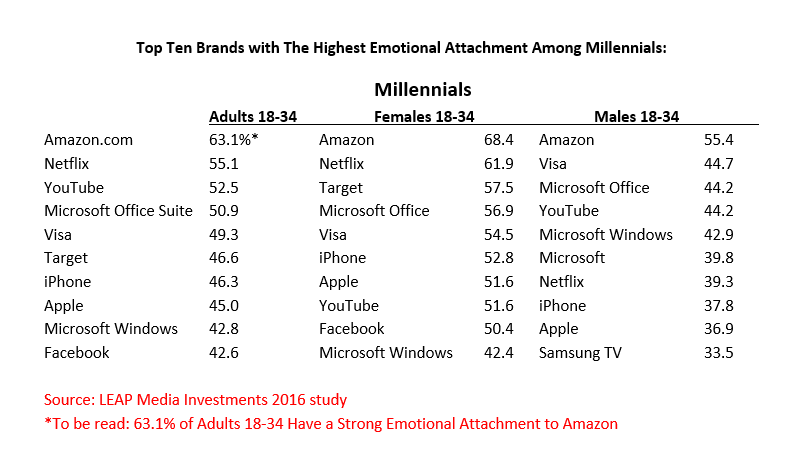
One clear winner among Millennials, according to LEAP, is Amazon, which has the greatest emotional attachment by both men and women.  Other brands in the top ten include Netflix (although it is stronger among women than men), Microsoft Office and Windows, YouTube, Visa, iPhone and Apple.  Differences are revealing: Women are more highly attached to Target and Facebook while men are more highly attached to Samsung.


"The marketers we work with who leverage the LEAP Enthusiasts audiences really find they're stimulating immediate sales and social sharing, which is so important in today's media marketplace," says Reisman.  "They're also able to target what we call the 'Conquests audiences,' which are moderately attached to the brand but help further solidify brand attachment and gain market share."
So, in this era of fragmentation and increased competition, the advantage of a strong emotional attachment to a consumer can't be understated. Millennials, with their own unique attractions to specific brands, will be dictating the purchasing patterns and brand affiliations of the future.  Smart and strategic brands will focus on emotional attachment as a way to insure future growth and loyalty among these pivotal consumers.

This article first appeared in www.MediaVillage.com


Jul 27, 2017

Leveraging Millennials Emotional Attachment to Brands Using LEAP


One of the most challenging aspects of marketing and branding efforts today is ascertaining how one’s brand connects with consumers and how healthy this attachment is for long term consumer affection. Today, the greatest focus for both agencies and media companies is on Millennials – what are their preferences, what are the connectors that bind this demographic to a brand and what are the long term prospects and opportunities for brands to more closely connect with this cohort. 

Agency executive, Katerina Sudit, Managing Partner, Executive Lead at Mindshare, believes that the biggest challenge to brands today is the “commoditization of established brands,” especially for Millennials because, “the importance of the brand for Millennials is paramount.” She notes that it is vital for large brands to connect with the consumer in, “what is it you are doing for them, not what it is you are selling to them. It is not just about the message. It is about the value-based engagement plan.” 

Media executive Mary Kate Callen, Senior Director, Velocity Culture and Creative Insights, Viacom, found through her research that Millennials value authenticity and have a stronger sense of relationship. She asks, “Will brands take this to the next level of what being a person really is? (Millennials) have complex, dimensionalized values and that is a difficult thing for brands to nail.”

From agencies to media companies, it is clear that Millennials in particular must experience a brand attachment that speaks personally to them. How can advertisers be sure that their brands are connecting with Millennials? Gary Reisman, CEO of LEAP Media Investments, has an answer. His company has developed a patented process which activates audiences that are connected with specific brands across all media platforms - online, social, mobile and in advanced TV planning and buying.
“It’s widely known that over 75% of our purchase decisions are made based on emotion – meaning the bonds and relationships we have with brands and products yields relevance and meaning that drive us to engage and purchase brands and products,” Reisman explains.

 The higher the emotional attachment is to a brand, the less willing a consumer is to give up the brand, the greater the attention paid to messages from that brand, the greater the advocacy on social media and the higher the sales. “Every brand has its own business plan and strategic needs. LEAP has developed audiences for over 400 brands across 25 categories.  LEAP audiences specifically allow marketers to target consumers based on what level of emotional attachment they have to their brands” notes Reisman. 

According to LEAP, Amazon is a clear winner among Millennials with the greatest emotional attachment for both females and males. Other brands in the top ten for Millennials include Netflix (although stronger among women than men), Microsoft Office and Windows, YouTube, Visa, iPhone and Apple. Differences are revealing: Women are more highly attached to Target and Facebook while men are more highly attached to Samsung.

The top ten brands with the highest emotional attachment among Millennials are:

                                                                                                Millennials
Adults 18-34                                      Females 18-34                                  Males 18-34                      
Amazon.com        63.1%*                 Amazon               68.4           Amazon                     55.4
Netflix                  55.1                      Netflix                  61.9           Visa                           44.7
YouTube              52.5                       Target                   57.5           Microsoft Office       44.2
Microsoft Suite    50.9                      Microsoft Office   56.9          YouTube                    44.2
Visa                      49.3                      Visa                       54.5          Microsoft Windows   42.9
Target                   46.6                      iPhone                   52.8          Microsoft                   39.8
iPhone                  46.3                       Apple                    51.6          Netflix                       39.3
Apple                   45.0                       YouTube               51.6          iPhone                        37.8
MicrosoftWindows    42.8                      Facebook               50.4        Apple                          36.9
Facebook             42.6                      Microsoft Windows     42.4        Samsung TV               33.5

                                       
Source: LEAP Media Investments 2016 study
*To be read: 63.1% of Adults 18-34 Have a Strong Emotional Attachment to Amazon

“The marketers we work with leverage the LEAP Enthusiasts audiences to stimulate immediate sales and social sharing, which is so important in today’s media marketplace. At the same time they also target their Conquests audiences who are moderately attached to the brand to further solidify brand attachment and gain market share,” stated Reisman.

So in this era of fragmentation and increased competition, the advantage of a strong emotional attachment to a consumer cannot be understated. Millennials, with their own unique attractions to specific brands, will be dictating the purchasing patterns and brand affiliations of the future.  Smart and strategic brands will focus on emotional attachment as a way to insure future growth and loyalty among these pivotal consumers.

This article first appeared in www.MediaVillage.com