Showing posts with label smartphones. Show all posts

Jul 2, 2019

Nielsen Reveals the Trends in American Video Consumption

According to the most recent Nielsen Total Audience Report, viewers are essentially creatures of habit. Overwhelmed by ever increasing content choices, Nielsen has found that viewers tend to stick with their familiar favorite shows. But, as Nielsen points out, as much as this is difficult for consumers, it is equally if not more difficult for content creators, programmers, platforms and marketers. “After all, if their efforts fail, consumers spend more time searching and less time consuming,” the report states.

Here are the takeaways:
  • Almost two-thirds of adults who stream video content are likely to watch when know exactly what they want. One-third will watch when they have a rough idea and only 22% watch when they don’t know what they want before diving into the options.
  • When faced with a decision of what to watch, 58% of users said they were more likely to go back to their favorite traditional channels if they couldn’t make a decision, 44% will scan through traditional channel options, 39% scan the program listings and 31% browse their DVR recordings.
  • SVOD users are less likely to scan their subscription content menus. Only one-third of adult respondents say they browse their SVOD content menus for more content, while 21% say they would simply opt out of watching anything if they couldn’t choose.
  • U.S. Adults have a large overall cross-media diet, spending 11 hours and 27 minutes per day interacting with media, up 21 minutes of additional media exposure across all platforms compared to 1Q2018.
  • Video viewing through TV-connected devices increased by 8 minutes daily, and as consumers replace old TV sets with TV screens preloaded with connected options, they’re adopting smart lifestyles.
  • Seven in 10 homes now have a subscription video on demand (SVOD) service and 72% use streaming-capable TV devices.
  • The group most susceptible to indecision is Adults 18-49. Younger adult viewers 18-34 are more likely to explore different viewing options. They’ll flip through menus, check out programs that have been recommended for them and step outside their traditional content comfort zones. But they also tend to rely on another “extreme” route, as they are reported to tune out all together at higher levels compared to other demos. They are also increasingly moving off the glass, spending over half of their daily media usage with digital media such as computers, smartphones, and tablets.
This article first appeared in Cynopsis

Dec 15, 2017

Discovery Influencer Viewers Alleviate Boredom with Smartphones


Smartphones are not only a great way to connect us to the world; they are also a good way to stave off boredom, according to Manu Singh, Group VP Commercial Insights and Digital, Discovery Communications. Discovery recently released the results of a new study on smartphones that demonstrates their ubiquity among society’s most influential consumers. 

As part of Discovery’s initiative to better understand trendsetters, the company embarked on a series of research studies designed to better understand attitudes and trigger points for a range of behaviors and purchases. They identified consumers who set the pace in technology, purchasing and viewership to comprise their panel, and extracted some compelling – if not surprising data.  As always, influencer studies may not be reflective of mass population, they are invariably the indicator of the next tipping point. 

“Our ever- increasing reliance on Smartphones to navigate and manage our lives makes it a deeply personal purchase for consumers”, said Manu Singh, Group Vice President, Commercial Insights and Digital, Discovery Communication. “Certainly, at a time when engaging on a more 1:1 basis is an imperative, providers and brands should consider opportunities to align with consumers’ relationship with their devices when looking to communicate plan benefits and brand features.”

Here are the key takeaways:
      1.       Smartphones are a must-have. 78% of Discovery Influencers don’t go anywhere without their smartphones and close to half (49%) spend more than 3 hours a day on their phones. The majority of them (65%) agree that their smartphone makes them feel more connected to the world.

      2.       Highly entertaining. But smartphones play an even greater role than that – they have become a go-to entertainment source when boredom hits. Seventy-three percent report that they turn to their phone when they are bored.  The spend their time browsing the internet (82%), on social media (75%) or watching TV/video content (41%).

      3.       Good Service. Consumers are happy with their providers. 76% of Discovery Influencers are satisfied with their current smartphone provider. Younger owners are even more satisfied with their current provider. Millennials are more likely to say they are “Very Satisfied” with their current smartphone provider than older viewers (35% vs 28%).

      4.       Eager early adopters. While very satisfied with their service providers, Discovery Influencers are eager to adopt the latest and greatest innovations for smartphones. . Nearly 1 in 4 Discovery Influencers are looking to upgrade or buy a new phone and 90% of this group plans to do so in the next 6 months.

      5.       Phone calls? C u l8r. Unlimited texting is the way to go.  Texting trumps all other forms of communication, with 66% of respondents saying that text message/iMessage is the preferred way to connect with friends and family. With such a high rate of Discovery Influencers opting for messaging, having unlimited texting is an absolute must-have. Being able to decode your family/friends’ text messages requires a whole other plan! 

      6.       I Want an Apple phone. Among all brands of smartphone, Apple ranks #1 as the best fit for their lifestyle and is also considered the most reliable, most trusted, and the highest quality.  However, Samsung is not far behind. Coming in at a close second for all the above qualities. Samsung emerges as a winner when it comes to price, with Discovery Influencers giving credit to the brand for having the best prices.

      7.       Millennials have a love/hate relationship with their phones. For Millennials, smartphones are an integral part of their lives Millennials live off their phones, using them for many more purposes than older (35-54) Influencers from shopping online (71% vs 52%) to buying groceries or ordering takeout (45% vs 27%) and watching TV or Video content (70% vs 37%). Yet, Millennials are twice as likely to describe their smartphone as “stressful” and 29% say their smartphone makes them feel lazy. And on an even sadder note, 20% of Millennials say they think their partner loves their smartphone more than them.

Discovery’s research has confirmed what most of us instinctually already knew – that smartphones play an outsized role in our lives, bringing ease and convenience -- but also stress and feelings of inadequacy.  Maybe there is a psychiatrist app for that?

This article first appeared in www.MediaVillage.com

Oct 17, 2017

Zenith Predicts Smartphone Penetration Will Reach 66% Worldwide

Forget your old flip phone.  The world is going totally smartphone, according to Zenith's Mobile Advertising Forecasts 2017, which was released today.  This impressive growth in smartphone adoption will pose both opportunities and challenges to advertisers and brands.

Among the findings in the forecast:  Western Europe and Asia Pacific continue to lead the world in smartphone ownership.  In 2018 66% of individuals in 52 key countries will own a smartphone, up from 63% in 2017 and 58% in 2016.  Those countries projected to have 90%+ penetration in 2018 include the Netherlands (94%), Taiwan (93%), Hong Kong (92%), Norway and Ireland (each at 91%).  Further, eleven markets will have penetration levels between 80% and 90%, all of them in Western Europe and Asia Pacific with the exception of Israel, where penetration will be 86%.  In terms of total number of users, China leads all other nations with 1.3 billion users, followed by India with 530 million users and then the U.S. with 229 million users.

While overall penetration of smartphones is reaching ubiquity to as much as 80% to 90% of populations in the world's most advanced markets, the actual rate of smartphone growth is projected to be only 7% year-on-year in 2018 compared to 10% growth in 2017, 14% in 2016 and 21% in 2015.

What does this bode for advertisers and brands?  "Brands need to design all their online communications for mobile viewing," says Jonathan Barnard, Zenith Head of Forecasting and Director of Global Intelligence.  "These communications need to look good on the small screen, grab the viewer's attention immediately and convey their messages quickly while their attention remains focused."

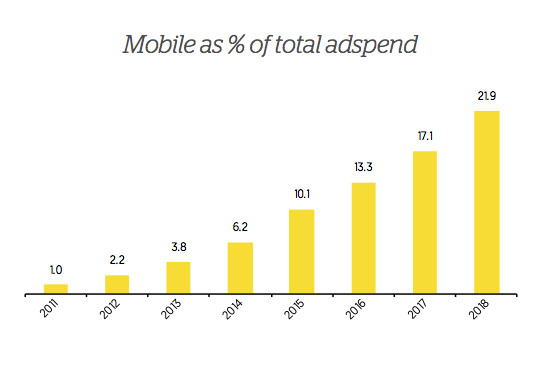
In addition to smartphone device growth, the importance of mobile will increase and will impact ad spend buying decisions.  The report notes that 53% of all Internet ad spend will go to ads viewed on mobile devices in 2017 and is forecasted to account for 59% in 2018 and 62% by 2019.  The amount of ad spend on mobile has surpassed that of desktop ads for the first time ever this year.  In addition, mobile devices are the primary means of accessing the Internet right now.  Users spend 70% of their Internet time on mobile in 2017 and this will grow to 73% in 2018 and 76% by 2019. "For most consumers and advertisers, the mobile Internet is now the normal Internet," posits Barnard.

Tablets, on the other hand, are losing appeal and projected to stabilize at 20% worldwide penetration.  China is distinctly unimpressed with tablets where their penetration is just 4.8% this year, compared to 85.4% for smartphones.  Tablet penetration is even declining in Thailand.  According to the report, tablets are usually household-owned as opposed to smartphones, which are individually owned, and the ability to attain a smartphone with a larger screen negates the need for a tablet.

The conclusion?  Mass uptake of smartphones and other mobile devices means increased contact between brands and consumers -- whether paid advertising in third party content, branded content exposure or stepped-up social media engagement.  It also facilitates new opportunities for consumers to connect to media content whenever and wherever they are and thus to broader brand experiences.

This article first appeared in www.MediaVillage.com

Nov 1, 2012

Surviving Sandy with “Old” Media


The past week has been a sobering lesson in what works and what doesn’t work during a disaster. My personal experience has been nothing compared to those who suffered grievous losses, some still displaced. It is heartbreaking and we hope that conditions improve immediately. There are many ways to volunteer and contribute 

We think we are connected all the time. We comfort ourselves that with all of our virtual and technological devices we can keep in touch any time any place. And with the ability to access the Internet, we can get the news easily and effortlessly no matter what catastrophe befalls us.  Well throw that idea out the window. 

We lost our electricity at 815p on Monday night. About that time, as my AT&T iPhone was half charged, I could call family and friends to give and receive updates. But the battery drains quickly so I shut it off to save it for the next day. I shouldn't have. The next day I had about half a battery charge left but there was no signal in all of lower Manhattan so there was effectively no service. Isolated on an upper floor of an apartment building as neighbors left in droves, it is remarkable that one can be in the middle of a city but suddenly realize that help was just a little too far away should we need it immediately. 

I am so happy that I am married to a luddite - someone who still has a flip phone and who listens to his transistor radio every morning. Those vital items were our only access to the outside world at home for the week since Hurricane Sandy hit. All of our state of the art devices failed.

Our bundled Time Warner service - including the landline which we keep for emergencies- went out with the electricity.  I guess that "landline" phone will be good for any emergency as long as we don’t lose our electricity. 

My husband’s Verizon flip phone worked beautifully and held its charge through the first four days. He also started to receive text updates from Con Edison as soon as the electricity went out .... which my smartphone never did. 

His trusty transistor radio kept us informed, provided a modicum of entertainment and helped us pass the time when there was not enough light to read. And we subscribe to print magazines. We could catch up on news from print publications and even read all the daily delivered newspapers that our absent neighbors left behind. 

Vittorio, the owner of La Laterna, a local coffee shop on Mac Dougal Street, offered free phone charges from his restaurant's generator. A lifesaver! His restaurant turned into a lively beacon of community in an otherwise dark neighborhood. "Connection" in times of catastrophe takes on an entirely different meaning.

While we worship all the sophisticated and fascinating things that the newest devices provide, when the chips are down, it is the older media and forms of connection that will be there for us. In fact, it may be our only link to the world when disaster strikes.