Showing posts with label Donna Speciale. Show all posts

May 16, 2019

WarnerMedia Upfront 2019 Connects the Consumer Dots

WarnerMedia 2019 Upfront
I love it when an upfront starts off with warm up research slides as the WarnerMedia upfront did this year. Did you know, for example, that CNN.com has 30,000 visits per minute? Or that half of TNT viewers say that they can’t function without coffee in the morning? Or that 52% of adult Cartoon Network viewers admit that they sometimes let their children influence what they buy? Or that 87% of truTVs audience watches the network live?

WarnerMedia’s CEO John Stankey greeted the assembled crowd, “excited about future of the advertising business. We are a new company with new ambitions and a new approach to the industry.” Now a subsidiary of AT&T, WarnerMedia can now take advantage of the data capabilities and insights divisions of their owners. “We are working with Xandr,” Stankey explained, as their “set top router and mobile data partners. And we are investing in premium content across all platforms to connect with fans at scale.”

Media companies must keep up with changing tastes, consumer consumption patterns, expanding platforms and choice of devices. Omni-channel curation with engaging content for a range of different audience tastes is a pivotal goal and one that WarnerMedia is aggressively addressing. Stankey noted that, “consumption is changing, technology is changing, the business model is changing but our need to connect with passionate consumers at scale is not changing.”

To that end, Donna Speciale, President Ad Sales, offered advertisers, “Expanded reach, measurable outcomes and driving impact,” with a unified WarnerMedia sales department and content available across all platforms. “It is a full funnel solution,” she explained. The company is offering content initiatives including Chasing The Cure which gathers in experts and audiences across social media to help those suffering from undiagnosed diseases.

“Marketers are seeing the value of partnering differently,” she stated, citing as an example, Lego’s initiative with Cartoon Network that, through an app, garnered over 12 million minutes spent with the advertiser. “What sets us apart is that we can leverage AT&T data with Xandr insights of 170 million consumer touchpoints and guarantee business outcomes.”  Hewlett Packard was one of the first clients, followed by Volkswagen and McDonalds. Volkswagen used AT&T dlinearata to target auto-intenders and spurred visits to the dealership by +6.5%. McDonald’s matched to A&T subscriber data, focusing delivery on custom strategic targets and drove double digit lift in in-store visits.

“Linear TV is critical to media mix,” she made sure to include, “but the only way to reach our fans is to advertise on all of our platforms. We are closing the engagement loop by leveraging data insights with meaningful advertising experiences that are needed and wanted by our consumers.

This article first appeared in Cynopsis.

Dec 16, 2018

Peering into the Media Crystal Ball at The TV of Tomorrow Conference


Every December in New York, we are given an opportunity to map out the future developments in media at the TV of Tomorrow conference. This year, Tracy Swedlow, co-founder and CEO, TMRW Corp., focused the event on hot topics such as Attribution, Addressable Advertising and Data and how these three impact content creation and sales.

Here are the major takeaways:

Addressable Advertising Advances
“Traditional TV was a one-to-many ad medium where all would see the same ad,” explained Brett Hurwitz, Business Lead, Advanced TV, Oath. ”Addressable is not the case. It delivers a direct ad to the most relevant individuals. It is individualized advertising,” he added.

According to Amy Leifer, Vice President Sales Planning and Operations, Xandr, there is huge potential in addressable. “When you use data to attract audiences, it is more meaningful. Outcomes are so much better than using blunt media,” she stated, and added, “The reality is that it works regardless of whatever vertical you use. And it continues to grow because it works.” Xandr, AT&T’s new advertising division, launched their addressable product seven years ago.

Competing companies, such as AT&T and Dish, are now partnering on certain addressable initiatives, such as the political advertising marketplace, where they need scale and reach. “They are a competitor but we are combining our audiences in certain markets. We have an office in Washington DC that is dedicated to that marketplace,” Leifer noted.

Desirable niche targets sometimes pose a risk in addressable. We need to monitor, “which households are seeing any given ad far too many times,” advised Kevin Arrix, Senior Vice President of Dish Media. “It is difficult to control because sequencing is sold by certain groups.”

Understand How to Leverage Content
Karen Leever, President, US Digital Products, Discovery, understands the importance of content format in attracting the right consumer on the right platform. “Consumers deserve ubiquity of content and we need to give them reasons to come back,” she explained. Discovery offers full seasons on demand and, with key tent pole shows like Shark Week, the company strives to “go deeper on those for super fans” by offering short form content on the event, 8-15 minutes in length that they especially enjoy.

Leever measures the success with number of streams and minutes watched which she examines every day for both long and short form programs. In addition, Discovery has a social media initiative and has developed a robust social media community. “We have 300 million social media fans,” she noted. Discovery partners with such companies as Group 9, Dodo and Seeker which helps age down their linear TV demographic. But this effort is only used to build awareness. “There is not a lot of access to  programming over social media. Viewers must go to the provider,” she explained.

While Discovery seeks to own their content, Google sources news rather than creates it, according to Rebekah Dopp, Principal, News and Local Media Global Partnerships, Google. And thre are no plans at this time to go beyond aggregating. “It is not our core competency, not in our DNA,” she explained. “We are not content creators but a platform. And we do all we can do to maintain integrity of those who provide content.”

Attribution is Hitting Its Stride
Media companies and agencies are focusing more and more on attribution. “Attribution is a super-hot topic,” according to Tracy Swedlow, co-founder and CEO, TMRW Corp, the parent company of TV of Tomorrow. 

For agencies, it is important to manage for frequency and understand targets that are applied to linear space, according to Helen Katz, SVP, Global Director of Data and Contract, Publicis Spine. Creative has been a bigger challenge, she noted, because there isn’t always multi versions of creative that can be used for targeting. “We are in a learning curve,” she stated. But it is possible to measure success. Katz has seen sellers guarantee against the outcome in addition to the grps. And yes, “they have to hit both guarantees,” she added.

Media companies have to create their own benchmarks in this new and emerging space because there is little history to rely upon. “We update our guidelines every year,” Katz said

Data Continues to Rule
Donna Speciale, President of Turner Ad Sales, is a big proponent of data to help sales maximize the value of their inventory. Their work with AT&T’s Xandr has been formalized this past June and now they are working closely, collaborating and gathering data to enhance their current products. Xandr offers Turner access to AT&T first party data for 25 million set top boxes and 147 million mobile devices. “Our goals is to enhance our audience products,” Speciale noted, “making them faster. Our goal is to have real time optimization so we can post a lot quicker and cleaner.”

Speciale is hoping to get to national addressable. “But we are not there yet,” she admitted. “To me, it would have to get to at least a 50% mark for it to be a viable option. It is hard for us to do anything of that size because anything that deviates in a national footprint for C3, we won't get credit for. Nielsen needs one marketer for a national unit.” If ads are split between two different advertisers, Turner would lose that national rating for that telecast.

But in the meantime, Turner is doing beta testing to make the data actionable within audience segments. Speciale expects to announce new products by 2Q 2019. She also plans on being able to do her own attribution instead of going to third party sources. “We’ve got to get out of the demo and into audiences,” she stated.

This article first appeared in www.MediaVillage.com

Aug 18, 2018

Working Together to Improve Measurement. Insights from the Cynopsis Data and Measurement Conference


For anyone working in the research, data and analytics space, there is no better event than the annual Cynopsis Measurement and Data conference. It is an opportunity to dissect what is going on in the Wild West World of media data that maps the intersection of two main issues; the ever increasing availability of new datasets that expand our knowledge of consumer behavior and the legacy measurement that continues to monetize and fuel the business. At some point these two forces must merge. But how?

What is Constant and What is Evolving
There are some aspects of the media business that remain constant such as the need to agree on KPIs for a campaign, the need to form partnerships that have open communication and the need to agree on how success will be measured. But more and more, we are seeing elements of the business that are perpetually in flux such as the range of data availability, metrics and measurement analytics and  consumer behavior with device usage. For George Ivie, CEO and Executive Director, Media Ratings Council, getting a handle on measurement all boils down to data usage. The two major industry changes according to Ivie, are, “How the industry views using research data and how consumers view data usage.”

Defining outcomes are pivotal to managing change. From a technological standpoint we need to understand “how consumers are using technology. They are moving off linear and the MRC is tracking that behavior. Everything is mobile which is harder to measure and nail down,” he noted. “Consumer choice is causing tension in our business. We need to design server side ad insertion and find ways to avoid ad blocking,” he concluded.

Improve the User Experience
Solving for content navigation in a world of increasing choice would seem to be a no-brainer for the industry. Carol Hanley, Chief Revenue Officer, TV Time offers a solution. “We are a consumer facing app,” she explained, “With 13 million global users who interact around TV content. There is a need in the TV business to understand how to get content and we are like a TV Guide on steroids,” she explained. This app also captures user data such as sentiment information, social dialogue and moment by moment interactions.

Scott Levine, Senior Vice President, Product and Technology Distribution, Univision, looks at content to drive viewer satisfaction and delight. This is an ongoing process. “Our whole history as media company is about evolution and creating a closer and more direct relationship to our audience. What makes people happy,” he explained.

Improve the Advertiser Experience
Attention appears to be the most valuable commodity for advertisers, once the ad itself is viewable and unblocked. But how does one define attention? Dan Schiffman, CRO and Co-Founder, TVision, believes that, “Attention can be defined by the outcomes that occur after a person sees an ad.” But how much time does it take for a brand attention to occur? How many seconds? Schiffman says three seconds is that threshold for recall and awareness of that ad. But Julie Detraglia, Vice President and Head of Research, Hulu, disagrees. “It’s hard to believe that three seconds are enough for an individual. We have more work to do to understand what the threshold is.” She noted that Hulu only charges when ad completed 100% and the viewer can't skip ads.

Donna Speciale, President Ad Sales, Turner, has made it her mission to reimagine TV and advertising. “Our collective goal is to make advertising better for our fans and clients,” she explained, “We develop smart marketing initiatives across all platforms empowered with ideas and solutions to drive consumer outcomes.” She advocates a new direction for measurement. “We need to transact on those formulas that show how people are actually consuming our content.” 

Next Steps
Maybe the era of competitive cooperation is here and will lead to much needed new industry measurements and standards. Apropos of OpenAP, the Advanced Audience Platform created by Turner, Fox and Viacom that has now added NBCU to the mix, Speciale noted that, “We have a lot more work to do. No one company can change the industry. We need to hold each other accountable so we all win.”

This article first appeared in www.Mediapost.com

Sep 22, 2017

Future of Marketing Forum with Neustar


Who would have thought that a forum on marketing would have so much discussion about data, research and analytics? So it was at the recent Future of Marketing Forum by Neustar. Steve Wolfe Pereira, Chief Marketing and Communications Officer at Neustar, painted a dire picture of the state of marketing in his conference introduction. "Over trillion dollars is currently spent in marketing but many companies experienced revenue decline," he began. "The medium tenure for a CMO is now down from 33 to 27 months. This is not a lot of time to achieve impact." And, he continued, "There are challenges from bots, to fraud to even hurricanes. Is this the end of marketing as we know it?"

Here is where marketing is going:

Preparing Content for Sales
There is an increasing viewer backlash to ad loads. Suzanne Vranica, advertising editor at the Wall Street Journal called it the "rise of anti-advertising" where "ad blocking has become a problem." The answer may be to reduce the ad load. But how does that impact revenue? Donna Speciale, President Ad Sales at Turner, explained why her company made it a strategy to reduce the ad loads on their networks. "We are focusing on the consumer," she stated, "Viewer behavior is changing. So, reducing ad loads for us was part of the equation. The messaging has to change and storytelling within pods had to change. We wanted to make the experience better." And, the reduced ad load withtruTV, had “a huge upside with ratings" and revenue-wise, the network "made more money," she added.

Forging Connection
Brands need to reinforce their connection to their customer. But how can we best do that in the cacophony of platform and content choices? Some companies like HBO have a business model based on opt-in subscriptions and a brand promise that has withstood the test of time. Lucinda Martinez, Senior Vice President, Multicultural and International Marketing, HBO, explained, "We deliver an experience that is specific and on brand. We market to a multicultural audience and we are really careful about designing the campaign." It is all about storytelling at HBO where content is designed so that "the story is bigger than the characters," she added.

To insure the connection between content, audience and branding, companies have to have inner connection.  At HBO, department silos have been broken down between marketing and the creators. Marketer Martinez noted that, "We sit in same room as creators so we know when the plot surprise is coming." in this way, marketing messages can be released to coincide with program climaxes that can come in the middle of the series' run. this can create more watercooler moments.

Messaging and Bots
Challenges to marketing and branding seem to abound. So, it is vital that marketers keep up with change. According to Michael J. Wolf, Founder and Partner, Activate, "The stakes are high in the messaging wars. But messaging will not be a winner-take-all. The battle will be fought by bots. People will get more comfortable using chat bots and integrating into their purchasing and personal lives." What this means is an evolution to more sophisticated AI, easier discovery tools, better payment integration and greater cross-platform portability.

The Future of Marketing
The future is a more connected world where there will continue to be great opportunities and vexing challenges. The secret to success is, as Pereira concluded, to get back to basics with a twist. It’s still product, price, promotion and place, in a radically transformed way, and, he noted: “Product becomes all about experience, price becomes the exchange of value, promotion becomes evangelists and place becomes everywhere. We need to focus on the things that matter.”

This article first appeared in www.MediaVillage.com

Aug 11, 2017

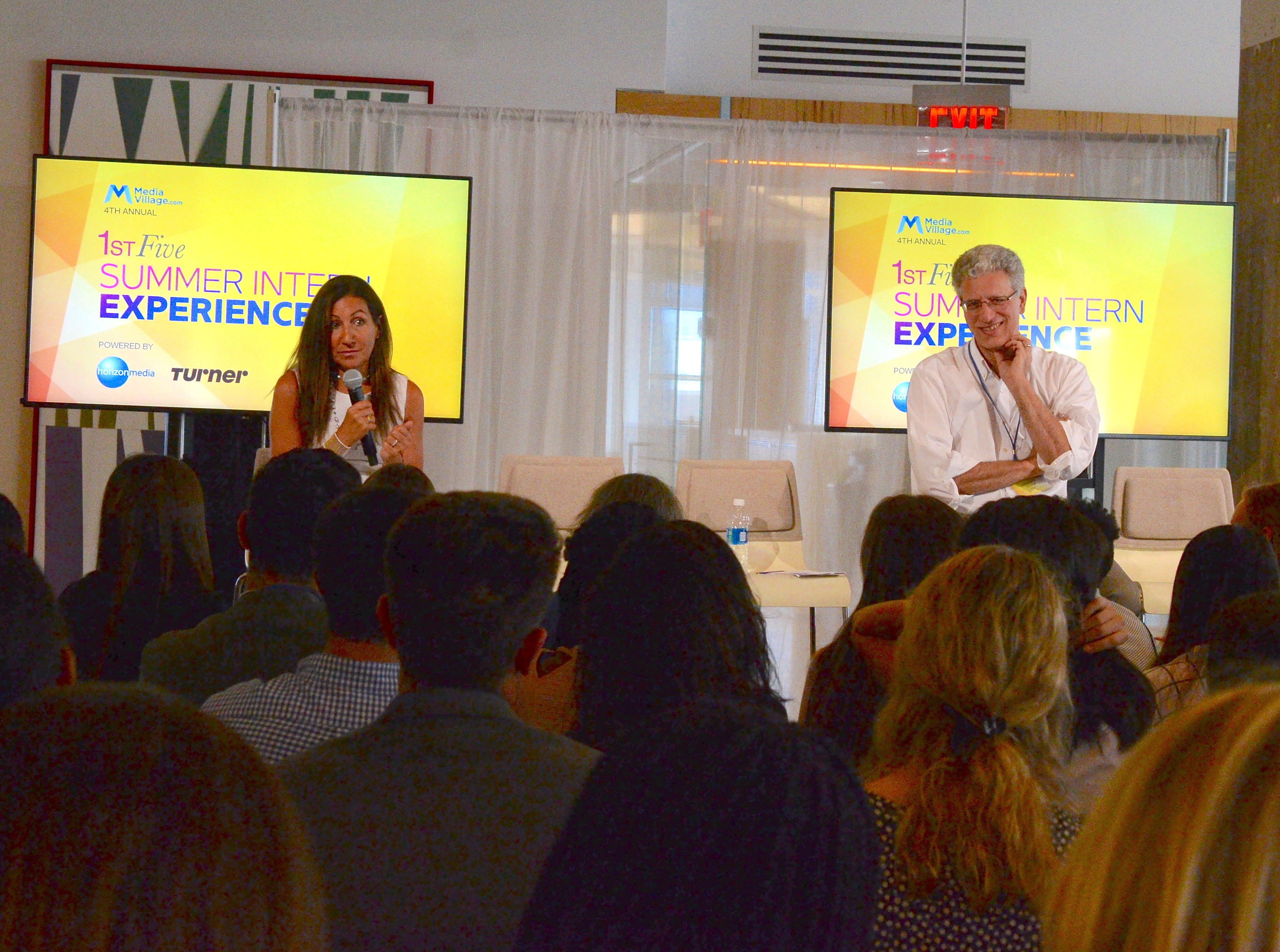
1stFive Experience: The Wisdom of Youth and Senior Executive Advice

In an industry as exciting and as dynamic as ours, the question of the development of tomorrow's leaders becomes vitally important. What can we do to encourage and train the next generation of media executives? Helping to address that issue is Media Village.com's bold initiative called 1st Five, which recently held its fourth annual Summer Intern Experience at Horizon Media. The Experience collected all of the summer interns who worked in a range of media companies this summer to a meeting designed to offer advice, further encourage their interest, and elicit their feedback.
This year's event was the first to capture a majority of Generation Z participants who grew up with the internet. "You are in my opinion, the most singularly important generation in history because you are the generation that is on the cusp of one of the most important significant shifts in our culture, our society, our business, our civilization," noted Jack Myers, Founder of MediaVillage.com, "and we can learn a lot from you."

Executives from host companies Turner and Horizon, as well as Viacom, 4A's, and Meredith, participated on panels and spoke directly to the interns about their experiences. In one of the break-out sessions, Howard Shimmel, Chief Research Officer, Turner, spoke to a large group of interns on the value of data and a career in Research. "It's a great field and it's a growing field." He explained that as Gen-Z disrupts the media business with their new and different viewing patterns and technologies, it is Research that is trying to understand the disruption. Putting it all into context, he explained that "We are in a world where there is more data than ever. If you use Siri there is data. If you use Alexa there is data. Your phone knows where you are now. The people who win are the people who actually understand what that data is and what that data means, and what you do with that."

In turning to the interns, Shimmel found that they were excited about all the uses of data and how it could be applied to creative and advertising. Olivia, who interned at the Ad Council, found that it was "interesting to see how data and research were used to target PSAs and its evaluation on the backend with the data collected to ensure that the PSAs were hitting their specific target." Shimmel agreed and added that the increase in digitization in television is "enabling advertisers to do a better job of reaching people they care about and not reaching people they don't care about" with ability to capitalize ROI by better targeting. "The future of TV is addressable," stated Shimmel.

Not all internships are successful. One intern noted that while she was interning at a fashion firm, the company went out of business. Another felt uncomfortable in a company's culture which did not embrace his values and made him feel like an outsider. Shimmel advised students to choose their future employers as carefully as they themselves will be chosen: "You spend so much time at work that you want the company you work for to be a good match and a place where you can voice your opinion and be heard," he said.

When an intern finds the perfect company with a compatible culture and responsibilities that excite and interest them, it can become a launching pad to a long and successful career. Taylor, who interned at Nickelodeon, was excited about learning about SVOD and "how television tackles the digital competition," finding it "inspiring."

As much as the interns need a job, the media industry needs them. We need the fresh perspectives of Generation Z because TV is in a quandary according to Shimmel. Viewing patterns are changing and challenging the established business model. "How many of you watch on demand? Watch TV when you want to watch?" he asked. Most hands went up. "That is exactly the challenge we are dealing with," he concluded.

Privacy is not as big a concern to the interns as one might think, because the addressability of the ads appears to be welcome. "As for me," described on intern, "I hate to be watching a show and have ads come on that I/m not interested in and that don't relate to my life. I want to get ads that I actually use and can see what's out there."


The next step for these interns is to network, build on their contacts and hone their skills in the area of media that most excites them. Many gems of advice were offered. "Go into a job and evaluate what you like and dislike. If it doesn't work out you can figure out exactly what makes you unhappy," Shimmel noted. An intern suggested to "use your contacts. I always thought that my work speaks for itself but I realize that you need to reach out and ask for help." In a parting word of advice, Donna Speciale (pictured above with Howard), President, Turner Ad Sales, concluded, "Open yourself up to what is going on and don't have fear. Be strong in your convictions. Be confident. There are no rules so don't be afraid."

This article first appeared in www.MediaVillage.com
 

Apr 13, 2017

OpenAP Unveiled


It takes some doing to keep a secret like this. For close to one year, Viacom, Turner and Fox have been working together to build a three-corporation consortium for accepting third and first party datasets for use as guidance in the sales marketplace. They announced their joint effort this past week in New York City to an audience of advertisers, clients, suppliers and press.

OpenAP Announcement
“This is a historical day for all, of us,” announced Donna Speciale, President Turner Ad Sales. “We three (Turner, Viacom and Fox) are all here together. It has been a year in the making.” And referring to the high level agency executives in the crowd, she added, “We came together because of all of you. You were the catalyst, asking us to get together to unify and make data more scalable. We listened and are making it happen.”

The OpenAp was designed to address the many concerns in the media marketplace regarding data. “Despite all of the value that data provides, we still hear same concerns and that is that it is complicated, not scalable, there is a lack of auditing and it is not consistent. We needed to simplify audience targeting. It sounds simple but it is not an easy task,” noted Speciale.

What is also not an easy task is bringing together and coordinating the efforts of three highly competitive corporations and keeping these efforts under wraps for so long. “It’s crazy that we could keep it quiet,” stated Sean Moran, Head of Sales, VIACOM Media Networks.

OpenAP Interface
For those of us working with data, OpenAp is a tremendous step forward in beginning to address some of the challenges in the media marketplace from walled gardens, to scalability and accreditation.

Bryson Gordon, EVP Data Strategy, Viacom, explained that OpenAP has two separate pathways to access the audience data and see how the contract is posting. The first pathway is a website. “If you work for an agency or an advertiser, you will have a login to this website,” he explained, “Through that website you will be able to explore advanced audience and onboard your own advanced audiences and you will be able to pull down the post from the campaign across inventory from Fox, Viacom and Turner and any other member publisher that has joined.” The second pathway offers a way to onboard custom datasets that might be proprietary to the agency or advertiser. “We recognize that agencies and advertisers have made huge investments in defining audiences in proprietary data systems, through DMPs. So it is critical that we make it easy and seamless for you to have clean pathways into and out of OpenAP,” Gordon added.

OpenAP Details
OpenAP address some of the marketplace challenges. With normalization, scalability and accreditation, the consortium hired Accenture to manage those tasks. “Accenture is doing the build and the auditing of the measurement,” according to Joe Marchese, President of Advanced Advertising Products, Fox Network. Notably, Accenture is the company who jumped in to fix the Affordable Care website after it first crashed and now handles many of the health exchanges across the country. They are adept at managing vast amounts of data, normalizing it and keeping the data quality consistent and high. 

When it comes to the data sets, “We are data agnostic,” explained, Gordon, “At the end of the day, OpenAP is about supporting all the datasets that advertisers need to create the high value segments they want to target.” To start, OpenAP is working with two major data source ecosystems – “comScore for all of the set top box data and the associated third party syndicated datasets that they have,” he added, and “Nielsen as a key part of this initiative.”  In a press release that came directly after the OpenAP announcement, Lynda Clarizio, Nielsen’s President of U.S. Media, stated, “We support the consortium’s ambitions to create a clearinghouse for audience-based buying on linear television. We look forward to working with the participating networks and advertisers on the broader success of this initiative.”

When it comes to consistency, Gordon said, “Consistency is about have the same segments for all publishers making it easy to activate at scale. You can go find an advanced audience, have it consistently defined, have it activated across most of television in premium content that is absolutely brand safe. It’s about on-boarding once and activing again and again.”

Working Together for a Common Cause
How can you get three major competing corporations to work together for a common cause? “We all experienced a very similar pain, in talking to our agencies and clients who were all buying Fox, Turner and Viacom,” said Michael Strober, EVP Client Strategy and Ad Innovation, Turner and co-head of Turner Ignite, who added, ”How do we make it easier to buy and transact on a larger scale? We had open and honest conversations – are you experiencing the same thing? We met with Kern Schireson, Chief Data Officer, Viacom. I sat with Joe Marchese. We decided that nobody is going to do this for us. We needed to find the solution and do it ourselves. It was very organic and a response to the market.”

This is a big first step for OpenAP. As Marchese noted, “This is step one - live linear television. What comes next are dynamic advertising and VOD environments.”

This article first appeared in www.MediaVillage.com