May 27, 2019

Getting Emotional with Movies at the Screenvision Upfront

Image result for movie going“The true magic of cinema,” stated John Partilla, CEO Screenvision Media, “engages audiences through emotions” and creates “moments of wonder.” Screenvision’s 2019 upfront, held at the Ziegfeld Theater, highlighted not only the unique experience of attending a movie in a theater but also the unique quality of that type of content. “The essential point is that movie theaters, whether neighborhood or epic, are the cathedrals of storytelling,” Partilla explained, saying they have the ability to, “mesmerize audiences and reach, engage, powerfully impact and move consumers.”

Part of what makes movies different is that it is a shared experience with people you don’t know. Today’s cinemas are also adding accoutrements such as bar service and recliner chairs that make the experience more of an event. “2018 was the biggest year for movies,” noted Katy Loria, Screenvision’s Chief Revenue Officer, “with the highest box office ever with The Avengers.” She added that theaters attract audiences that are young, affluent, educated and socially active decision-makers.

Screenvision’s point of differentiation is that these audiences are essentially unreachable with TV because consumers have become streamers of glass content and avoid ads by either subscribing to SVOD or multitasking by using a digital device while watching TV. Dubbed the “unreachables” by Christine Martino, EVP, National Ad Sales, she posited that they are, “not distracted at the movies. They are craving to pay attention.” She advised advertisers that reallocating GRPs from TV to cinema will, “get those eyeballs back. Cinema is a solution to audience replacement. It is incremental reach.”

The company has been collecting data on moviegoers for last four years and now has a deep understanding of viewer needs, actions, habits and media consumption at the screen level. Among the new technological innovations are pixels built into the screen and a smart network which are access points to advanced targeting. This will extend beyond the screen to social retargeting and measuring attribution. They have also recently constructed new metric – an engagement rating.

In addition to data initiatives that highlight the value of cinema audiences, Screenvision also announced a partnership with the Geena Davis institute to support films that break through stereotypes to identify those scripts and films that show balanced portrayals of women and girls. This pro-social partnership will be featured in segment in Screenvision’s preshow.

In a world where viewers have the option to view content anywhere at any time, the ability to lean back in the dark comfort of a cushy chair and share an emotional experience with a group of strangers may just break through the haze of device distractions.

This article first appeared in Cynopsis

May 25, 2019

Simulmedia’s Dave Morgan Seeks Bold Change

Dave Morgan, CEO Simulmedia, made headlines recently when he resigned from the board of the ARF, citing the need for bolder action in fixing ad measurement.  According to Morgan, “We do not have a trusted way to measure the basics of impression reach and frequency across channels, even just the big media channels like linear TV, digital banners, digital video and radio.”
 
He shares his views on the state of the industry, its challenges and opportunities, to help clarify this position:

Charlene Weisler: I know your decision sparked a lot of industry discussion. What is holding us back in measurement?

Dave Morgan: It’s not because we lack the technology to do it. It’s because many lack the will to lead and drive it. The industry has sat back and let the Google and Facebook own the measurement and attribution stage and claim virtually all of the overall ad industry’s growth.

Weisler: How has the media landscape changed since you first launched Simulmedia?

Dave Morgan: A lot has changed, particularly in the world of video. Television didn’t go away – more people watch more live linear TV than in 2009 – but the viewing is much, much more fragmented across many more channels, programs, day-parts and devices. Plus we’ve seen a dramatic increase in streaming video viewing, most of it on connected TV’s, though only a small portion of it with ads. While digital video advertising has been a darling of the buying community for much of the past ten years, many of the advertisers have come to realize that it’s also fraught with problematic measurement, a lot of unsuitable content and way too much outright fraud. This is now driving a lot of large national advertisers to reevaluate TV, particularly now that there are platforms like ours that bring digital, audience approaches to TV ad targeting, activation and optimization.

Weisler: What are the major challenges that you face?

Morgan: Education. Industry trades, press releases and conference stages are loaded with a never-ending swirl of bright, shiny objects and acronyms-of-the-month, creating confusion and sowing too much misinformation.

Weisler: What is the current state of addressable advertising?

Morgan: Addressable advertising on TV is beginning to have its moment. While it will always lack the scale, quick impact and efficiency of data-optimized linear buys, it is becoming a powerful complement to more conventional linear and data-optimized buys and OTT ad buys.

Weisler: What is the current state of attribution?

Morgan: Attribution needs a lot of help. Walled Gardens like Google and Facebook have stolen the march by building strong, though naturally biased solutions of their own and working tirelessly to promote and educate their capabilities. We need more aggressive leadership here, and in advertising measurement generally, by the advertisers themselves. I am hopeful that the recent efforts of the Association of National Advertisers in this area will make a real impact.

Weisler: What do you think the media landscape will look like three years from now?

Morgan: In 2022, we’ll still see 80% of the premium video ad load on linear TV, but most video campaigns will be much better coordinated across linear TV and OTT and we’ll see a real resurgence and growth regional, mid-sized agencies as they begin to leverage software, data and superior client service and strategy to manage national media as well or better than large holding company agencies.

This article first appeared in Cynopsis.

May 24, 2019

Tying Attribution to OOH Sampling. An Interview with Marci Weisler of Vengo Labs


Image result for marci weislerMarci Weisler (no relation, though we tried to figure it out), Chief Commercial Officer, Vengo Labs, works for a uniquely situated company in the out of home space. Billed a, “retail and marketing tech company that is reimagining how brands connect with consumers,” Marci noted that this technology “bridges the gap between digital and real world experiences by combining retail with DOOH media and product sampling.”

Vengo is actually a network of over 1200 mini interactive digital vending machines at gyms, hotels, colleges and corporate locations in major DMAs. Future plans include expanding into retail stores. The company offers a consumer the ability to sample products from personal tech (headphones and chargers) to beauty and wellness, to CPG and non-perishable food. 

According to Marci, the data they collect is opt-in via consumer interactions with surveys and quizzes, also collecting emails and/or phone numbers on a campaign by campaign basis. The “cloud based Vengo Information Portal (VIP) tracks retail (product inventory, sales), all media (impressions delivered, screen interactions) and sampling campaigns (samples vended, opt-ins),” she explained. The campaign level data is shared with Vengo’s clients on a campaign by campaign basis.   “On the sampling side, Vengo is closing the loop enabling brands to understand ROI and retarget consumers in ways they have not been able to use in the past, and giving them the opportunity to connect with consumers post-sample and drive to purchase/conversion,” she stated.

While Marci believes that Vengo is unique in the combination of retail, DOOH media and trackable product sampling, their competitive set varies by product category. In fact, Vengo sees them as potential partners such as in the following categories:

Ø  Sampling--in-store reps handing out samples, sampling companies like Birchbox, sampling-only kiosks.
Ø  DOOH Media--other networks and media.
Ø  Retail/vending--Zoom Systems, micro-markets

The retail ecosystem changing, she noted, with consumers spending less time in brick and mortar stores and making purchasing decisions everywhere.  “Vengo meets consumers at contextually relevant times in their day, aligning product availability with the time they need them most.  For example, in the gym locker room they can purchase headphones or trial a new beauty product, while seeing an ad for a new wellness supplement. We are also working with retailers to enhance the in-store experience and drive engagement at the point of sale,” she added.

Vengo is also going cross platform with connections to mobile devices through geo-fencing as well as marketing initiatives such as mobile coupon codes redeemable at Vengo, or sampling opportunities that require taking a quiz and giving your email address to get a free sample which can then result in another coupon code to use for next retail purchase of the product.

But there are challenges. She explained that with a big hardware component, there are challenges expanding the network (as opposed to building traffic to a web site or mobile app), “but now that our network has surpassed over 1200, we are ramping quickly.  We also have a size constraint since our machines are compact and take only two square feet of wall space, but our ex-aerospace engineering team has maximized the ability to put a high quantity of product into a small space.”

Advantages include the ability to engage consumers digitally--whether through sampling or interactive DOOH media, collect actionable marketing data to convert “trailers” to buyers and drive product trial and calculate ROI on sampling programs. “For retailers we provide retail tech solutions that make shopping in-store fun and compelling--and provide metrics-based sampling programs that drive in-store purchase,” Marci stated.

And what she terms as, “critically interesting” is Vengo’s ability to “tie attribution to sampling which never existed before. For that reason we got a major investment from Arcade Beauty,, the world's leading manufacturer of beauty samples and are working to reimagine the space for brands and for retailers. We've got some exciting campaign results,” to be released in the possible future.

This article first appeared in www.Mediapost.com

May 19, 2019

Disney’s Upfront by the Numbers

Image result for DisneyDisney’s highly anticipated upfront comes at the heels of its acquisition of Fox properties. So the event this year not only heralds in a new expansive era for the company, it also presented a synergy of established, previously frenemy properties. As part of their presentation, it was also announced that Disney has just acquired full operational control of Hulu with the ability to acquire full ownership at a future time.

Storytelling in all of its forms is a paramount vision for the network group, from ESPN (focusing on gaining more rights, weaving compelling stories and showcasing more live events), National Geographic (focusing on premium factual storytelling), FX (scripted shows) and Freeform (embracing disruptive voices).

In addition to a range of network specific content, Rita Ferro, President, The Walt Disney Company Advertising Sales and Partnerships, announced there were, “investments around data and technology. There has been tremendous advancement in that space with an emphasis on reach, effectiveness and delivering on those results that are important to our clients.”

Disney+, the OTT subscription service, loomed large with some of the properties slated to be included in the service and other waiting to hear. The aggregation of compelling content has been ramped up in this new expanding company with each network offering something for a different audience segment.

ESPN announced a deal with Caesars to be the official odds provider for the network for, as Connor Schell, EVP Content, ESPN, stated, “for fans interested in betting content.” He noted that in 2018, and for the 5th straight year, ESPN was “the top network in every key male demo,” and added that the network had the “best portfolio of rights across the industry for live events – 25,000 of them.” He proposed an aggressive social media strategy including 200 live shows on Twitter, all with advertising.

For FX CEO John Landgraf, there is, “a lot to figure out as to how this (acquisition) will work out in its optimal form.” But with an array of original scripted programming, the network has the inventory. “Over the past 15 years, we went from one to 15 scripted shows,” he stated, and then added, “but 15 scripted shows aren’t enough.” He is examining non-linear rights and expects to see “a lot of innovation about what can be done in this new system.” Rather than placing FX on Disney+, Landgraf sees Hulu as the best streaming service for his network.

Courteney Monroe, CEO, National Geographic, noted that her network is a recent addition to Disney and sets itself apart with “premium factual storytelling,” and “quality, excellence and distinctiveness above all else.” The network is adding scripted anthologies such as the Genius series and reaching bigger and broader upscale audiences. “Entertaining and smart are not mutually exclusive,” she concluded.

Tom Ascheim, President, Freeform, positions the network for young adult women and highlights inclusiveness. “We are embracing disruptive voices,” he explained and added that one of the benefits of the merger is that Freeform will air The Simpsons. “Millennials currently outnumber boomers,” he stated, “and we are the leading brand for that audience.”

Karey Burke, President ABC Entertainment, concluded the event with an overview of the new season’s schedule, stressing the importance of stability and the need to carefully craft every show before it’s ready to launch. “We are stabilizing the schedule and scheduling fewer new series,” she explained, “There are too many messages to get out there so we will have fewer and bigger launches. There is a value in nurturing the shows you already have.” ABC network is aiming for a strong female POV and this strategy is paying off. “ABC dominates with women. We are #1 since January,” she concluded.

This article first appeared in Cynopsis.

May 17, 2019

Nielsen Tracks the Asian American Consumer Journey

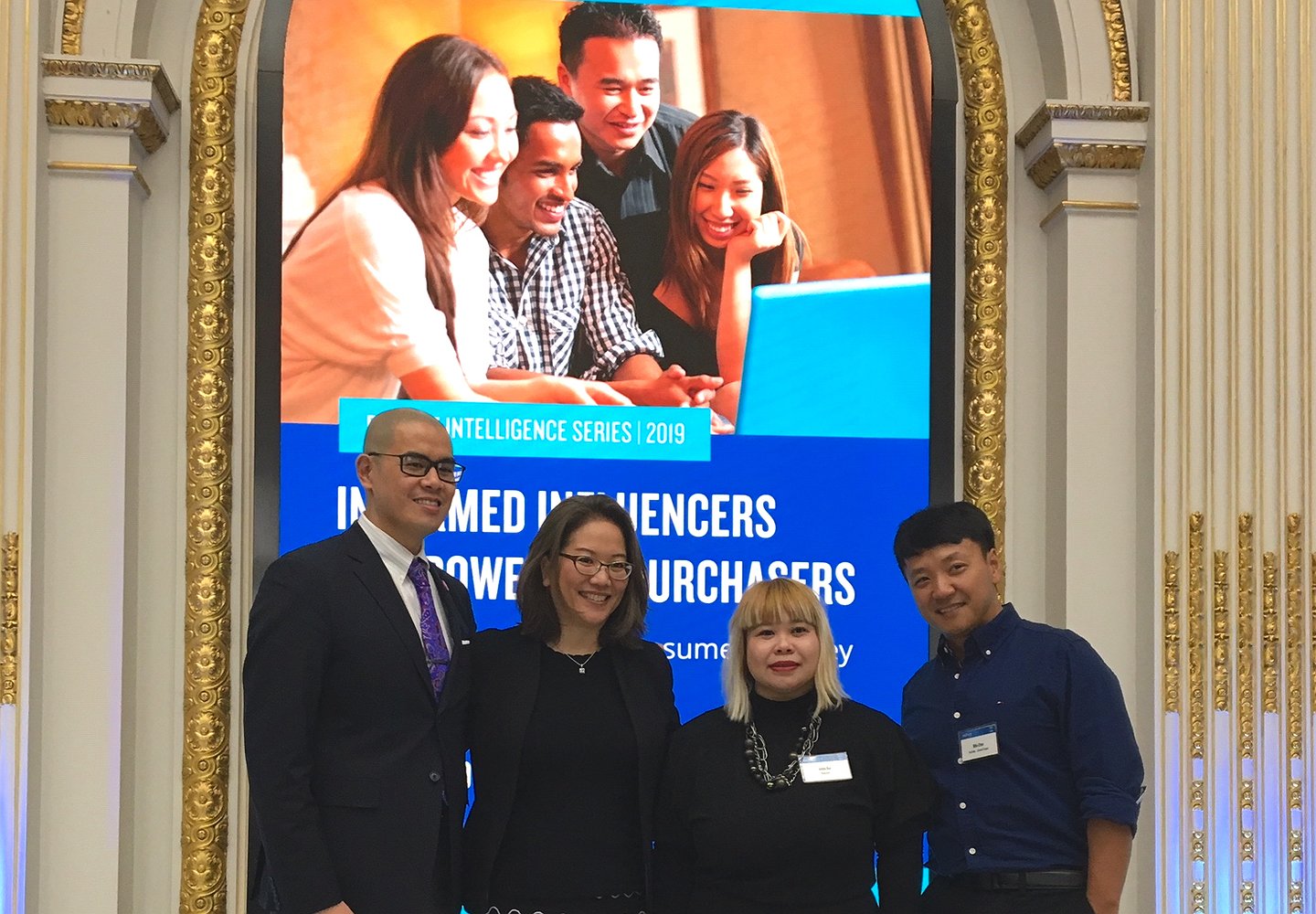
Nielsen Tracks the Asian American Consumer Journey Asian American consumers "are part of this country today and in the future," stated Mariko Carpenter, Nielsen's Vice President of Strategic Community Alliance as she presented the findings of the latest Nielsen annual Asian American study.  Taking place during Asian Pacific American Heritage month, this is the seventh year that of the study, but was presented to the industry in New York versus Los Angeles for the first time.

Carpenter began by outlining the unique attributes of the Asian American consumer journey.  "We are, indeed, at an inflection point in our community," she stated as movies such as Crazy Rich Asians are playing to mainstream audiences, actor Sandra Oh has been awarded an array of honors for her role in Killing Eve, Andrew Yang is running as the first Asian American presidential candidate and Nestle announced that this year's Gerber baby is Asian -- a first.

The power of Asian American consumers is profound. "We are voting with our wallet, time and voice," Carpenter said.  "We are no longer 'the other.'  Brands are embracing the diversity."  The study found that today's path to purchase is no longer linear with a range of device and platform options to guide the consideration journey.

In addition to being an especially well educated, wealthy and highly employed population, Nielsen reported three major trends in the Asian American community that set them apart from other ethnic groups:
  1.  Family is a key influencer.  Asian households are multi-generational with 27% living with that household composition compared to 15% of the general population.  Asian households are +17% larger than average (averaging 2.91 persons vs 2.49 for the total population).  Extended families, some just starting life in the U.S., account for some of the higher household income.  But these homes also tend to have more married couples (63% vs. 48%) and children (40% vs. 31%).  All of this contributes to purchasing patterns that are often dissimilar to other groups.  Across a variety of consumer categories, the intended user of products purchased for Asian households is often not the primary shopper (98 index), but is instead for children (134), a spouse/partner (120) or other household members (120).
  1. Digital is the key to entry.  Asian consumers learn about new products from digital ads and are the most digitally connected consumer segment.  Ninety-seven percent own a smartphone, 81% own at least one device connected to SVOD and 94% have an internet connection.  They spend more time on their smartphone (84%) than viewing linear TV (70%).  Through all of this, social media plays an integral role fostered by such mega apps as WeChat from China.  Nielsen found that 30% of smartphone time is on WeChat where a range of interactions are possible from buying products, streaming music, curating photos and transferring money all in one app environment.
  1. Shopping is a reimagined experience.  Asian Americans are the fastest growing ethnic group population-wise with buying power of $1 trillion.  This is the equivalent of the 17th largest GPD in the world -- larger than Switzerland and Turkey.  "We are small in size, but we have significant buying power," Carpenter noted.  Asian Americans are shifting from offline to online transactions at a higher rate and have a higher spend than the general population.  Eighty-seven percent made an online purchase in the past twelve months.  They are also early adopters of online grocery shopping (22% in the past 12 months) and are great e-sports fans (49%).  In fact, 63% say that they are more loyal to businesses that sponsor their events.  "Asians are leaning in now," Carpenter explained.  "We are becoming significantly influential."  She added that advertisers need to understand that human story is a key to connection. "Reaching Asians on digital has to be thoughtful," she noted.
This young, growing and connected group offers marketers a long-term potential to any investment.  "We are experiencing tremendous population growth across the country," Carpenter concluded.  "We live longer (86.7 vs. 78.9), our median age is younger (35.4 vs. 38.7) and we have many more years of buying power ahead (51.3 vs. 40.2)."

This article first appeared in www.MediaVillage.com

May 16, 2019

WarnerMedia Upfront 2019 Connects the Consumer Dots

WarnerMedia 2019 Upfront
I love it when an upfront starts off with warm up research slides as the WarnerMedia upfront did this year. Did you know, for example, that CNN.com has 30,000 visits per minute? Or that half of TNT viewers say that they can’t function without coffee in the morning? Or that 52% of adult Cartoon Network viewers admit that they sometimes let their children influence what they buy? Or that 87% of truTVs audience watches the network live?

WarnerMedia’s CEO John Stankey greeted the assembled crowd, “excited about future of the advertising business. We are a new company with new ambitions and a new approach to the industry.” Now a subsidiary of AT&T, WarnerMedia can now take advantage of the data capabilities and insights divisions of their owners. “We are working with Xandr,” Stankey explained, as their “set top router and mobile data partners. And we are investing in premium content across all platforms to connect with fans at scale.”

Media companies must keep up with changing tastes, consumer consumption patterns, expanding platforms and choice of devices. Omni-channel curation with engaging content for a range of different audience tastes is a pivotal goal and one that WarnerMedia is aggressively addressing. Stankey noted that, “consumption is changing, technology is changing, the business model is changing but our need to connect with passionate consumers at scale is not changing.”

To that end, Donna Speciale, President Ad Sales, offered advertisers, “Expanded reach, measurable outcomes and driving impact,” with a unified WarnerMedia sales department and content available across all platforms. “It is a full funnel solution,” she explained. The company is offering content initiatives including Chasing The Cure which gathers in experts and audiences across social media to help those suffering from undiagnosed diseases.

“Marketers are seeing the value of partnering differently,” she stated, citing as an example, Lego’s initiative with Cartoon Network that, through an app, garnered over 12 million minutes spent with the advertiser. “What sets us apart is that we can leverage AT&T data with Xandr insights of 170 million consumer touchpoints and guarantee business outcomes.”  Hewlett Packard was one of the first clients, followed by Volkswagen and McDonalds. Volkswagen used AT&T dlinearata to target auto-intenders and spurred visits to the dealership by +6.5%. McDonald’s matched to A&T subscriber data, focusing delivery on custom strategic targets and drove double digit lift in in-store visits.

“Linear TV is critical to media mix,” she made sure to include, “but the only way to reach our fans is to advertise on all of our platforms. We are closing the engagement loop by leveraging data insights with meaningful advertising experiences that are needed and wanted by our consumers.

This article first appeared in Cynopsis.

May 15, 2019

Nielsen’s Asian American Study Results Revealed

Image result for asian americansAccording to Nielsen, the Asian American market is an evolving mix of ages, English fluency and family composition where purchasing behavior is often technologically driven, non-linear and a family-based consideration. Mariko Carpenter, VP of Strategic Community Alliance, Nielsen, presented the results of their recent Asian American research study, focusing this year on consumer behavior.

Among the highlights of the research,
  1. Technology and its use impact a range of behaviors. “Asian Americans are early adopters of technology,” Carpenter explained. “When we look at devices and platforms that are on the rise, Asian Americans over-index. Over time, the rest of the U.S. population catches up to us.” In addition to being ahead of the curve technologically, Asian Americans also “tend to move on,” from older technology. “Currently we under-index in DVRs, for example,” she noted. This group also has very high reach on a range of devices and how these devices are being used – from entertainment where they can find content that is more relevant to them and banking, travel booking, shopping and trying a new app – all at a far faster pace than the general population. Notably, this behavior transcends age.

  1. Mega Apps such as WeChat, which enables users to conduct a range of tasks from content consumption to banking to shopping, are very popular in China and are being used by Asian Americans in the U.S. These mega apps are projected to further expand in use here. “Integration is key for multi-purpose apps and this generates more usage. WeChat allows for US brands to advertise in it,” Carpenter explained, giving advertisers an opportunity to reach these Chinese Americans.

  1. Asian American behaviors, based on nativity, vary greatly by generation. Younger Asians tend to be U.S. born and are less connected to Asian culture while older generations tend to be foreign-born. This impacts language preference and the ability to navigate in American society. In addition, the Asian American market is not monolithic. Similar to Hispanics, there are great differences based on country of origin. “The Asian American community has the highest wealth disparity of any group,” Carpenter noted. With representation from more than two dozen countries, “subsets range from the highest levels of wealth to refugees with the lowest – close to poverty lines.”     

  1. As a group, Asian American have great buying power with $1.0 trillion spent in 2018, a 68% gain over 2010 compared to 32% for the general population. Advertisers should focus on providing a satisfy purchasing experience with a choice of familiar brands, good brand alignment with values and environmental responsibility, high quality with a trusted brand and the feeling that their money is well spent.

This study, currently in its third year, is one of three ethnic annual studies by Nielsen, along with African American and Hispanic consumer groups.

This article first appeared in Cynopsis.